. 2020 May 19:11:352.
doi: 10.3389/fneur.2020.00352. eCollection 2020.

Serum-Based Proteomics Reveals Lipid Metabolic and Immunoregulatory Dysregulation in Cervical Artery Dissection With Stroke

Affiliations

Serum-Based Proteomics Reveals Lipid Metabolic and Immunoregulatory Dysregulation in Cervical Artery Dissection With Stroke

Yongtao Yang et al. Front Neurol. .

Abstract

Cervical artery dissection (CAD) is an important causal factor for stroke in young and middle-aged individuals and presents a great burden to the individual stroke victim. However, the pathophysiological mechanisms underlying CAD remain unknown. Here, an iTRAQ (isobaric tagging for relative and absolute quantitation)-based quantitative proteomic approach was performed, to identify differentially expressed proteins in serum samples obtained from spontaneous CAD and non-CAD ischemic stroke subjects. Differential protein expression was analyzed for Kyoto Encyclopedia of Genes and Genomes (KEGG) pathway overrepresentation, and six differential proteins were selected for enzyme-linked immunosorbent assay validation. Through KEGG analysis, the significantly differentiated proteins were primarily involved in immunoregulation, blood coagulation, and lipid metabolism. For the first time, differential expressions of apolipoprotein B, apolipoprotein C-I, lipopolysaccharide-binding protein, vascular cell adhesion molecule 1, fibulin-1, and ficolin-2 were confirmed as being significantly upregulated in CAD as compared to non-CAD ischemic stroke subjects. In conclusion, proteomic analysis reveals that early perturbation of immunoregulation and lipid metabolism may be involved in the pathophysiology of CAD. Specifically, the panel of six proteins identified is promising as serum-based biomarkers for the detection of increased CAD risk in stroke subjects.

Keywords: cervical artery dissection; immunoregulation; lipid metabolism; serum; stroke.


Figures

Figure 1
Figure 1
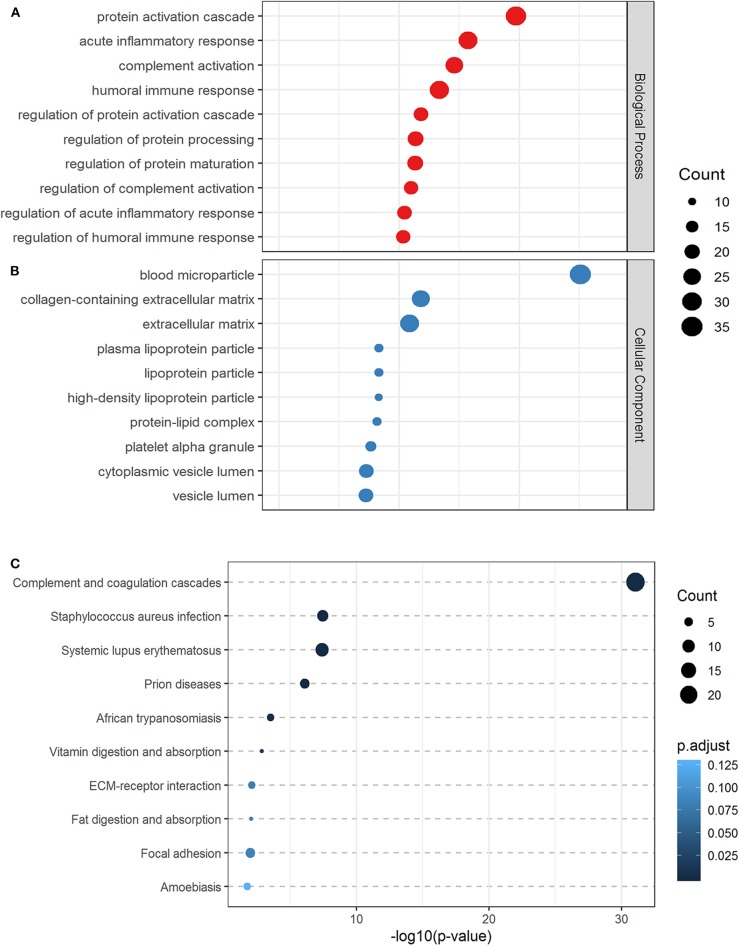
Gene ontology and pathway analysis. The top 10 biological processes (A) cellular components (B), and canonical KEGG pathways (C) associated with differential proteins were based on gene ontology and pathway analysis.
Figure 2
Figure 2
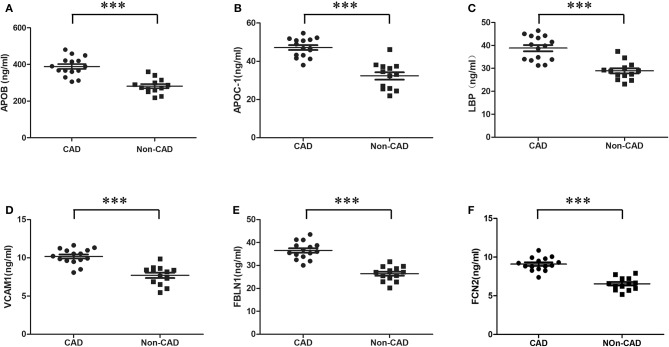
Enzyme-linked immunosorbent assay validation of differential proteins. Six proteins analyzed by ELISA displayed significant changes between CAD (n = 15) and non-CAD ischemic stroke (n = 13) subjects. (A) APOB, (B) APOC1, (C) LBP, (D) VCAM1, (E) FBLN1, and (F) FCN2 were significantly upregulated in CAD subjects compared to non-CAD ischemic stroke subjects. Statistical analysis was performed using the Statistical Package of Social Science (SPSS) for Windows v21.0. The Student t test was applied to identify proteins with significant differences in abundance between the CAD and non-CAD ischemic stroke subjects. All the tests were two-tailed, and the significance threshold was set at P < 0.05. ***P = 0.000. ELISA, enzyme-linked immunosorbent assay; CAD, cerebral artery dissection; APOB, apolipoprotein B; APOC-1, apolipoprotein C-I; LBP, lipopolysaccharide-binding protein; VCAM1, vascular cell adhesion molecule 1; FBLN1, fibulin-1; FCN2, ficolin-2.
Figure 3
Figure 3
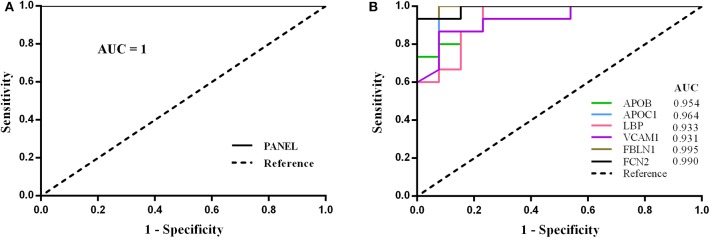
Receiver operating characteristic analyses showing the combined diagnostic utility of the panel including APOB, APOC1, LBP, VCAM1, FBLN1, and FCN2 in CAD. By leave-one-out (LOO) cross-validation, ELISA-based ROC analyses of combined quantitation of APOB, APOC1, LBP, VCAM1, FBLN1, and FCN2 showing promising for the detection of increased CAD risk in stroke subjects (PANEL = APOB + APOC1 + LBP + VCAM1 + FBLN1 + FCN2). The AUC of panel (A) was 1, and the panel exhibited a higher sensitivity (100%) and specificity (100%) than the six proteins individually (B).

References

    1. Schwartz NE, Vertinsky AT, Hirsch KG, Albers GW. Clinical and radiographic natural history of cervical artery dissections. J Stroke Cerebrovasc Dis. (2009) 18:416–23. 10.1016/j.jstrokecerebrovasdis.2008.11.016 - DOI - PubMed
    1. Arnold M, Kappeler L, Georgiadis D, Berthet K, Keserue B, Bousser MG, et al. Gender differences in spontaneous cervical artery dissection. Neurol. (2006) 67:1050–2. 10.1212/01.wnl.0000237341.30854.6a - DOI - PubMed
    1. Gallai V, Caso V, Paciaroni M, Cardaioli G, Arning E, Bottiglieri T, et al. Mild hyperhomocyst(e)inemia: a possible risk factor for cervical artery dissection. Stroke. (2001) 32:714–8. 10.1161/01.STR.32.3.714 - DOI - PubMed
    1. Grond-Ginsbach C, Giossi A, Aksay SS, Engelter ST, Lyrer PA, Metso TM, et al. Elevated peripheral leukocyte counts in acute cervical artery dissection. Eur J Neurol. (2013) 20:1405–10. 10.1111/ene.12201 - DOI - PubMed
    1. Zhu Z, Tang W, Ge L, Han X, Dong Q. The value of plasma fibrillin-1 level in patients with spontaneous cerebral artery dissection. Neurology. (2018) 90:e732–7. 10.1212/WNL.0000000000005027 - DOI - PubMed