


The Effects of Cerebral Vasospasm on Cerebral Blood Flow and the Effects of Induced Hypertension: A Mathematical Modelling Study
- PMID: 32508897
- PMCID: PMC7253865
- DOI: 10.1159/000496616
The Effects of Cerebral Vasospasm on Cerebral Blood Flow and the Effects of Induced Hypertension: A Mathematical Modelling Study
Abstract
Background: Induced hypertension has been used to promote cerebral blood flow under vasospastic conditions although there is no randomised clinical trial to support its use. We sought to mathematically model the effects of vasospasm on the cerebral blood flow and the effects of induced hypertension.
Methods: The Anatomically Detailed Arterial Network (ADAN) model is employed as the anatomical substrate in which the cerebral blood flow is simulated as part of the simulation of the whole body arterial circulation. The pressure drop across the spastic vessel is modelled by inserting a specific constriction model within the corresponding vessel in the ADAN model. We altered the degree of vasospasm, the length of the vasospastic segment, the location of the vasospasm, the pressure (baseline mean arterial pressure [MAP] 90 mm Hg, hypertension MAP 120 mm Hg, hypotension), and the presence of collateral supply.
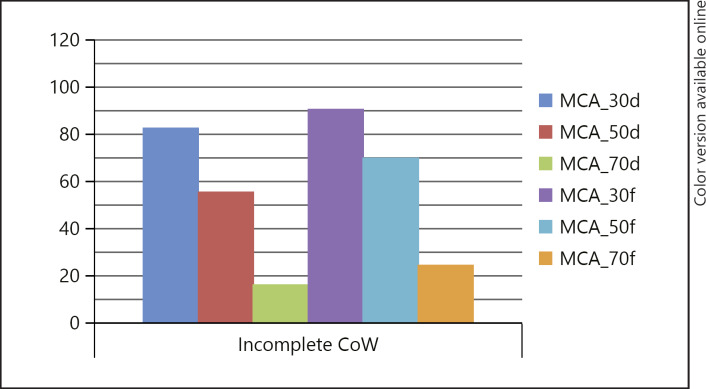
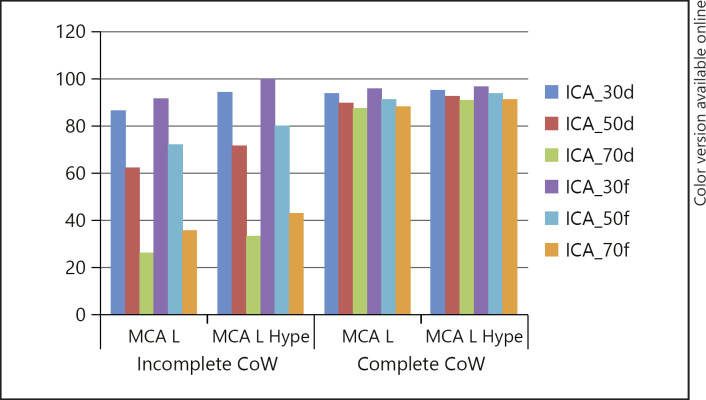
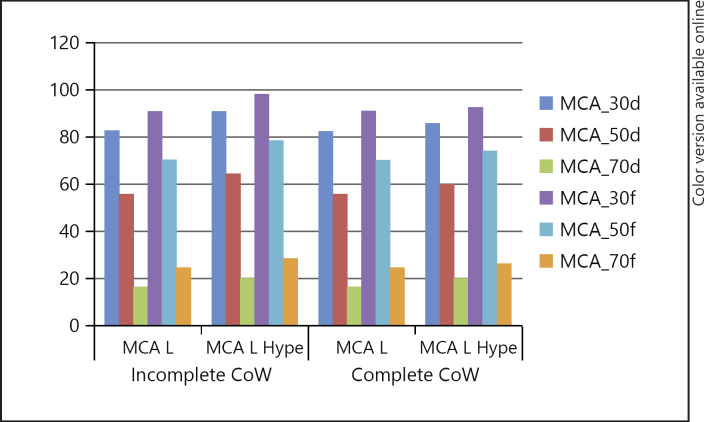
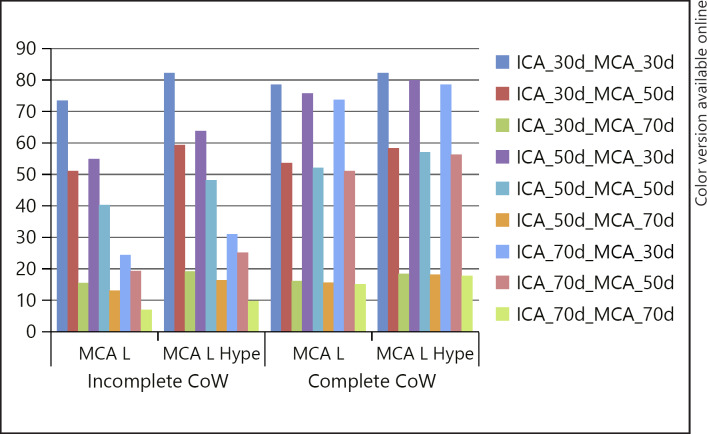
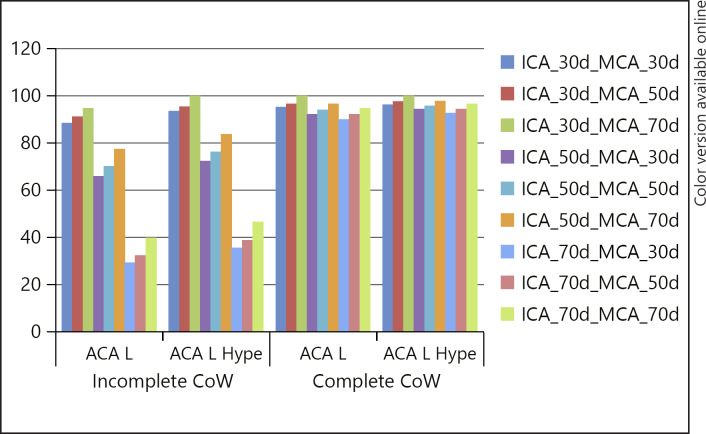
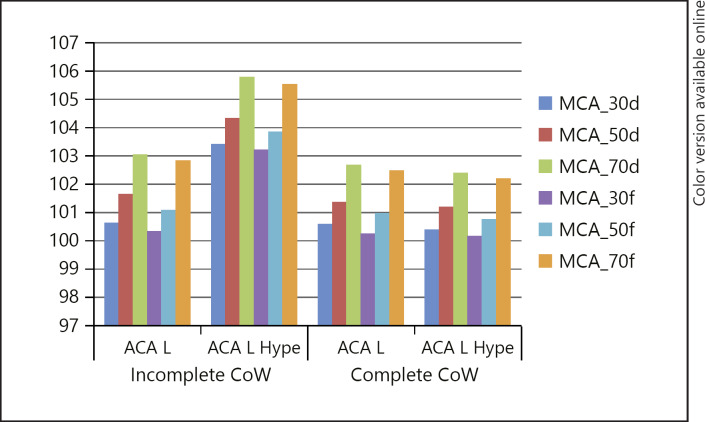
Results: Larger decreases in cerebral flow were seen for diffuse spasm and more severe vasospasm. The presence of collateral supply could maintain cerebral blood flow, but only if the vasospasm did not occur distal to the collateral. Induced hypertension caused an increase in blood flow in all scenarios, but did not normalise blood flow even in the presence of moderate vasospasm (30%). Hypertension in the presence of a complete circle of Willis had a marginally greater effect on the blood flow, but did not normalise flow.
Conclusion: Under vasospastic condition, cerebral blood flow varies considerably. Hypertension can raise the blood flow, but it is unable to restore cerebral blood flow to baseline.
Keywords: Cerebral vasospasm; Induced hypertension; Modelling; Subarachnoid haemorrhage.
Copyright © 2019 by S. Karger AG, Basel.
Conflict of interest statement
P. Bhogal: proctoring and consultancy agreements with phenox. The other authors declare no conflict of interests. This research received no specific grant from any funding agency in the public, commercial, or not-for-profit sectors.
Figures
References
-
- Sen J, Belli A, Albon H, Morgan L, Petzold A, Kitchen N. Triple-H therapy in the management of aneurysmal subarachnoid haemorrhage. Lancet Neurol. 2003 Oct;2((10)):614–21. - PubMed
-
- Blanco PJ, Watanabe SM, Passos MA, Lemos PA, Feijóo RA. An anatomically detailed arterial network model for one-dimensional computational hemodynamics. IEEE Trans Biomed Eng. 2015 Feb;62((2)):736–53. - PubMed
-
- Blanco PJ, Müller LO, Watanabe SM, Feijóo RA. Computational modeling of blood flow steal phenomena caused by subclavian stenoses. J Biomech. 2016 Jun;49((9)):1593–600. - PubMed
-
- Müller LO, Blanco PJ, Watanabe SM, Feijóo RA. A high-order local time stepping finite volume solver for one-dimensional blood flow simulations: application to the ADAN model. Int J Numer Methods Biomed Eng. 2016 Oct;32((10)):e02761. - PubMed
LinkOut - more resources
Full Text Sources
