


Linguistic Information in Auditory Dynamic Events Contributes to the Detection of Fine, Not Coarse Event Boundaries
- PMID: 32509043
- PMCID: PMC7265132
- DOI: 10.5709/acp-0254-9
Linguistic Information in Auditory Dynamic Events Contributes to the Detection of Fine, Not Coarse Event Boundaries
Abstract
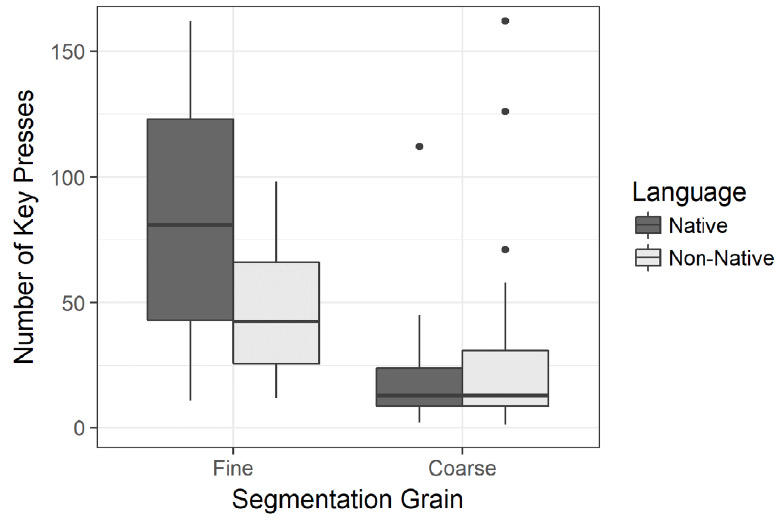
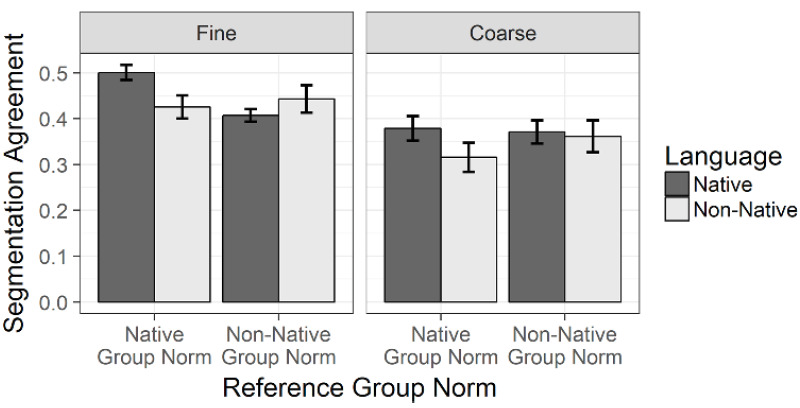
Human observers (comprehenders) segment dynamic information into discrete events. That is, although there is continuous sensory information, comprehenders perceive boundaries between two meaningful units of information. In narrative comprehension, comprehenders use linguistic, non-linguistic , and physical cues for this event boundary perception. Yet, it is an open question - both from a theoretical and an empirical perspective - how linguistic and non-linguistic cues contribute to this process. The current study explores how linguistic cues contribute to the participants' ability to segment continuous auditory information into discrete, hierarchically structured events. Native speakers of German and non-native speakers, who neither spoke nor understood German, segmented a German audio drama into coarse and fine events. Whereas native participants could make use of linguistic, non-linguistic, and physical cues for segmentation, non-native participants could only use non-linguistic and physical cues. We analyzed segmentation behavior in terms of the ability to identify coarse and fine event boundaries and the resulting hierarchical structure. Non-native listeners identified almost identical coarse event boundaries as native listeners, but missed some of the fine event boundaries identified by the native listeners. Interestingly, hierarchical event perception (as measured by hierarchical alignment and enclosure) was comparable for native and non-native participants. In summary, linguistic cues contributed particularly to the identification of certain fine event boundaries. The results are discussed with regard to the current theories of event cognition.
Keywords: event cognition; event hierarchy; event segmentation; linguistic information.
Copyright: © 2019 University of Economics and Human Sciences in Warsaw.
Figures
References
-
- Baggett P. Structurally equivalent stories in movie and text and the effect of the medium on recall. Journal of Verbal Learning and Verbal Behavior. 1979;18:333–356.
-
- Baker L. J., Levin D. T. The role of relational triggers in event perception. Cognition. 2015;136:14–29. - PubMed
-
- Bates D., Maechler M., Bolker B., Walker S., Christensen R. H. B., Singmann H., Dai B. lme4: Linear mixed-effects models using Eigen and S4 (Version 1.1-7) http://cran.r-project.org/web/packages/lme4/index.html. 2014
LinkOut - more resources
Full Text Sources