


Design and testing of a mobile health application rating tool
- PMID: 32509971
- PMCID: PMC7242452
- DOI: 10.1038/s41746-020-0268-9
Design and testing of a mobile health application rating tool
Abstract
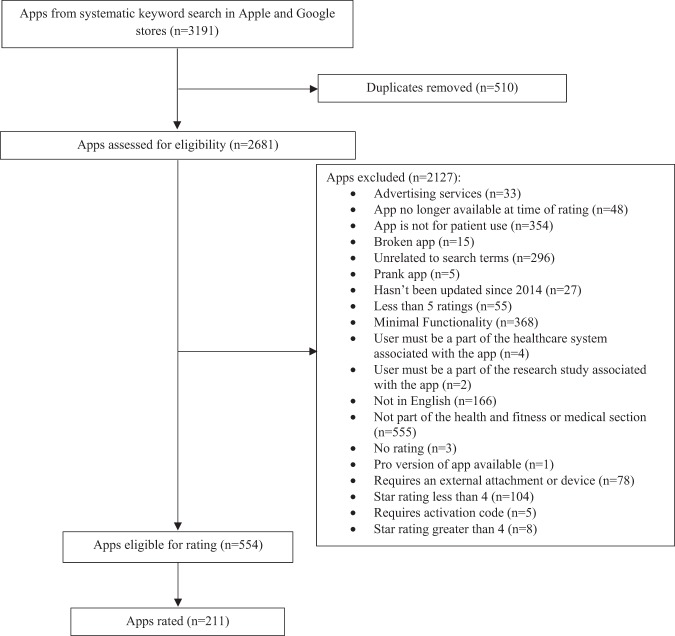
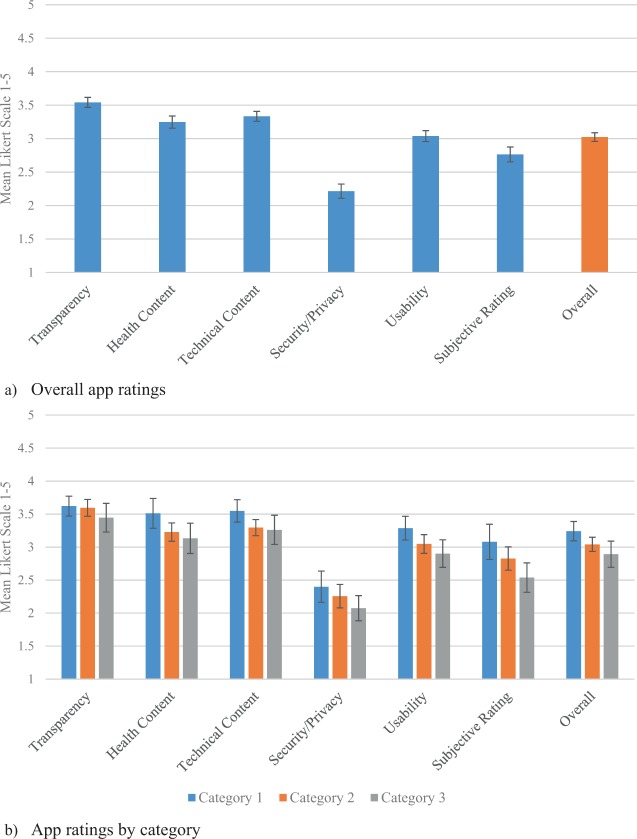
Mobile health applications ("apps") have rapidly proliferated, yet their ability to improve outcomes for patients remains unclear. A validated tool that addresses apps' potentially important dimensions has not been available to patients and clinicians. The objective of this study was to develop and preliminarily assess a usable, valid, and open-source rating tool to objectively measure the risks and benefits of health apps. We accomplished this by using a Delphi process, where we constructed an app rating tool called THESIS that could promote informed app selection. We used a systematic process to select chronic disease apps with ≥4 stars and <4-stars and then rated them with THESIS to examine the tool's interrater reliability and internal consistency. We rated 211 apps, finding they performed fair overall (3.02 out of 5 [95% CI, 2.96-3.09]), but especially poorly for privacy/security (2.21 out of 5 [95% CI, 2.11-2.32]), interoperability (1.75 [95% CI, 1.59-1.91]), and availability in multiple languages (1.43 out of 5 [95% CI, 1.30-1.56]). Ratings using THESIS had fair interrater reliability (κ = 0.3-0.6) and excellent scale reliability (ɑ = 0.85). Correlation with traditional star ratings was low (r = 0.24), suggesting THESIS captures issues beyond general user acceptance. Preliminary testing of THESIS suggests apps that serve patients with chronic disease could perform much better, particularly in privacy/security and interoperability. THESIS warrants further testing and may guide software and policymakers to further improve app performance, so apps can more consistently improve patient outcomes.
Keywords: Diagnosis; Health policy; Health services; Therapeutics.
© The Author(s) 2020.
Conflict of interest statement
Competing interestsD.M.L. is the PI of an investigator-initiated study in collaboration with the for-profit entity Biofourmis, Ltd. to refine a predictive analytics algorithm for home hospitalized patients. D.W.B. consults for EarlySense, which makes patient safety monitoring systems. He receives cash compensation from CDI (Negev), Ltd., which is a not-for-profit incubator for health IT startups. He receives equity from ValeraHealth, which makes software to help patients with chronic diseases. He receives equity from Clew which makes software to support clinical decision-making in intensive care. He receives equity from MDClone, which takes clinical data and produces deidentified versions of it. D.W.B.’s financial interests have been reviewed by Brigham and Women’s Hospital and Partners HealthCare in accordance with their institutional policies. All other authors have no disclosures.
Figures

References
-
- The Growing Value of Digital Health. https://www.iqvia.com/institute/reports/the-growing-value-of-digital-health (2017).
-
- Demographics of Mobile Device Ownership and Adoption in the United States. Pew Research Center. http://www.pewinternet.org/fact-sheet/mobile/ (2018).
LinkOut - more resources
Full Text Sources
