


Level of completion along continuum of care for maternal and newborn health services and factors associated with it among women in Arba Minch Zuria woreda, Gamo zone, Southern Ethiopia: A community based cross-sectional study
- PMID: 32511230
- PMCID: PMC7279583
- DOI: 10.1371/journal.pone.0221670
Level of completion along continuum of care for maternal and newborn health services and factors associated with it among women in Arba Minch Zuria woreda, Gamo zone, Southern Ethiopia: A community based cross-sectional study
Abstract
Background: Completion along continuum of care for maternal and newborn health (MNH) services like antenatal care, skilled birth attendance and postnatal care services is advantageous over each segment of services. It is one of the currently recommended strategies to reduce both maternal and neonatal mortality and achieve the global target of ending preventable maternal and under-five children's mortality. Although studies on factors affecting each segment of MNH services have been well documented in Ethiopia, there is a dearth of evidence about the level of continuum of care and factors associated with it. This study was intended to fill this gap in evidence in the study area so that interventions could be taken to improve maternal and newborn health.
Methods: A community-basedcross-sectional study was conducted among 432 postnatal women who gave birth in the previous year in Arba Minch Health and Demographic Surveillance System (HDSS) site. Women were selected by computer generated random numbers from a list of women who stayed at least 6 weeks after birth. A pre-tested, structured, and interviewer-administered questionnaire was used for data collection. Data were entered and coded in Epi-data and analyzed using SPSS software version 23. Binary logistic regression model was fitted to identify factors associated with the dependent variable. Bivariate and multivariable analyses were fitted in steps to select candidate variables for multivariable analysis and to control for potential confounding effect respectively.
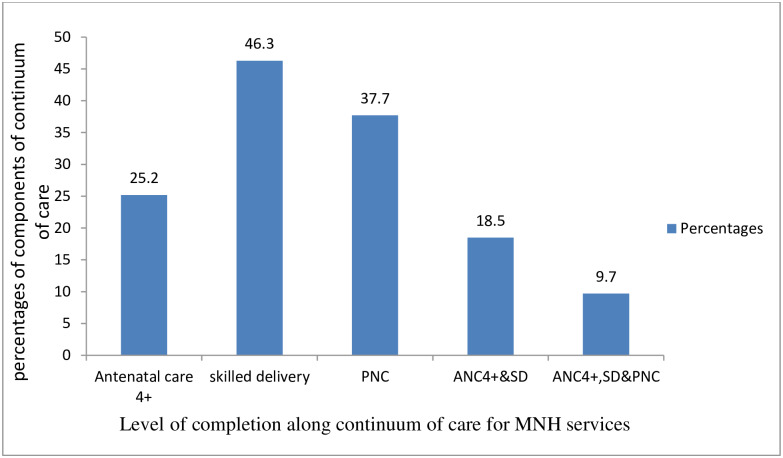
Results: The overall completion along the continuum of care was 42(9.7%). The factors significantly associated with completion of care along the continuumwere timely initiation of antenatalcare (before16weeks) [AOR: 10.7, CI (5.1, 22.7], birth preparedness and complication readiness [AOR: 2.9, CI (1.4, 6.1), pre-pregnancy contraception utilization [AOR: 3.9, CI: 1.4, 11.0], being employed [AOR: 2.6 CI:(1.3, 5.4)], and having a planned pregnancy [AOR:3.5 CI: (1.1, 11.4)].
Conclusion and recommendation: Completion along the continuum of care for MNH services was low in the study area. Thus, efforts to improve the completion of care should focus on interventions that enhance early initiation of antenatal care, planned pregnancy, and birth preparedness and complication readiness.
Conflict of interest statement
The authors have declared that no competing interests exist.
Figures
References
-
- WHO, UNFPA, World Bank. The United Nations Population Division. Trends in maternal mortality: 1990 to 2015. 2015.
-
- ICF, C.S.A., Ethiopia Demographic and Health Survey, 2016: Key Indicators Report. 2016.
-
- UNICEF, WHO, and World Bank. Levels and Trends in Child Mortality, Estimates developed by the UN Inter-agency Group for Child Mortality Estimation. 2018.
MeSH terms
LinkOut - more resources
Full Text Sources
Miscellaneous
