[Preprint]. 2020 Apr 18:2020.04.16.045302.
doi: 10.1101/2020.04.16.045302.

Broad Host Range of SARS-CoV-2 Predicted by Comparative and Structural Analysis of ACE2 in Vertebrates

Affiliations

Broad Host Range of SARS-CoV-2 Predicted by Comparative and Structural Analysis of ACE2 in Vertebrates

Joana Damas et al. bioRxiv. .

Update in

Abstract

The novel coronavirus SARS-CoV-2 is the cause of Coronavirus Disease-2019 (COVID-19). The main receptor of SARS-CoV-2, angiotensin I converting enzyme 2 (ACE2), is now undergoing extensive scrutiny to understand the routes of transmission and sensitivity in different species. Here, we utilized a unique dataset of 410 vertebrates, including 252 mammals, to study cross-species conservation of ACE2 and its likelihood to function as a SARS-CoV-2 receptor. We designed a five-category ranking score based on the conservation properties of 25 amino acids important for the binding between receptor and virus, classifying all species from very high to very low. Only mammals fell into the medium to very high categories, and only catarrhine primates in the very high category, suggesting that they are at high risk for SARS-CoV-2 infection. We employed a protein structural analysis to qualitatively assess whether amino acid changes at variable residues would be likely to disrupt ACE2/SARS-CoV-2 binding, and found the number of predicted unfavorable changes significantly correlated with the binding score. Extending this analysis to human population data, we found only rare (<0.1%) variants in 10/25 binding sites. In addition, we observed evidence of positive selection in ACE2 in multiple species, including bats. Utilized appropriately, our results may lead to the identification of intermediate host species for SARS-CoV-2, justify the selection of animal models of COVID-19, and assist the conservation of animals both in native habitats and in human care.

Keywords: ACE2; COVID-19; SARS-CoV-2; comparative genomics; evolution; host range; species conservation.


Figures
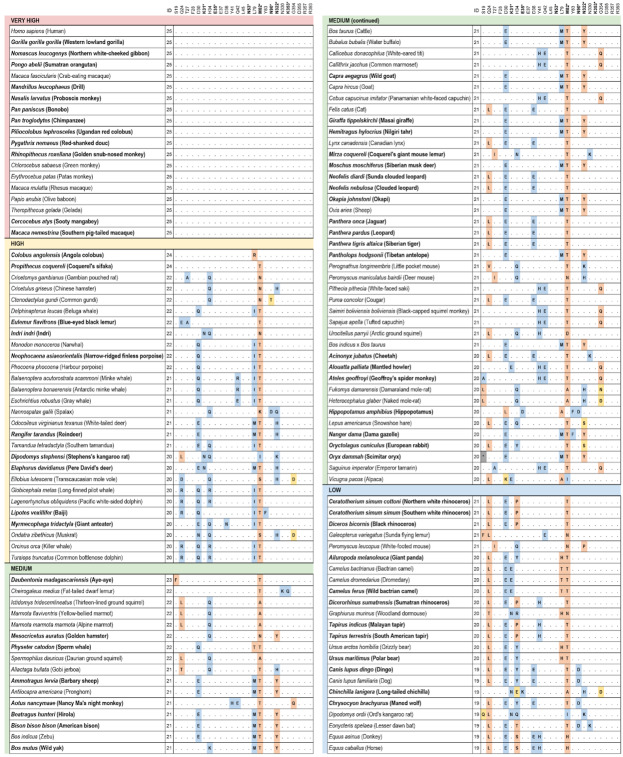
Figure 1.
Figure 1.
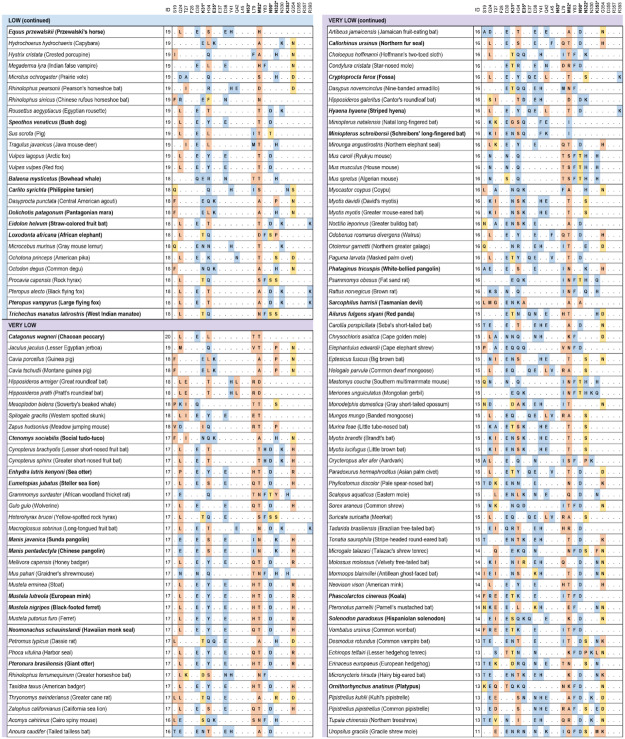
Cross-species conservation of ACE2 and predictions of SARS-CoV-2 susceptibility. Species are sorted by binding score of ACE2 for SARS-CoV-2 S. The ‘ID’ column depicts the number of amino acids identical to human binding residues. Bold amino acid positions (also labeled with *) represent residues at binding hotspots and constrained in the scoring scheme. Each amino acid substitution is colored according to its classification as non-conservative (orange), semi-conservative (yellow) or neutral (blue), as compared to the human residue. Bold species names depict species with threatened IUCN risk status. The 410 vertebrate species dataset is available in Dataset S1.
Figure 1.
Figure 1.
Cross-species conservation of ACE2 and predictions of SARS-CoV-2 susceptibility. Species are sorted by binding score of ACE2 for SARS-CoV-2 S. The ‘ID’ column depicts the number of amino acids identical to human binding residues. Bold amino acid positions (also labeled with *) represent residues at binding hotspots and constrained in the scoring scheme. Each amino acid substitution is colored according to its classification as non-conservative (orange), semi-conservative (yellow) or neutral (blue), as compared to the human residue. Bold species names depict species with threatened IUCN risk status. The 410 vertebrate species dataset is available in Dataset S1.
Figure 2.
Figure 2.
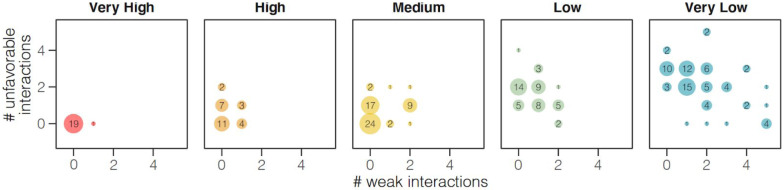
Congruence between binding score and structural homology analysis. Species classified by sequence identity to human ACE2 as very high (red) or high binding score (orange) have significantly fewer amino acid substitutions rated as potentially altering the binding interface between ACE2 and SARS-CoV-2 through protein structural analysis, as compared to low (green) or very low (blue) species. The more severe unfavorable variants are counted on y-axis and less severe weaken variants on the x-axis. Black numerical labels indicate species count.
Figure 3.
Figure 3.
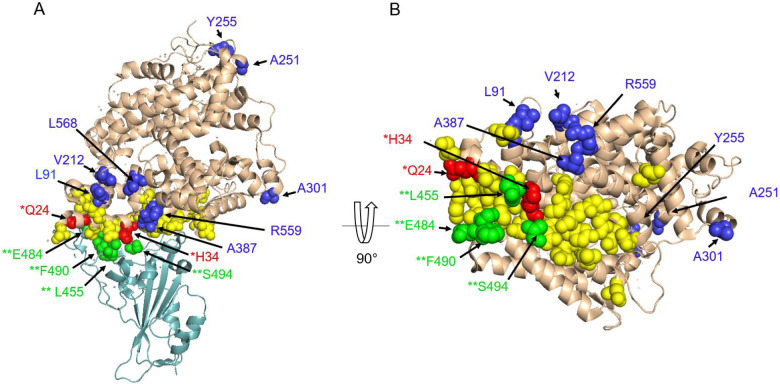
Residues under positive selection detected with CODEML and acceleration with phyloP in mammals. (A) ACE2 is represented in wheat cartoon with residues involved in the binding interface shown in yellow spheres. Dark blue and red spheres indicate residues in ACE2 that are accelerated and under positive selection. Red spheres represent residues that overlap with positions in the binding interface and are labeled with (*). The spike RBD is shown in light teal cartoon. Green spheres indicate residues on the SARS-CoV-2 spike protein under positive selection and are labeled with (**). (B) 90 degree rotation of the ACE2 protein.

References

    1. Zhou P., et al. , A pneumonia outbreak associated with a new coronavirus of probable bat origin. Nature 579, 270–273 (2020). - PMC - PubMed
    1. Lu G., Wang Q., Gao G. F., Bat-to-human: spike features determining “host jump” of coronaviruses SARS-CoV, MERS-CoV, and beyond. Trends Microbiol. 23, 468–478 (2015). - PMC - PubMed
    1. Shan C., et al. , Infection with Novel Coronavirus (SARS-CoV-2) Causes Pneumonia in the Rhesus Macaques 10.21203/rs.2.25200/v1. - DOI - PMC - PubMed
    1. Laude H., Van Reeth K., Pensaert M., Porcine respiratory coronavirus: molecular features and virus-host interactions. Vet. Res. 24, 125–150 (1993). - PubMed
    1. Saif L. J., Bovine respiratory coronavirus. Vet. Clin. North Am. Food Anim. Pract. 26, 349–364 (2010). - PMC - PubMed

Publication types