[Preprint]. 2021 Apr 29:2020.04.22.056283.
doi: 10.1101/2020.04.22.056283.

SwabExpress: An end-to-end protocol for extraction-free COVID-19 testing

Affiliations

SwabExpress: An end-to-end protocol for extraction-free COVID-19 testing

Sanjay Srivatsan et al. bioRxiv. .

Update in

  • SwabExpress: An End-to-End Protocol for Extraction-Free COVID-19 Testing.
    Srivatsan S, Heidl S, Pfau B, Martin BK, Han PD, Zhong W, van Raay K, McDermot E, Opsahl J, Gamboa L, Smith N, Truong M, Cho S, Barrow KA, Rich LM, Stone J, Wolf CR, McCulloch DJ, Kim AE, Brandstetter E, Sohlberg SL, Ilcisin M, Geyer RE, Chen W, Gehring J; Seattle Flu Study Investigators; Kosuri S, Bedford T, Rieder MJ, Nickerson DA, Chu HY, Konnick EQ, Debley JS, Shendure J, Lockwood CM, Starita LM. Srivatsan S, et al. Clin Chem. 2021 Dec 30;68(1):143-152. doi: 10.1093/clinchem/hvab132. Clin Chem. 2021. PMID: 34286830 Free PMC article.

Abstract

Background: The urgent need for massively scaled clinical testing for SARS-CoV-2, along with global shortages of critical reagents and supplies, has necessitated development of streamlined laboratory testing protocols. Conventional nucleic acid testing for SARS-CoV-2 involves collection of a clinical specimen with a nasopharyngeal swab in transport medium, nucleic acid extraction, and quantitative reverse transcription PCR (RT-qPCR) (1). As testing has scaled across the world, the global supply chain has buckled, rendering testing reagents and materials scarce (2). To address shortages, we developed SwabExpress, an end-to-end protocol developed to employ mass produced anterior nares swabs and bypass the requirement for transport media and nucleic acid extraction.

Methods: We evaluated anterior nares swabs, transported dry and eluted in low-TE buffer as a direct-to-RT-qPCR alternative to extraction-dependent viral transport media. We validated our protocol of using heat treatment for viral activation and added a proteinase K digestion step to reduce amplification interference. We tested this protocol across archived and prospectively collected swab specimens to fine-tune test performance.

Results: After optimization, SwabExpress has a low limit of detection at 2-4 molecules/uL, 100% sensitivity, and 99.4% specificity when compared side-by-side with a traditional RT-qPCR protocol employing extraction. On real-world specimens, SwabExpress outperforms an automated extraction system while simultaneously reducing cost and hands-on time.

Conclusion: SwabExpress is a simplified workflow that facilitates scaled testing for COVID-19 without sacrificing test performance. It may serve as a template for the simplification of PCR-based clinical laboratory tests, particularly in times of critical shortages during pandemics.


Figures
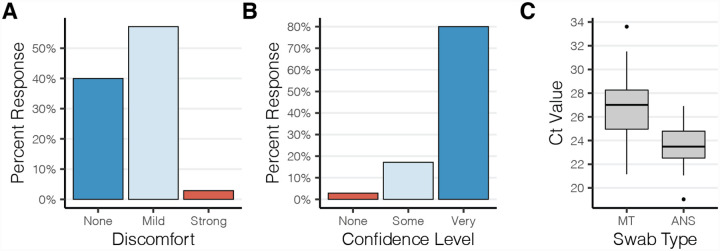
Figure 1.
Figure 1.. Polyester anterior nares swabs are both comfortable and easy to use.
(A,B) Study participants’ (n=35) self reported (A) discomfort and (B) confidence during self administration of an anterior nares swab at home. (C) Boxplot depicting the RT-qPCR crossing threshold values for RNaseP from self-administered anterior nares swabs (ANS) and mid-turbinate (MT) swabs.
Figure 2.
Figure 2.. Extraction free RT-qPCR set-up and test performance.
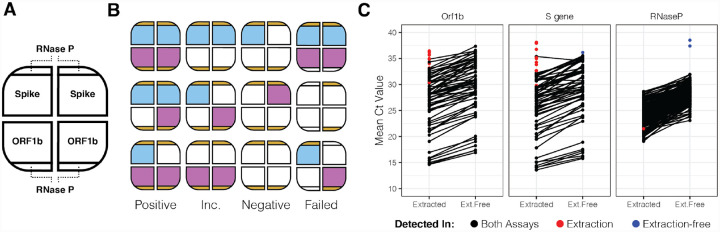
(A) Assay layout of the EF-RT-qPCR test. One sample is assayed in four wells on a 384 well-plate. Each sample is tested for two probes, in duplicate. RNase P is assayed in each well. (B) Combinations of how positive, inconclusive (abbreviated Inc.), negative, and failed samples are determined. (C) Mean Ct values for 67 specimens processed by EF-RT-qPCR and extraction-based RT-qPCR.
Figure 3.
Figure 3.. Addition of Proteinase K improves test performance.
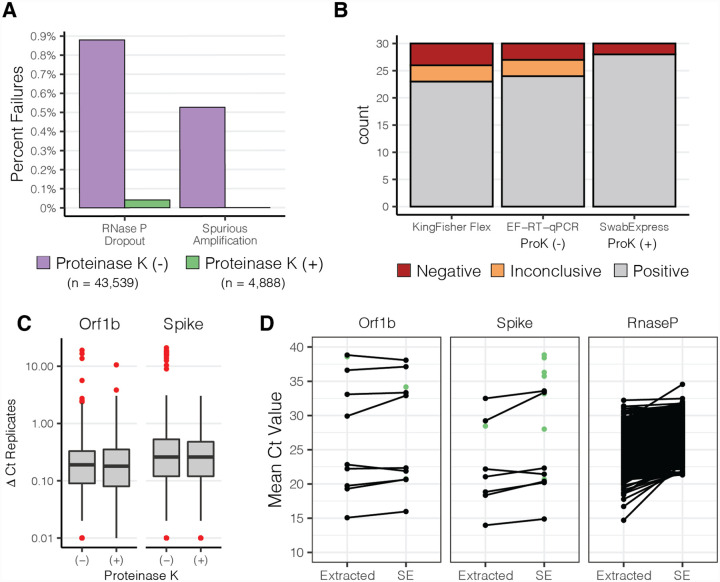
(A) Observed percentage of test failures with and without the addition of Proteinase K. (B) Archived samples with Ct > 28 reprocessed with either KingFisher Flex Extraction (left), Extraction-Free RT-PCR (middle), or SwabExpress (Extraction-Free RT-PCR + ProK) (right). Colors signify the number of samples and their classifications. (C) Box and whisker plots depicting the average delta Ct between replicate wells for SARS-Cov2 positive specimens. Red points indicate outliers. ΔCt values were more consistent upon addition of Proteinase K. (D) Mean Ct values of matched specimens run through the automated KingFisher extraction system (left) or using SwabExpress (SE). Specimens which were detected in only one of the two protocols are displayed as green points.
Figure 4.
Figure 4.. SwabExpress workflow.
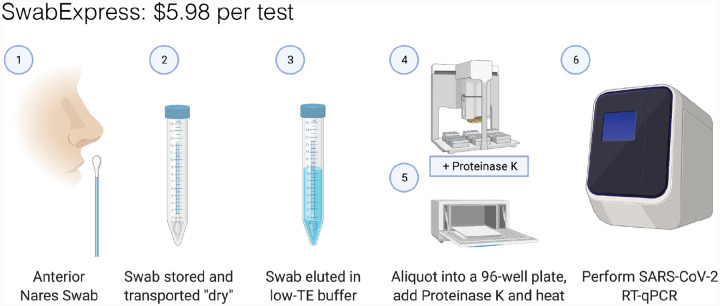
(1) Anterior nares swabs are collected and (2) transported dry to the lab. Upon receipt, (3) each swab is then hydrated with low-TE buffer, aliquoted into a 96 well plate, and (4) proteinase K is added to every well. (5) The eluted specimens are digested and heat-inactivated in a laboratory oven before (6) they are loaded as the template in a RT-qPCR reaction. The cost listed includes reagents and consumables.

References

    1. Cheng MP, Papenburg J, Desjardins M, Kanjilal S, Quach C, Libman M, et al. Diagnostic Testing for Severe Acute Respiratory Syndrome–Related Coronavirus 2 [Internet]. Annals of Internal Medicine. 2020. page 726–34. Available from: 10.7326/m20-1301 - DOI - PMC - PubMed
    1. Botti-Lodovico Y, Rosenberg E, Sabeti PC. Testing in a Pandemic — Improving Access, Coordination, and Prioritization [Internet]. New England Journal of Medicine. 2021. page 197–9. Available from: 10.1056/nejmp2025173 - DOI - PubMed
    1. Cevik M, Tate M, Lloyd O, Maraolo AE, Schafers J, Ho A. SARS-CoV-2, SARS-CoV, and MERS-CoV viral load dynamics, duration of viral shedding, and infectiousness: a systematic review and meta-analysis. Lancet Microbe. Elsevier BV; 2021;2:e13–22. - PMC - PubMed
    1. Brauner JM, Mindermann S, Sharma M, Johnston D, Salvatier J, Gavenčiak T, et al. Inferring the effectiveness of government interventions against COVID-19. Science [Internet]. American Association for the Advancement of Science; 2021. [cited 2021 Apr 23];371. Available from: https://science.sciencemag.org/content/371/6531/eabd9338.abstract - PMC - PubMed
    1. Larremore DB, Wilder B, Lester E, Shehata S, Burke JM, Hay JA, et al. Test sensitivity is secondary to frequency and turnaround time for COVID-19 surveillance. medRxiv [Internet]. 2020; Available from: 10.1101/2020.06.22.20136309 - DOI - PMC - PubMed

Publication types