[Preprint]. 2020 Mar 27:2020.03.06.20032334.
doi: 10.1101/2020.03.06.20032334.

Rapid Detection of 2019 Novel Coronavirus SARS-CoV-2 Using a CRISPR-based DETECTR Lateral Flow Assay

Affiliations

Rapid Detection of 2019 Novel Coronavirus SARS-CoV-2 Using a CRISPR-based DETECTR Lateral Flow Assay

James P Broughton et al. medRxiv. .

Abstract

An outbreak of novel betacoronavirus, SARS-CoV-2 (formerly named 2019-nCoV), began in Wuhan, China in December 2019 and the COVID-19 disease associated with infection has since spread rapidly to multiple countries. Here we report the development of SARS-CoV-2 DETECTR, a rapid (~30 min), low-cost, and accurate CRISPR-Cas12 based lateral flow assay for detection of SARS-CoV-2 from respiratory swab RNA extracts. We validated this method using contrived reference samples and clinical samples from infected US patients and demonstrated comparable performance to the US CDC SARS-CoV-2 real-time RT-PCR assay.

Keywords: 2019-nCoV; COVID-19; CRISPR; CRISPR-Cas12; DETECTR; SARS-CoV-2; Wuhan; betacoronavirus; coronavirus; diagnostic testing; epidemic; isothermal amplification; lateral flow; loop-mediated isothermal amplification (LAMP); molecular testing; outbreak; pandemic; zoonotic.


Figures
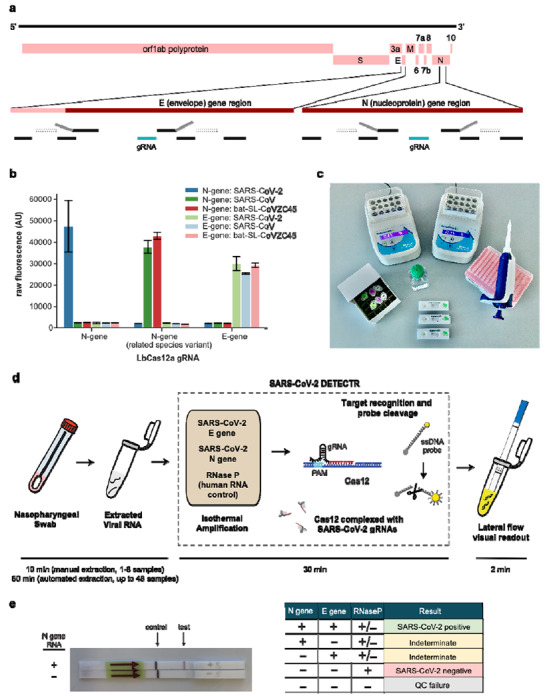
Figure 1.
Figure 1.. A CRISPR-Cas12 based assay for detection of SARS-CoV-2.
(a) Genome map showing primers, probes and gRNAs. Visualization of primers and probes on the SARS-CoV-2 genome (b) gRNA specificity. Cas12 gRNAs are programmed to specifically target SARS-CoV-2 or broadly detect related coronavirus strains. The N gene gRNA used in the assay (left) is specific for SARS-CoV-2, whereas the E gene gRNA is able to detect 3 SARS-like coronavirus (right). A separate N gene gRNA targeting SARS-CoV and a bat coronavirus and differing by a single nucleotide from the N gene gRNA used in the assay fails to detect SARS-CoV-2 (middle). (c) Minimum equipment needed to run protocol. With appropriate biosafety level 2 requirements, the minimum equipment required to run the protocol includes Eppendorf tubes with reagents, heat blocks or water bath (37°C and 62°C), nuclease-free water, pipettes and tips, and lateral flow strips. (d) Schematic of SARS-CoV-2 DETECTR workflow. Conventional RNA extraction or sample matrix can be used as an input to DETECTR (LAMP pre-amplification and Cas12-based detection for E gene, N gene and RNase P), which is visualized by a fluorescent reader or lateral flow strip. (e) Lateral flow strip assay readout. A positive result requires detection of at least the two SARS-CoV-2 viral gene targets (N gene and E gene).
Figure 2.
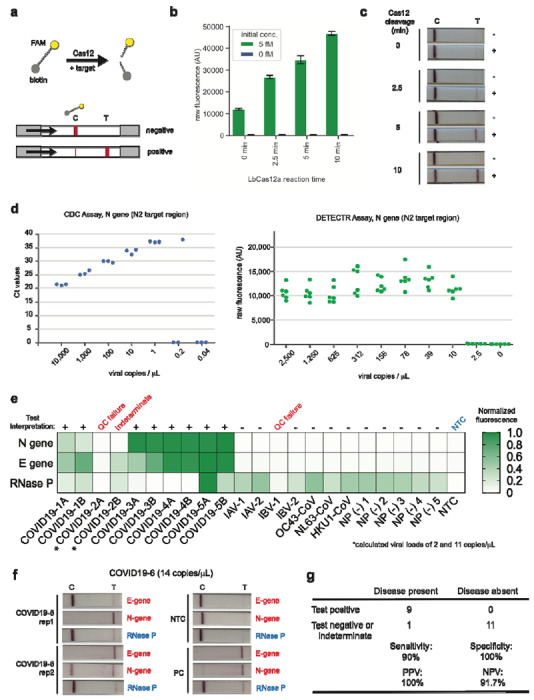
Figure 2.. Detection of SARS-CoV-2 in contrived and clinical nasopharyngeal or oropharyngeal swab samples.
(a) Schematic of DETECTR coupled with lateral flow readout. The intact FAM-biotinylated reporter molecule flows to the control capture line. Upon recognition of the matching target, the Cas-gRNA complex cleaves the reporter molecule, which flows to the target capture line. (b-c) Comparison of fluorescence to lateral flow. (b) Fluorescence signal of LbCas12a detection assay on RT-LAMP amplicon for SARS-CoV-2 N-gene saturates within 10 min. RT-LAMP amplicon generated from 2 μL of 5 fM or 0 fM SARS-CoV-2 N-gene IVT RNA by amplifying at 62°C for 20 min. (c) LbCas12a on the same RT-LAMP amplicon produces visible signal through lateral flow assay within 5 min. (d) Limit of detection for CDC qPCR and DETECTR. Ct values using the CDC qPCR assay (n=3) and fluorescence values using SARS-CoV-2 DETECTR (n=6) using SARS-CoV-2 N2 gene IVT-RNA. (e) Patient sample DETECTR data. DETECTR fluorescence values were normalized to the highest value within the N gene, E gene or RNase P set, with a positive threshold at five standard deviations above background. Final determination of the SARS-CoV-2 test was based on the interpretation matrix in Fig. 1e, with results indicated above the heat map. (f) SARS-CoV-2 DETECTR assay identifies presence of SARS-CoV-2 viral RNA from clinical sample. Two replicate assays were performed using 2 μL of extracted RNA for each reaction (titer 12 copies/μL). Positive controls used IVT RNA for SARS-CoV-2 targets and total human RNA for RNase P. LbCas12a detection assays were run on lateral flow strips (TwistDx) and imaged after 3 min. (g) Performance characteristics of the SARS-CoV-2 DETECTR assay. Abbreviations: fM, femtomolar; NTC, no-template control; PPV, positive predictive value; NPV, negative predictive value.

References

    1. Wang C., Horby P. W., Hayden F. G. & Gao G. F. A novel coronavirus outbreak of global health concern. Lancet 395, 470–473, doi:10.1016/S0140-6736(20)30185-9 (2020). - DOI - PMC - PubMed
    1. Zhu N. et al. A Novel Coronavirus from Patients with Pneumonia in China, 2019. N Engl J Med 382, 727–733, doi:10.1056/NEJMoa2001017 (2020). - DOI - PMC - PubMed
    1. World Health Organization. Coronavirus disease 2019 (COVID-19) Situation Report - 44. 8 (World Health Organization, Geneva, Switzerland, 2020).
    1. Bai Y. et al. Presumed Asymptomatic Carrier Transmission of COVID-19. JAMA, doi:10.1001/jama.2020.2565 (2020). - DOI - PMC - PubMed
    1. Rothe C. et al. Transmission of 2019-nCoV Infection from an Asymptomatic Contact in Germany. N Engl J Med 382, 970–971, doi:10.1056/NEJMc2001468 (2020). - DOI - PMC - PubMed

Publication types