This is a preprint.
Characterization and clinical course of 1000 patients with COVID-19 in New York: retrospective case series
- PMID: 32511507
- PMCID: PMC7273275
- DOI: 10.1101/2020.04.20.20072116
Characterization and clinical course of 1000 patients with COVID-19 in New York: retrospective case series
Update in
-
Characterization and clinical course of 1000 patients with coronavirus disease 2019 in New York: retrospective case series.BMJ. 2020 May 29;369:m1996. doi: 10.1136/bmj.m1996. BMJ. 2020. PMID: 32471884 Free PMC article.
Abstract
Objective: To characterize patients with coronavirus disease 2019 (COVID-19) in a large New York City (NYC) medical center and describe their clinical course across the emergency department (ED), inpatient wards, and intensive care units (ICUs).
Design: Retrospective manual medical record review.
Setting: NewYork-Presbyterian/Columbia University Irving Medical Center (NYP/CUIMC), a quaternary care academic medical center in NYC.
Participants: The first 1000 consecutive patients with laboratory-confirmed COVID-19.
Methods: We identified the first 1000 consecutive patients with a positive RT-SARS-CoV-2 PCR test who first presented to the ED or were hospitalized at NYP/CUIMC between March 1 and April 5, 2020. Patient data was manually abstracted from the electronic medical record.
Main outcome measures: We describe patient characteristics including demographics, presenting symptoms, comorbidities on presentation, hospital course, time to intubation, complications, mortality, and disposition.
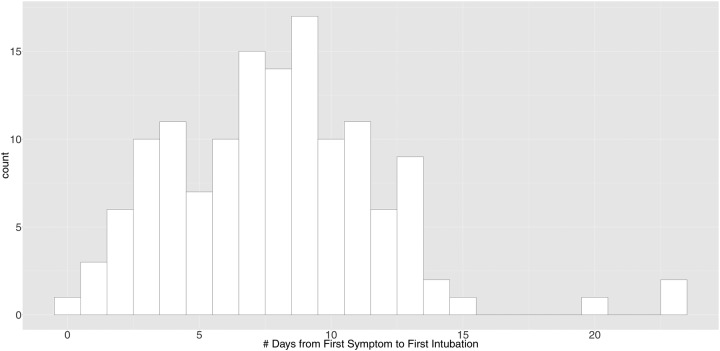
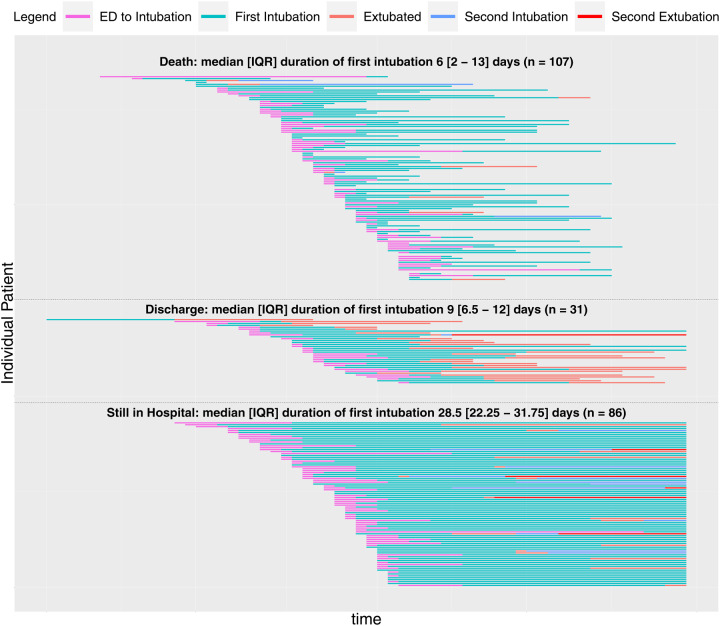
Results: Among the first 1000 patients, 150 were ED patients, 614 were admitted without requiring ICU-level care, and 236 were admitted or transferred to the ICU. The most common presenting symptoms were cough (73.2%), fever (72.8%), and dyspnea (63.1%). Hospitalized patients, and ICU patients in particular, most commonly had baseline comorbidities including of hypertension, diabetes, and obesity. ICU patients were older, predominantly male (66.9%), and long lengths of stay (median 23 days; IQR 12 to 32 days); 78.0% developed AKI and 35.2% required dialysis. Notably, for patients who required mechanical ventilation, only 4.4% were first intubated more than 14 days after symptom onset. Time to intubation from symptom onset had a bimodal distribution, with modes at 3-4 and 9 days. As of April 30, 90 patients remained hospitalized and 211 had died in the hospital.
Conclusions: Hospitalized patients with COVID-19 illness at this medical center faced significant morbidity and mortality, with high rates of AKI, dialysis, and a bimodal distribution in time to intubation from symptom onset.
Conflict of interest statement
Conflict of Interest Disclosures: All authors have completed the ICMJE uniform disclosure form and declare: no support from any organization for the submitted work; no competing interests with regards to the submitted work. MMS reports grants from Amgen, outside the submitted work. JJC reports personal fees from Allergan, outside the submitted work. RGB reports grants from Alpha1 Foundation and COPD Foundation, outside the submitted work. GH reports grants from Janssen Research, outside the submitted work. The remaining authors MGA, SLB, CLS, JRT, KN, RC, MRB, BPC, NG, PG, AMM, AAP, MSR, NWS, SS, MDS, KN, PAA, FMB, RB, MFC, MIC, LAC, JHD, LBD, SAD, KAE, ZPG, DTG, AAH, NH, SH, LEK, EL, AL, AYS, ACS, ZES, CPS, YX, HWZ, and RL have nothing to disclose.
Figures
References
-
- NYC Department of Health. COVID-19: Data 2020. [accessed 1 May 2020].
Publication types
Grants and funding
LinkOut - more resources
Full Text Sources
Research Materials
Miscellaneous