


Phytotoxic and Antimicrobial Activities of Teucrium polium and Thymus decussatus Essential Oils Extracted Using Hydrodistillation and Microwave-Assisted Techniques
- PMID: 32512751
- PMCID: PMC7356946
- DOI: 10.3390/plants9060716
Phytotoxic and Antimicrobial Activities of Teucrium polium and Thymus decussatus Essential Oils Extracted Using Hydrodistillation and Microwave-Assisted Techniques
Abstract
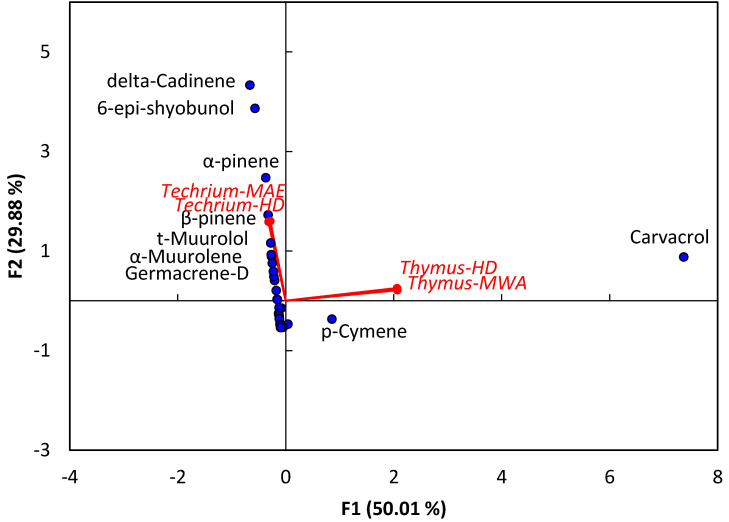
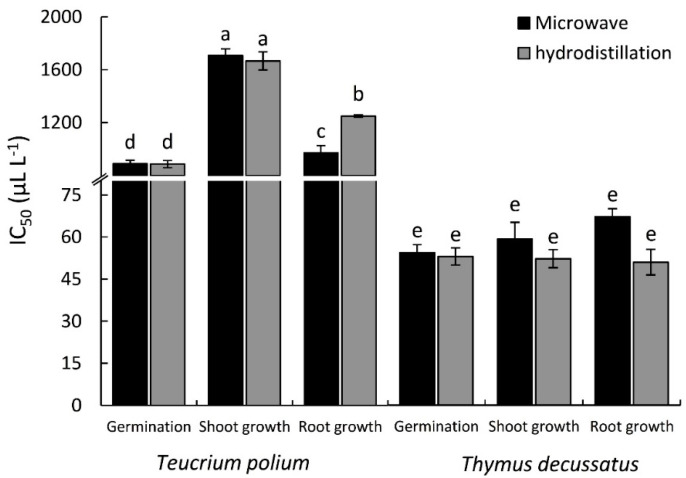
Essential oils (EOs) have been described as promising eco-friendly secondary products of aromatic plants with several biological activities. The present study aimed to characterize the chemical composition and explore phytotoxic and antimicrobial activities of Teucrium polium and Thymus decussatus EOs extracted using hydrodistillation (HD) and microwave-assisted extraction (MAE) methods. Twenty-seven and twenty-eight compounds were identified from HD and MAE extracted EOs of T. polium, respectively. The oxygenated sesquiterpenes (57.68%) were characterized as the main components of the hydrodistilled EO with a prominence of 6-epi-shyobunol (33.00%), while sesquiterpene hydrocarbons (54.48%) were the main components of the MAE method, with a prominence of delta-cadinene (25.13%). Eighteen and nineteen compounds, were characterized in T. decussatus EOs extracted using HD and MAE methods, respectively, and oxygenated monoterpenes represented the main components of both EOs with carvacrol (94.40% and 75.91%, respectively) as the main compound. The EOs extracted using the MAE method were slightly more phytotoxic than those extracted using the HD method. The T. decussatus EO extracted using the MAE method showed a higher inhibitory effect than T. polium by 16-, 32-, and 24-fold, regarding seed germination, shoot, and root growth of lettuce, respectively. Moreover, EOs extracted by HD method showed a similar pattern with 16-, 28-, and 14-fold effects. Both T. decussatus EOs exhibited potent inhibitory effect against all tested bacteria with an inhibition zone of 34-39 mm and the lowest minimum inhibitory concentration (MIC) of 0.49, 0.98, and 1.95 μg/mL against Aspergillus niger, Escherichia coli, and Staphylococcus aureus, respectively. However, the EOs of T. polium showed weak antibacterial activity and no antifungal effect. Further studies are needed for the characterization of bioactive major compounds, either singular or synergistic, at field scale and to determine their modes of action and safety.
Keywords: Lamiaceae; Teucrium polium; Thymus decussatus; antimicrobial; essential oils; phytotoxicity.
Conflict of interest statement
The authors declare no conflict of interest.
Figures
References
-
- Zahran M.A., Willis A.J. The Vegetation of Egypt. Volume 2 Springer Science & Business Media; Berlin, Germany: 2008.
-
- Boulos L. Flora of Egypt Checklist. Al-Hadara Publishing; Cairo, Egypt: 2009. pp. 198–201.
-
- Batanouny K.H., Aboutabl E., Shabana M.F.S. Wild Medicinal Plants in Egypt. An Inventory to Support Conservation and Sustainable Use. The Palm Press; Cairo, Egypt: 1999.
Grants and funding
LinkOut - more resources
Full Text Sources
