


Further Evidence of Benefits to Mood and Working Memory from Lipidated Curcumin in Healthy Older People: A 12-Week, Double-Blind, Placebo-Controlled, Partial Replication Study
- PMID: 32512782
- PMCID: PMC7352411
- DOI: 10.3390/nu12061678
Further Evidence of Benefits to Mood and Working Memory from Lipidated Curcumin in Healthy Older People: A 12-Week, Double-Blind, Placebo-Controlled, Partial Replication Study
Abstract
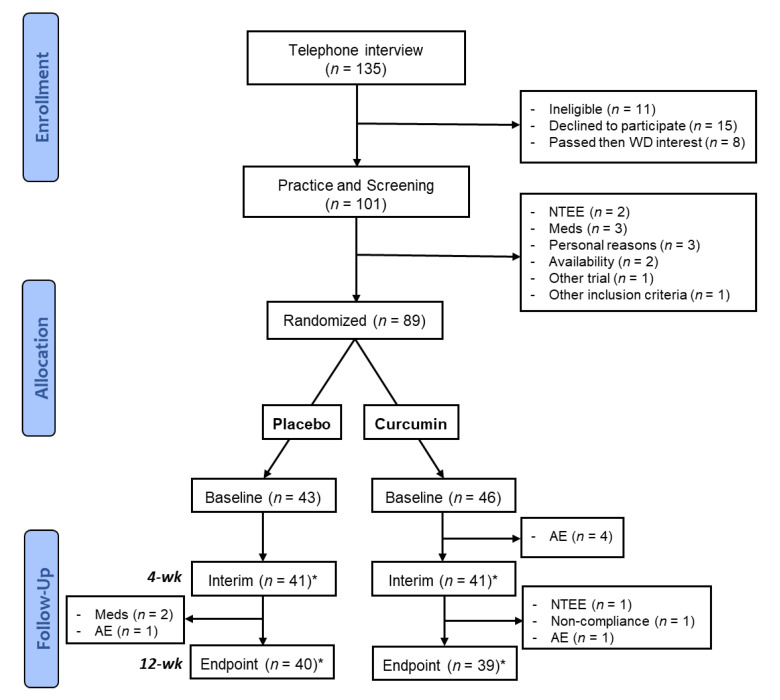
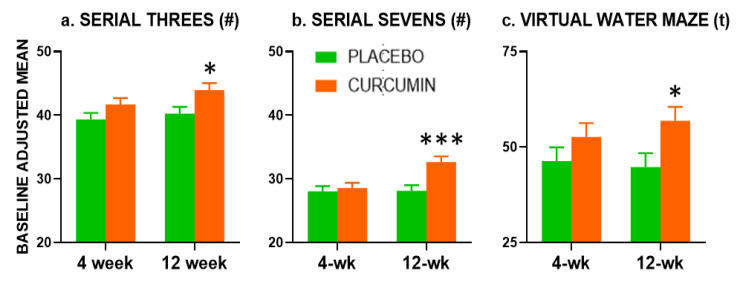
Curcumin (a flavonoid isolated from turmeric) affects several processes involved in neurocognitive aging. We have previously reported that short term (4-weeks) administration of a highly bioavailable curcumin preparation (Longvida©) improved working memory and reduced fatigue and stress reactivity in a healthy older cohort. The present trial (ACTRN12616000484448) was a partial replication study, evaluating similar effects at 4 and 12-weeks Longvida© supplementation. A double-blind, placebo-controlled, parallel-groups trial was conducted. Eighty participants aged 50-80 years (mean = 68.1, SD = 6.34) were randomised to receive Longvida© (400 mg daily containing 80 mg curcumin) or a matching placebo. Assessment took place at baseline then following 4 and 12 weeks treatment. Outcome measures included cognitive performance, mood and biomarkers. Compared with placebo, curcumin was associated with several significant effects. These included better working memory performance at 12-weeks (Serial Threes, Serial Sevens and performance on a virtual Morris Water Maze), and lower fatigue scores on the Profile of Mood States (POMS) at both 4 and 12-weeks, and of tension, anger, confusion and total mood disturbance at 4-weeks only. The curcumin group had significantly elevated blood glucose. These results confirm that Longvida© improves aspects of mood and working memory in a healthy older cohort. The pattern of results is consistent with improvements in hippocampal function and may hold promise for alleviating cognitive decline in some populations.
Keywords: cognition; curcumin; mood; working memory.
Conflict of interest statement
The funders had no role in the design of the study; in the collection, analyses, or interpretation of data; in the writing of the manuscript, or in the decision to publish the results. D.J.W., A.P. and A.S. have received funding from the nutrition and supplement industry.
Figures

References
-
- World Health Organization . Global Action Plan on the Public Health Response to Dementia 2017–2025. World Health Organization; Geneva, Switzerland: 2017.
-
- Farooqui T., Farooqui A.A. Curcumin for Neurological and Psychiatric Disorders. Elsevier; Amsterdam, The Netherlands: 2019. Potential Therapeutic impacts of curcumin for improving memory impairment; pp. 257–273.
Publication types
MeSH terms
Substances
Grants and funding
LinkOut - more resources
Full Text Sources
Medical
