


Drug dosing in the critically ill obese patient-a focus on sedation, analgesia, and delirium
- PMID: 32513237
- PMCID: PMC7282067
- DOI: 10.1186/s13054-020-03040-z
Drug dosing in the critically ill obese patient-a focus on sedation, analgesia, and delirium
Abstract
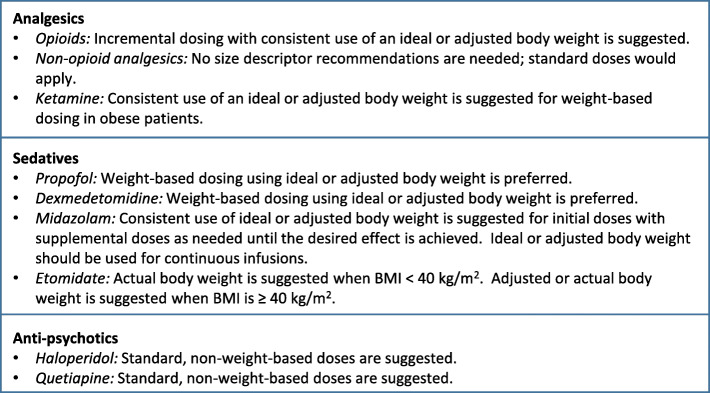
Practice guidelines provide clear evidence-based recommendations for the use of drug therapy to manage pain, agitation, and delirium associated with critical illness. Dosing recommendations however are often based on strategies used in patients with normal body habitus. Recommendations specific to critically ill patients with extreme obesity are lacking. Nonetheless, clinicians must craft dosing regimens for this population. This paper is intended to help clinicians design initial dosing regimens for medications commonly used in the management of pain, agitation, and delirium in critically ill patients with extreme obesity. A detailed literature search was conducted with an emphasis on obesity, pharmacokinetics, and dosing. Relevant manuscripts were reviewed and strategies for dosing are provided.
Keywords: Critical illness; Drug-dosing; Obesity; Pharmacokinetics.
Conflict of interest statement
BLE: No conflicts of interest.
JFB: Consultant for Wolters Kluwer.
Figures
References
-
- Eastman C, Erstad BL. Availability of information for dosing commonly used medications in special ICU populations. Am J Health-Syst Pharmacy. 2020;77(7):529–534. - PubMed
-
- Devlin JW, Skrobik Y, Gelinas C, Needham DM, Slooter AJC, Pandharipande PP, et al. Clinical practice guidelines for the prevention and management of pain, agitation/sedation, delirium, immobility, and sleep disruption in adult patients in the ICU. Crit Care Med. 2018;46(9):e825–ee73. - PubMed
-
- Wishart DS, Feunang YD, Guo AC, Lo EJ, Marcu A, Grant JR, et al. DrugBank 5.0: a major update to the DrugBank database for 2018. Nucleic Acids Res. 2018;46(D1):D1074-82. https://www.drugbank.ca/. Accessed Oct 2019. - PMC - PubMed
Publication types
MeSH terms
Substances
LinkOut - more resources
Full Text Sources
Medical
