


Gender differences in the pathways to higher education
- PMID: 32513710
- PMCID: PMC7322061
- DOI: 10.1073/pnas.2002861117
Gender differences in the pathways to higher education
Abstract
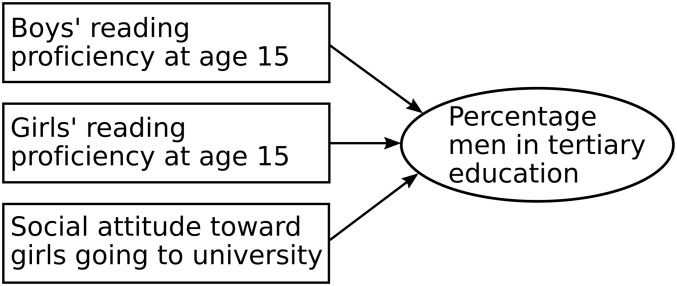
It is well known that far fewer men than women enroll in tertiary education in the United States and other Western nations. Developed nations vary in the degree to which men are underrepresented, but the Organization for Economic Co-operation and Development (OECD) average lies around 45% male students. We use data from the OECD Education at a Glance statistical reports, the Program for International Student Assessment (PISA), and the World Values Survey to explain the degree to which men are underrepresented. Using a multiple regression model, we show that the combination of both the national reading proficiency levels of 15-y-old boys and girls and the social attitudes toward girls attending university can predict the enrollment in tertiary education 5 y later. The model also shows that parity in some countries is a result of boys' poor reading proficiency and negative social attitudes toward girls' education, which suppresses college enrollment in both sexes, but for different reasons. True equity will at the very least require improvement in boys' reading competencies and the liberalization of attitudes regarding women's pursuit of higher education. At this time, there is little reason to expect that the enrollment gap will decrease, given the stagnating reading competencies in most countries.
Keywords: discrimination; education; gender gap; reading.
Copyright © 2020 the Author(s). Published by PNAS.
Conflict of interest statement
The authors declare no competing interest.
Figures


Comment in
-
Understanding educational, occupational, and creative outcomes requires assessing intraindividual differences in abilities and interests.Proc Natl Acad Sci U S A. 2020 Jul 21;117(29):16720-16722. doi: 10.1073/pnas.2009042117. Epub 2020 Jul 13. Proc Natl Acad Sci U S A. 2020. PMID: 32661167 Free PMC article. No abstract available.
References
-
- Brydsten A., Hammarström A., Strandh M., Johansson K., Youth unemployment and functional somatic symptoms in adulthood: Results from the Northern Swedish cohort. Eur. J. Public Health 25, 796–800 (2015). - PubMed
-
- Carmichael F., Ward R., Male unemployment and crime in England and Wales. Econ. Lett. 73, 111–115 (2001).
-
- Breuer C., Unemployment and suicide mortality: Evidence from regional panel data in Europe. Health Econ. 24, 936–950 (2015). - PubMed
-
- Reilly D., Neumann D. L., Andrews G., Gender differences in reading and writing achievement: Evidence from the national assessment of educational progress (NAEP). Am. Psychol. 74, 445–458 (2019). - PubMed
MeSH terms
LinkOut - more resources
Full Text Sources
Miscellaneous
