. 2020 May 14:18:1173-1181.
doi: 10.1016/j.csbj.2020.05.010. eCollection 2020.

NormQ: RNASeq normalization based on RT-qPCR derived size factors

Affiliations

NormQ: RNASeq normalization based on RT-qPCR derived size factors

Ravindra Naraine et al. Comput Struct Biotechnol J. .

Abstract

The merit of RNASeq data relies heavily on correct normalization. However, most methods assume that the majority of transcripts show no differential expression between conditions. This assumption may not always be correct, especially when one condition results in overexpression. We present a new method (NormQ) to normalize the RNASeq library size, using the relative proportion observed from RT-qPCR of selected marker genes. The method was compared against the popular median-of-ratios method, using simulated and real-datasets. NormQ produced more matches to differentially expressed genes in the simulated dataset and more distribution profile matches for both simulated and real datasets.

Keywords: DESeq; Median-of-ratios; Normalization; RNASeq; TOMOSeq; Transcriptomics.


Figures

None
Graphical abstract
Fig. 1
Fig. 1
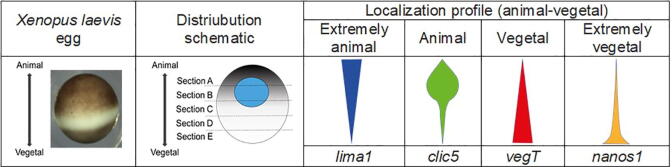
Schematic of the localization profile of selected mRNAs representing the four major profiles observed in Xenopus laevis egg.
Fig. 2
Fig. 2
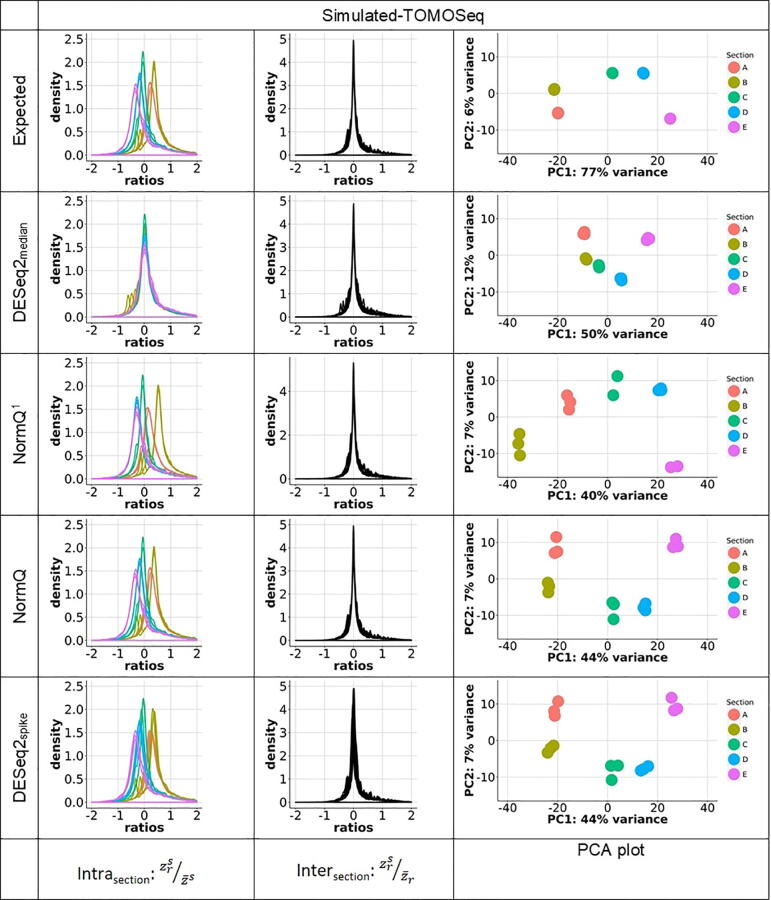
degCheckFactor analysis of the proportion of the normalized counts for each gene relative to its mean count across the different sections (intra-section) or all same sections (inter-section) from the Simulated-TOMOSeq data and the resulting Principle Component Analysis for the 5000 genes showing the most variance. Replicate number is represented as r, a given egg section as s and gene as z. Intra-section analysis shows how well the normalization technique maintains separation between the different sections, while the inter-section analysis shows how well the median-of-ratios method can normalize between replicates.
Fig. 3
Fig. 3
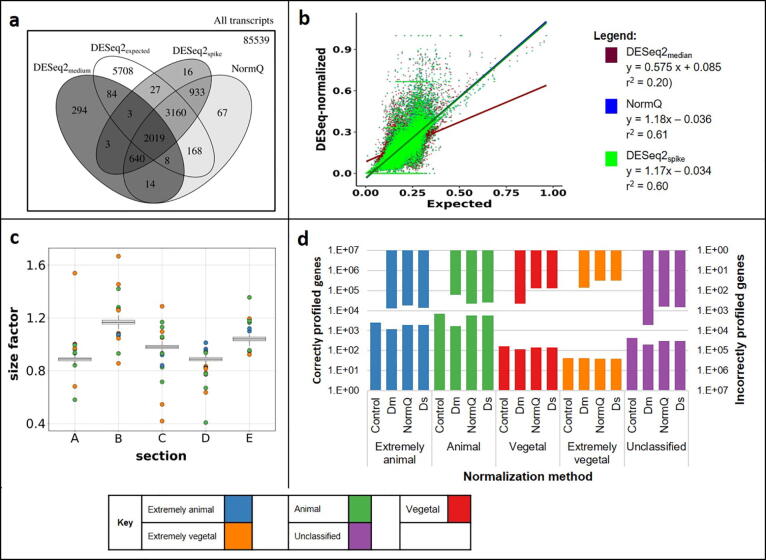
a) Differences in the number of significant (padj < 0.1) DEGs detected between sections when using different normalization techniques for the Simulated-TomoSeq. b) Correlation between each section’s gene count proportion (relative to the egg) for the normalized data, versus those from the expected proportions in the Simulated-TOMOSeq. c) Distribution of the size factors obtained from each marker gene for each replicate and section for the Simulated-TOMOSeq. d) Number of marker genes detected within each profile after use of each normalization method. The localization profile comparison for the Simulated-TOMOSeq was assessed using genes that were commonly detected in all three normalization methods. The bottom axis shows the number of genes that were correctly identified within the given profile while the top axis shows the number of genes that were incorrectly profiled. The y-axis represents the log(10) of the number of detected genes. “Dm” represents DESeq2median while Ds represents DESeq2spike.
Fig. 4
Fig. 4
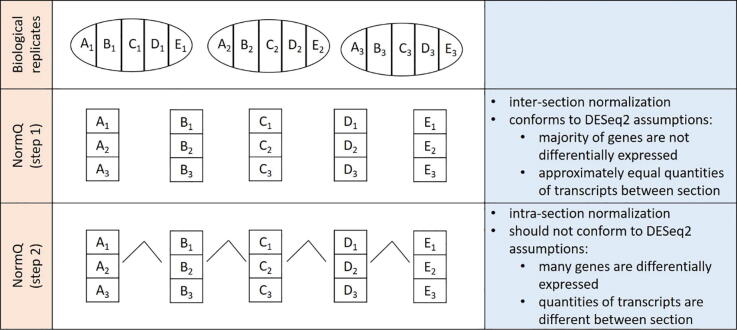
Schematic showing the normalization steps used for the NormQ method.

References

    1. Wang Z., Gerstein M., Snyder M. RNA-Seq: a revolutionary tool for transcriptomics. Nat Rev Genet. 2009;10:57–63. doi: 10.1038/nrg2484. - DOI - PMC - PubMed
    1. Evans C, Hardin J, Stoebel D. Selecting between-sample RNA-Seq normalization methods from the perspective of their assumptions 2016:1–32. https://doi.org/10.1093/bib/bbx008. - PMC - PubMed
    1. Bullard J.H., Purdom E., Hansen K.D., Dudoit S. Evaluation of statistical methods for normalization and differential expression in mRNA-Seq experiments evaluation of statistical methods for normalization and differential expression in mRNA-Seq experiments. UC Berkeley Div Biostat Pap Ser. 2009;11:94. doi: 10.1186/1471-2105-11-94. - DOI - PMC - PubMed
    1. Dillies M.A., Rau A., Aubert J., Hennequet-Antier C., Jeanmougin M., Servant N. A comprehensive evaluation of normalization methods for Illumina high-throughput RNA sequencing data analysis. Brief Bioinform. 2013;14:671–683. doi: 10.1093/bib/bbs046. - DOI - PubMed
    1. Jiang L., Schlesinger F., Davis C.A., Zhang Y., Li R., Salit M. Synthetic spike-in standards for RNA-seq experiments. Genome Res. 2011;21:1543–1551. doi: 10.1101/gr.121095.111. - DOI - PMC - PubMed