


Reflections, impact and recommendations of a co-produced qualitative study with young people who have experience of mental health difficulties
- PMID: 32515538
- PMCID: PMC8137486
- DOI: 10.1111/hex.13088
Reflections, impact and recommendations of a co-produced qualitative study with young people who have experience of mental health difficulties
Abstract
Background: There is limited evidence of genuine equal partnership where power is shared with young people with mental health difficulties throughout all research stages, particularly in data collection and analysis.
Objective: To describe how our qualitative study, exploring young peoples' perceptions on the feasibility of using technology to detect mental health deterioration, was co-produced using principles of co-production, whilst reflecting on impact, challenges and recommendations.
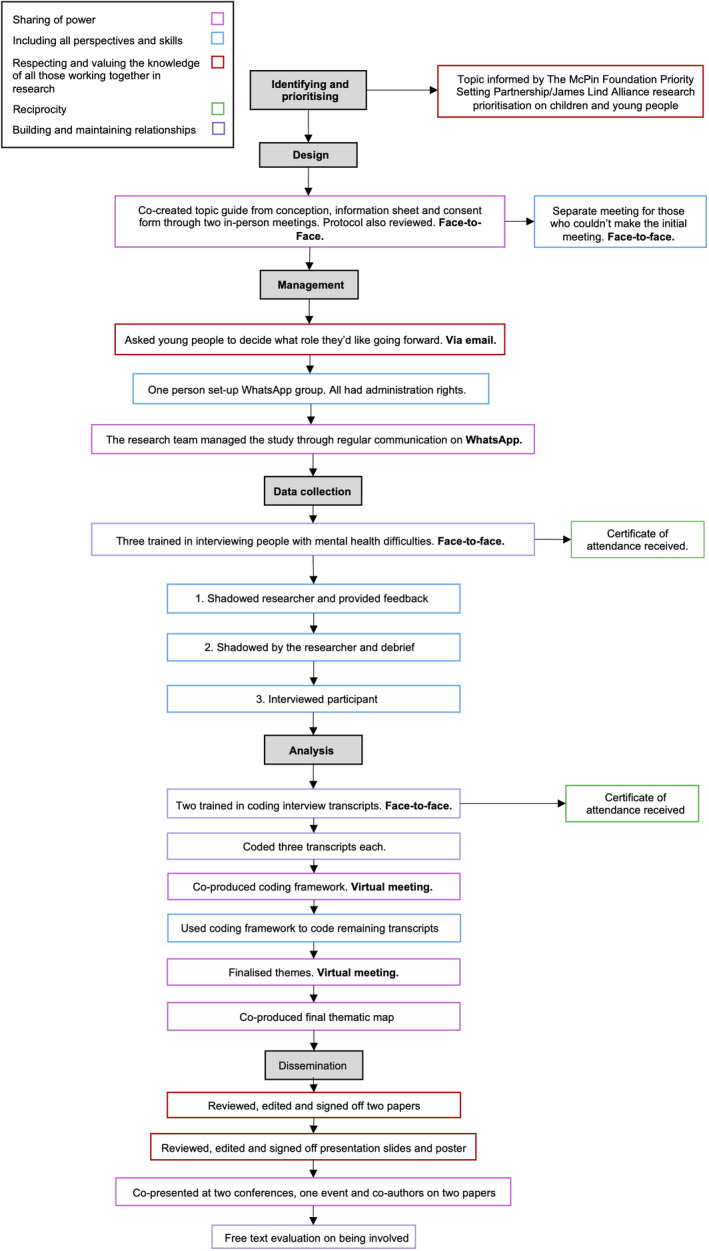
Methods: Young people with experience of mental health difficulties were appointed and then worked with researchers throughout all research stages. The study was evaluated against the five principles of co-production. Reflections from researchers and young people were collected throughout.
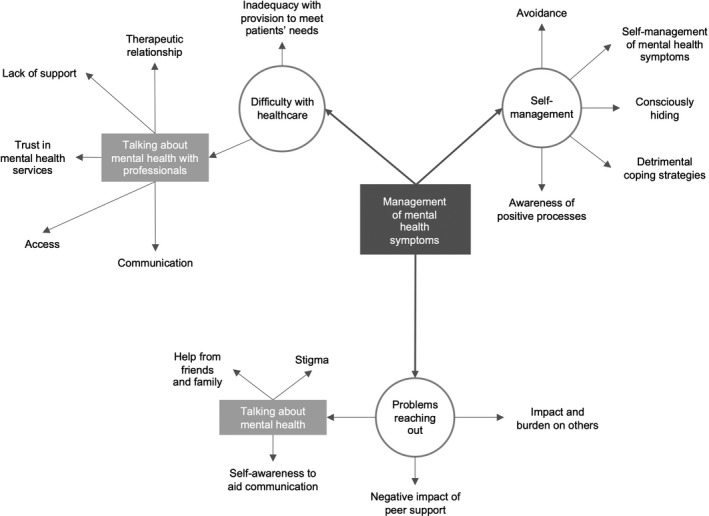
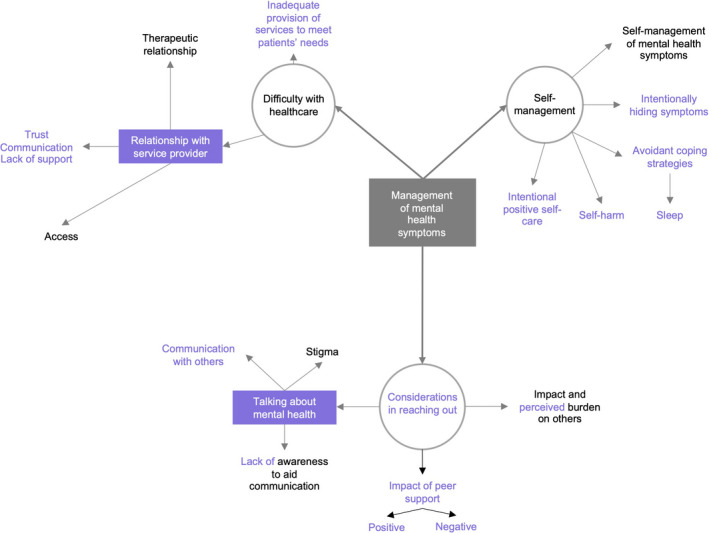
Results: Seven young people formed an initial Young People's Advisory Group (YPAG); three became co-researchers. Reflection was key throughout the process. Sharing power became easier and more evident as trust, confidence and mutual respect grew over time, particularly after a safe space was established. The safe space was crucial for open discussions, and our WhatsApp group enabled continual communication, support and shared decision-making. The resulting co-produced topic guide, coding framework, thematic map, papers and presentations demonstrated significant impact.
Conclusions: To our knowledge, this is the first qualitative mental health study to be co-produced using the principles of co-production. Our rigorous assessment can be utilized as an informative document to help others to produce meaningful co-produced future research. Although co-production takes time, it makes significant impact to the research, researchers and co-researchers. Flexible funding for spontaneous suggestions from co-researchers and more time for interview training is recommended.
Keywords: co-production; health research; mental health; patient and public involvement; technology; young people.
© 2020 The Authors Health Expectations published by John Wiley & Sons Ltd.
Conflict of interest statement
All authors have completed the Unified Competing Form and declare: no support from any organization for the submitted work; no financial relationships with any organizations that might have an interest in the submitted work in the previous three years; and no other relationships or activities that could appear to have influenced the submitted work.
Figures
References
-
- The BMJ . Reporting patient and public involvement in research. https://www.bmj.com/sites/default/files/attachments/resources/2018/03/PP.... Accessed January 10, 2019
-
- Richards T, Godlee F. The BMJ’s own patient journey. BMJ. 2014;348:g3726. - PubMed
-
- Richards T, Snow R, Schroter S. Logging the BMJ’s “patient journey”: Big changes, big challenges, much learning, and encouraging progress. BMJ. 2015;351:h4396. - PubMed
-
- National Institute for Health Research, Research Design Service (RDS) . Patient and Public Involvement in Health and Social Care Research: A Handbook for Researchers. London; 2014. https://www.rds-yh.nihr.ac.uk/wp-content/uploads/2015/01/RDS_PPI-Handboo.... Accessed September 9, 2019
Publication types
MeSH terms
LinkOut - more resources
Full Text Sources
Medical
