Review
. 2020 Jun 5;12(6):1473.
doi: 10.3390/cancers12061473.

BCMA-Targeting Therapy: Driving a New Era of Immunotherapy in Multiple Myeloma

Affiliations
Review

BCMA-Targeting Therapy: Driving a New Era of Immunotherapy in Multiple Myeloma

Shih-Feng Cho et al. Cancers (Basel). .

Abstract

The treatment of multiple myeloma (MM) has entered into a new era of immunotherapy. Novel immunotherapies will significantly improve patient outcome via simultaneously targeting malignant plasma cell (PC) and reversing immunocompromised bone marrow (BM) microenvironment. B-cell maturation antigen (BCMA), selectively expressed in PCs and a key receptor for A proliferation-inducing ligand (APRIL), is highly expressed in MM cells from patients at all stages. The APRIL/BCMA signal cascades promote the survival and drug resistance of MM cells and further modulate immunosuppressive BM milieu. Impressively, anti-BCMA immunotherapeutic reagents, including chimeric antigen receptor (CAR), antibody-drug conjugate (ADC) and bispecific T cell engager (BiTE) have all shown high response rates in their first clinical trials in relapse and refractory patients with very limited treatment options. These results rapidly inspired numerous development of next-generation anti-BCMA biotherapeutics, i.e., bispecific molecule, bispecific or trispecific antibodies, a novel form of CAR T/NK cells and T Cell Antigen Coupler (TAC) receptors, antibody-coupled T cell receptor (ACTR) as well as a cancer vaccine. We here highlight seminal preclinical and clinical studies on novel BCMA-based immunotherapies as effective monotherapy and discuss their potential in combination with current anti-MM and novel checkpoint drugs in earlier disease stages to further achieve durable responses in patients.

Keywords: ADC; ADCC; ADCP; B-cell maturation antigen; BCMA; BM; BiTE; CAR T; MM; MoAb; NK cell; T cell dependent cytotoxicity; TDCC; antibody drug conjugate; antibody-dependent cellular cytotoxicity; antibody-dependent cellular phagocytosis; bispecific T cell engager; bone marrow; chimeric antigen receptor T cell; monoclonal antibody; multiple myeloma; natural killer cell; signal transduction; targeted immunotherapy; tumor targeting; tumor-associated antigen.


Conflict of interest statement

K.C.A. serves on advisory boards Celgene, Millennium-Takeda, Bristol-Myers Squibb, Gilead Sciences, Janssen, and Sanofi-Aventis and is a Scientific founder of OncoPep and C4 Therapeutics. All other authors declare no competing financial interests. All other authors declare no conflict of interest.

Figures
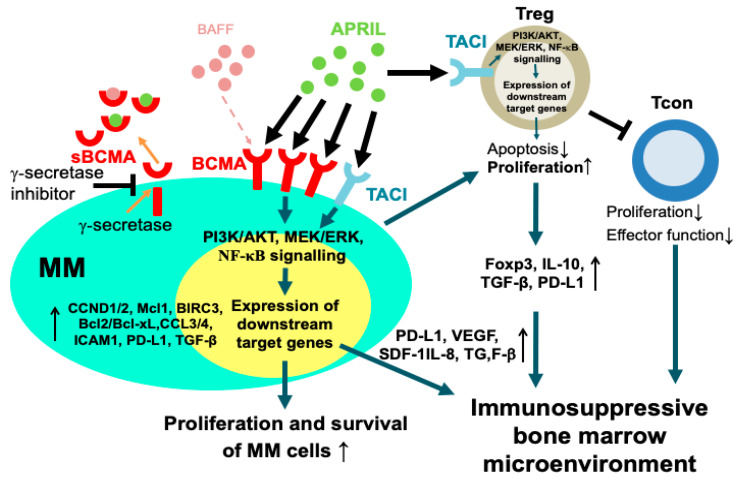
Figure 1
Figure 1
The A-proliferation inducing ligand/B cell maturation antigen (APRIL/BCMA) pathway and its biological effect in the multiple myeloma bone marrow microenvironment. APRIL is mainly secreted from macrophages and osteoclasts in the bone marrow (BM) microenvironment. It binds to BCMA with significantly higher affinity than B-cell activation factor (BAFF) to critically regulate multiple myeloma (MM) cell growth, survival, and drug resistance. BCMA is expressed at significantly higher levels than transmembrane activator and calcium modulator and cyclophilin ligand interactor (TACI) in MM cells to constitutively transmit tumor-promoting signaling. In addition to upregulate key cell cycle progression (i.e., CCND1/2), anti-apoptotic proteins (i.e., Mcl1, Bcl-2, Bcl-xL, BIRC3), osteoclast-promoting factors (i.e., CCL3/4, SDF-1), and adhesion molecules (i.e., ICAM-1, CD44), APRIL/BCMA signaling cascade further induces major immunosuppressive factors (i.e., IL-10, PD-L1, TGF-β, VEGF) in MM cells. BCMA on the cell membrane of MM cells is shed by γ-secretase and soluble BCMA (sBCMA) is detected in serum samples of MM patients. Inhibitors blocking cleavage by γ-secretase can reduce the generation of sBCMA. MM cells further stimulate proliferation of regulatory T cells (Treg) via cell–cell contact and cytokine factor-dependent mechanisms. Despite no BCMA expression, regulatory T cells (Treg) utilizes TACI to deliver APRIL signaling pathway while conventional T cells (Tcon) rarely express TACI when compared with Treg. The interaction of APRIL with TACI induces the expression of proliferation and survival genes as well as central immunosuppressive markers (Foxp3, IL-10, PD-L1, TGF-β) in Treg but not Tcon. This signaling pathway enhances the inhibitory effects of Treg on conventional T cells (Tcon), thereby decreasing the proliferation and function of Tcon. Significantly, these signaling pathways contribute to the pathophysiology of MM cells and MM-induced immune suppression in the BM microenvironment.
Figure 2
Figure 2
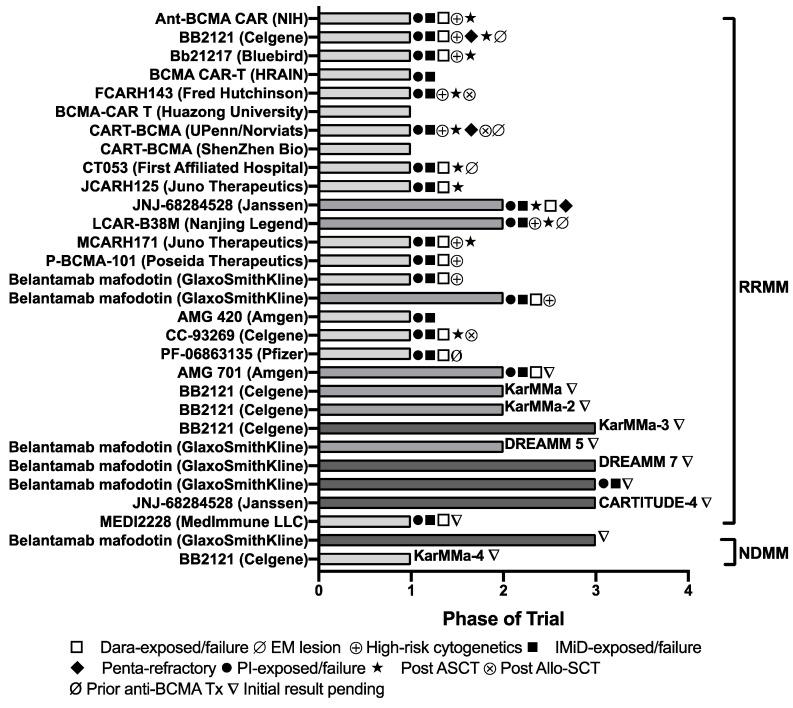
Immunotherapies targeting BCMA in clinical development. This figure shows various anti-BCMA agents in current clinical trials. The major enrollment criteria or characteristics of participants are also indicated. Every effort has been made to obtain reliable data from multiple sources including http://clinicaltrials.gov/, company, and other web sites, but accuracy cannot be fully guaranteed to date.
Figure 3
Figure 3
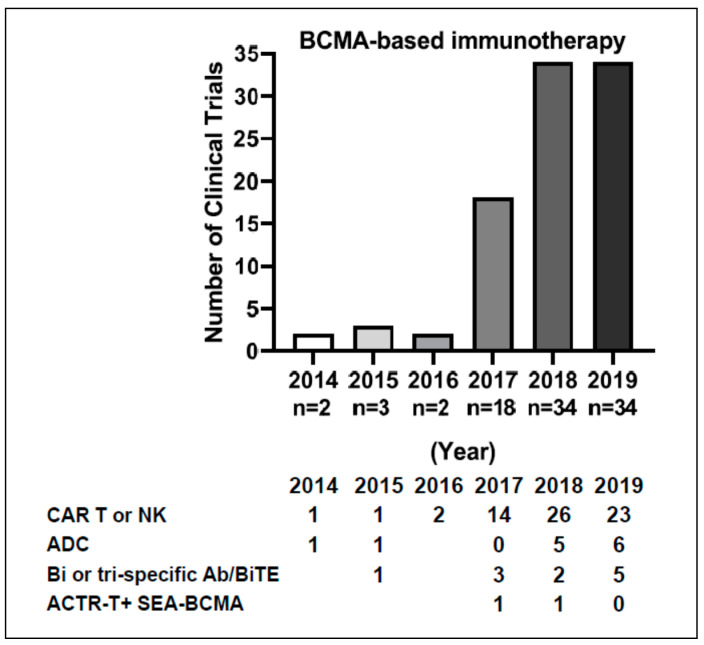
The annual number of clinical trials of BCMA-targeting immunotherapy in MM since 2014. The searching word is “myeloma”. The “Year” indicates the first post year of the trial on Clinicaltrial.gov. Shown below are the numbers of trials in various immunotherapeutic modalities each year. For example, there are 23 CAR T, 6 ADC, and 5 Bi/Tri-specific Ab/BiTE trials in 2019. Every effort has been made to obtain reliable data from multiple sources including http://clinicaltrials.gov/, company, and other web sites, but accuracy cannot be fully guaranteed to date.

References

    1. Palumbo A., Anderson K. Multiple myeloma. N. Engl. J. Med. 2011;364:1046–1060. doi: 10.1056/NEJMra1011442. - DOI - PubMed
    1. Lonial S., Dimopoulos M., Palumbo A., White D., Grosicki S., Spicka I., Walter-Croneck A., Moreau P., Mateos M.V., Magen H., et al. Elotuzumab Therapy for Relapsed or Refractory Multiple Myeloma. N. Engl. J. Med. 2015;373:621–631. doi: 10.1056/NEJMoa1505654. - DOI - PubMed
    1. Tai Y.T., Anderson K.C. A new era of immune therapy in multiple myeloma. Blood. 2016;128:318–319. doi: 10.1182/blood-2016-06-719856. - DOI - PubMed
    1. Palumbo A., Chanan-Khan A., Weisel K., Nooka A.K., Masszi T., Beksac M., Spicka I., Hungria V., Munder M., Mateos M.V., et al. Daratumumab, bortezomib, and dexamethasone for multiple myeloma. N. Engl. J. Med. 2016;375:754–766. doi: 10.1056/NEJMoa1606038. - DOI - PubMed
    1. Mateos M.V., Dimopoulos M.A., Cavo M., Suzuki K., Jakubowiak A., Knop S., Doyen C., Lucio P., Nagy Z., Kaplan P., et al. Daratumumab plus bortezomib, melphalan, and prednisone for untreated myeloma. N. Engl. J. Med. 2018;378:518–528. doi: 10.1056/NEJMoa1714678. - DOI - PubMed