. 2020 Jun 5;12(6):1690.
doi: 10.3390/nu12061690.

Allithiamine Alleviates Hyperglycaemia-Induced Endothelial Dysfunction

Affiliations

Allithiamine Alleviates Hyperglycaemia-Induced Endothelial Dysfunction

Attila Biró et al. Nutrients. .

Abstract

Diabetes mellitus-related morbidity and mortality is a rapidly growing healthcare problem, globally. Several nutraceuticals exhibit potency to target the pathogenesis of diabetes mellitus. The antidiabetic effects of compounds of garlic have been extensively studied, however, limited data are available on the biological effects of a certain garlic component, allithiamine. In this study, allithiamine was tested using human umbilical cord vein endothelial cells (HUVECs) as a hyperglycaemic model. HUVECs were isolated by enzymatic digestion and characterized by flow cytometric analysis using antibodies against specific marker proteins including CD31, CD45, CD54, and CD106. The non-cytotoxic concentration of allithiamine was determined based on MTT, apoptosis, and necrosis assays. Subsequently, cells were divided into three groups: incubating with M199 medium as the control; or with 30 mMol/L glucose; or with 30 mMol/L glucose plus allithiamine. The effect of allithiamine on the levels of advanced glycation end-products (AGEs), activation of NF-κB, release of pro-inflammatory cytokines including IL-6, IL-8, and TNF-α, and H2O2-induced oxidative stress was investigated. We found that in the hyperglycaemia-induced increase in the level of AGEs, pro-inflammatory changes were significantly suppressed by allithiamine. However, allithiamine could not enhance the activity of transketolase, but it exerts a potent antioxidant effect. Collectively, our data suggest that allithiamine could alleviate the hyperglycaemia-induced endothelial dysfunction due to its potent antioxidant and anti-inflammatory effect by a mechanism unrelated to the transketolase activity.

Keywords: advanced glycation end-products; allithiamine; cytokines; garlic; hyperglycaemia.


Conflict of interest statement

The authors declare no conflicts of interest.

Figures
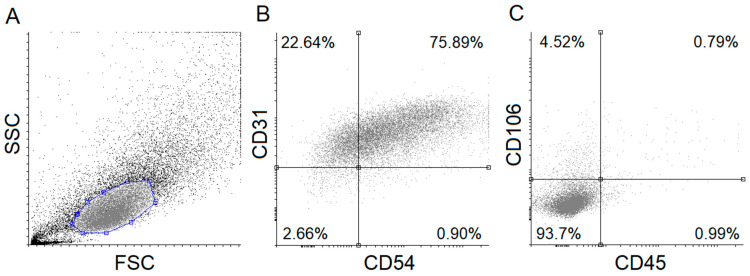
Figure 1
Figure 1
Flow cytometric analysis of human umbilical cord vein endothelial cells (HUVECs). Isolated HUVECs were verified using specific fluorescent-labeled antibodies. Forward- and side-scatter plot and dot-plots (A) of HUVEC positive (CD54, CD31) (B) and negative (CD45, CD106) (C) markers are shown. FSC: Forward scatter, SSC: Side scatter.
Figure 2
Figure 2
Viability of HUVECs was examined after 24 (A), 48 (B), or 72 (C) h. Results are expressed in the percentage of the control (0 μg/mL allithiamine). Data are expressed as the mean ± SEM of three individual experiments. Two additional experiments yielded similar results. *, ***, and **** mark significant (p < 0.05, 0.0005, and 0.0001, respectively) differences compared with control.
Figure 3
Figure 3
Fluorescent DilC1(5) and SYTOX Green labeling. Effect of allithiamine on apoptosis and necrosis after 24 (A), 48 (B), or 72 (C) h. Results (intensity of fluorescence) are expressed in the percentage of the control (0 μg/mL allithiamine; 100% is represented by the solid lines). Apoptosis is indicated by a decrease in fluorescence of DilC1(5), and necrosis is indicated by an increase in fluorescence of SYTOX Green. Data are expressed as the mean ± SEM of three individual experiments. Two additional experiments yielded similar results. **** and #### mark significant (p < 0.0001 in both cases) differences compared with the control group (0 μg/mL allithiamine). CCCP: carbonyl cyanide m-chlorophenyl hydrazone (positive control for apoptosis); LB: lysis buffer (positive control for necrosis). SYTOX Green: non-permeable fluorescent nucleic acid dye; DilC1(5): 1,1′,3,3,3′,3′-hexamethylindodicarbocyanin iodide dye.
Figure 4
Figure 4
Effect of allithiamine on level of advanced glycation end-products (AGEs) in HUVECs after one day and one week. Data are expressed as the mean ± SEM of three individual experiments. **** marks a significant (p < 0.0001) difference between the control and HG, and between HG and HG+5 μg/mL allithiamine after one week. n.s.: not significant. HG: hyperglycaemia (30 mMol/L glucose).
Figure 5
Figure 5
Effect of allithiamine on the activation of NF-κB in HUVECs after 6 and 12 h. Data are expressed as the mean ± SEM of three individual experiments *, **, and *** mark significant (p < 0.05, p < 0.005, and p < 0.0005) differences between the control and HG, and between HG and HG+5 μg/mL allithiamine, HG: hyperglycaemia (30 mMol/L glucose).
Figure 6
Figure 6
Effect of allithiamine on the level of pro-inflammatory cytokines including IL-6 (A), IL-8 (B), and TNF-α (C) in HUVECs after 6, 12, and 24 h. Data are expressed as the mean ± SEM of three individual experiments *, **, ***, and **** mark significant (p < 0.05, p < 0.005, p < 0.0005, and p < 0.0001) differences between the control and HG, between HG and HG+5 μg/mL allithiamine, and between control and HG+5 μg/mL allithiamine. HG: hyperglycaemia (30 mMol/L glucose).
Figure 7
Figure 7
Effect of allithiamine on the transketolase activity in HUVECs after 6 h of incubation. Data are expressed as the mean ± SEM of three individual experiments. Two additional experiments yielded similar results. ** marks a significant (p < 0.005) difference between the control and HG+20 μg/mL benfotiamin. HG: hyperglycaemia (30 mMol/L glucose).
Figure 8
Figure 8
Antioxidative effect of allithiamine in HUVECs incubated with or without 100 μMol/L H2O2. Fluorescent intensity was normalized to the baseline (A). H2O2 was administrated as indicated by the arrow. Statistical analysis was performed at the peak fluorescence (F/F0) values (B). Data are expressed as the mean ± SEM of three individual experiments. Two additional experiments yielded similar results. **** marks a significant (p < 0.0001) difference between the control and H2O2, and between H2O2 and H2O2+5 μg/mL allithiamine. H2O2: hydrogen-peroxide. – indicates the absence of treatment substance; + indicates the presence of treatment substance.

References

    1. Dias D.A., Urban S., Roessner U. A historical overview of natural products in drug discovery. Metabolites. 2012;2:303–336. doi: 10.3390/metabo2020303. - DOI - PMC - PubMed
    1. Thomford N.E., Senthebane D.A., Rowe A., Munro D., Seele P., Maroyi A., Dzobo K. Natural Products for Drug Discovery in the 21st Century: Innovations for Novel Drug Discovery. Int. J. Mol. Sci. 2018;19:1578. doi: 10.3390/ijms19061578. - DOI - PMC - PubMed
    1. Bayan L., Koulivand P.H., Gorji A. Garlic: A review of potential therapeutic effects. Avicenna J. Phytomed. 2014;4:1–14. - PMC - PubMed
    1. Jang H.-J., Lee H.-J., Yoon D.-K., Ji D.-S., Kim J.-H., Lee C.-H. Antioxidant and antimicrobial activities of fresh garlic and aged garlic by-products extracted with different solvents. Food Sci. Biotechnol. 2017;27:219–225. doi: 10.1007/s10068-017-0246-4. - DOI - PMC - PubMed
    1. Arreola R., Quintero-Fabián S., López-Roa R.I., Flores-Gutiérrez E.O., Reyes-Grajeda J.P., Carrera-Quintanar L., Ortuño-Sahagún D. Immunomodulation and anti-inflammatory effects of garlic compounds. J. Immunol. Res. 2015;2015:401630. doi: 10.1155/2015/401630. - DOI - PMC - PubMed

MeSH terms
