Sounds of sickness: can people identify infectious disease using sounds of coughs and sneezes?
- PMID: 32517611
- PMCID: PMC7341931
- DOI: 10.1098/rspb.2020.0944
Sounds of sickness: can people identify infectious disease using sounds of coughs and sneezes?
Abstract
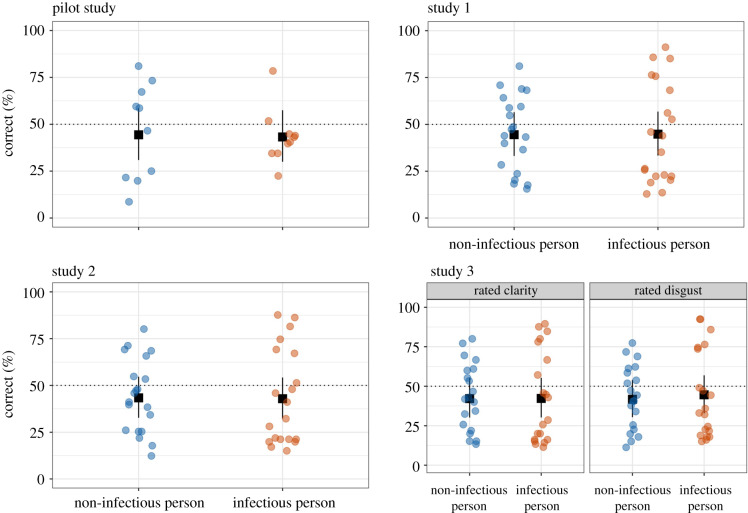
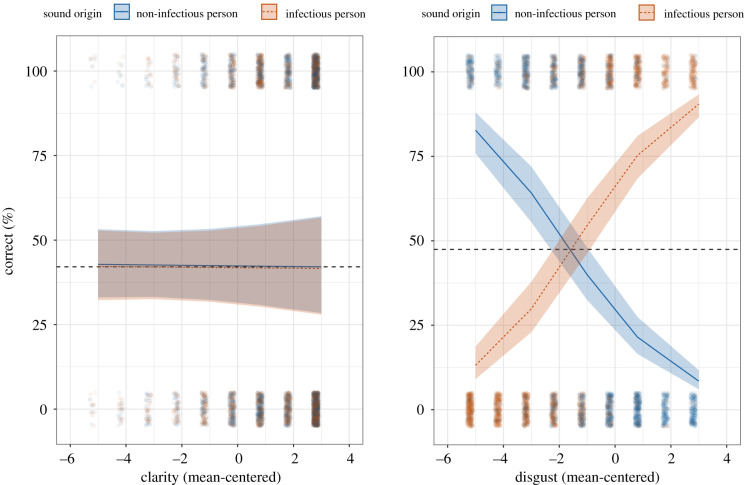
Cough, cough. Is that person sick, or do they just have a throat tickle? A growing body of research suggests pathogen threats shape key aspects of human sociality. However, less research has investigated specific processes involved in pathogen threat detection. Here, we examine whether perceivers can accurately detect pathogen threats using an understudied sensory modality-sound. Participants in four studies judged whether cough and sneeze sounds were produced by people infected with a communicable disease or not. We found no evidence that participants could accurately identify the origins of these sounds. Instead, the more disgusting they perceived a sound to be, the more likely they were to judge that it came from an infected person (regardless of whether it did). Thus, unlike research indicating perceivers can accurately diagnose infection using other sensory modalities (e.g. sight, smell), we find people overperceive pathogen threat in subjectively disgusting sounds.
Keywords: accuracy; auditory perception; behavioural immune system; evolutionary psychology; pathogen detection.
Conflict of interest statement
We declare we have no competing interests.
Figures
Similar articles
-
Coughs and sneezes spread diseases: an empirical study of absenteeism and infectious illness.J Health Econ. 2009 Sep;28(5):1012-7. doi: 10.1016/j.jhealeco.2009.06.006. Epub 2009 Jun 16. J Health Econ. 2009. PMID: 19619909
-
Distinction of cough from other sounds produced by daily activities in the upper airways.Bratisl Lek Listy. 2011;112(3):120-4. Bratisl Lek Listy. 2011. PMID: 21452762
-
Categorical representation from sound and sight in the ventral occipito-temporal cortex of sighted and blind.Elife. 2020 Feb 28;9:e50732. doi: 10.7554/eLife.50732. Elife. 2020. PMID: 32108572 Free PMC article.
-
The effect of looming and receding sounds on the perceived in-depth orientation of depth-ambiguous biological motion figures.PLoS One. 2011 Feb 23;6(2):e14725. doi: 10.1371/journal.pone.0014725. PLoS One. 2011. PMID: 21373181 Free PMC article. Clinical Trial.
-
Representation of temporal sound features in the human auditory cortex.Rev Neurosci. 2011;22(2):187-203. doi: 10.1515/RNS.2011.016. Rev Neurosci. 2011. PMID: 21476940 Review.
Cited by
-
Immunoactivation Affects Perceived Body Odor and Facial but Not Vocal Attractiveness.Evol Psychol. 2023 Oct-Dec;21(4):14747049231218010. doi: 10.1177/14747049231218010. Evol Psychol. 2023. PMID: 38087426 Free PMC article.
-
Brain spatial reconciliation through multisensory integration in the impact of pandemic fatigue on workplace.Front Hum Neurosci. 2024 Dec 6;18:1419889. doi: 10.3389/fnhum.2024.1419889. eCollection 2024. Front Hum Neurosci. 2024. PMID: 39713173 Free PMC article.
-
Sorry, I am sneezing and coughing but I do not have COVID-19.Brain Behav Immun. 2022 Mar;101:57-58. doi: 10.1016/j.bbi.2021.12.018. Epub 2021 Dec 27. Brain Behav Immun. 2022. PMID: 34968716 Free PMC article. Review. No abstract available.
-
Assessment of cough in head and neck cancer patients at risk for dysphagia-An overview.Cancer Rep (Hoboken). 2021 Oct;4(5):e1395. doi: 10.1002/cnr2.1395. Epub 2021 May 1. Cancer Rep (Hoboken). 2021. PMID: 33932152 Free PMC article. Review.
-
Emerging infectious disease and the challenges of social distancing in human and non-human animals.Proc Biol Sci. 2020 Aug 12;287(1932):20201039. doi: 10.1098/rspb.2020.1039. Epub 2020 Aug 12. Proc Biol Sci. 2020. PMID: 32781952 Free PMC article. Review.
References
-
- World Health Organization. 2018. Global health estimates 2016: deaths by cause, age, sex, by country and by region, 2000–2016. See https://www.who.int/healthinfo/global_burden_disease/GHE2016_DALYs-2016-....
-
- Ackerman JM, Hill SE, Murray DR. 2018. The behavioral immune system: current concerns and future directions. Soc. Pers. Psychol. Compass 12, e12371 (10.1111/spc3.12371) - DOI
-
- Schaller M, Park JH. 2011. The behavioral immune system (and why it matters). Curr. Dir. Psychol. Sci. 20, 99–103. (10.1177/0963721411402596) - DOI
MeSH terms
LinkOut - more resources
Full Text Sources
Medical