Randomized Controlled Trial
. 2020 Aug 1;77(8):787-796.
doi: 10.1001/jamapsychiatry.2020.0927.

Association of Naturalistic Administration of Cannabis Flower and Concentrates With Intoxication and Impairment

Affiliations
Randomized Controlled Trial

Association of Naturalistic Administration of Cannabis Flower and Concentrates With Intoxication and Impairment

L Cinnamon Bidwell et al. JAMA Psychiatry. .

Abstract

Importance: The rapidly growing legal cannabis market includes new and highly potent products, the effects of which, to our knowledge, have not previously been examined in biobehavioral research studies because of federal restrictions on cannabis research.

Objective: To use federally compatible, observational methods to study high-∆9-tetrahydrocannabinol (THC) legal market forms of cannabis.

Design, setting, and participants: In this cohort study with a between-groups design that was conducted in a community and university setting, cannabis flower users and concentrate users were randomly assigned to higher- vs lower-THC products within user groups. Participants completed a baseline and an experimental mobile laboratory assessment that included 3 points: before, immediately after, and 1 hour after ad libitum legal market flower and concentrate use. Of the 133 individuals enrolled and assessed, 55 regular flower cannabis users (41.4%) and 66 regular concentrate cannabis users (49.6%) complied with the study's cannabis use instructions and had complete data across primary outcomes.

Exposures: Flower users were randomly assigned to use either 16% or 24% THC flower and concentrate users were randomly assigned to use either 70% or 90% THC concentrate that they purchased from a dispensary.

Main outcomes and measures: Primary outcome measures included plasma cannabinoids, subjective drug intoxication, and neurobehavioral tasks testing attention, memory, inhibitory control, and balance.

Results: A total of 121 participants completed the study for analysis: 55 flower users (mean [SD] age, 28.8 [8.1] years; 25 women [46%]) and 66 concentrate users (mean [SD] age, 28.3 [10.4] years; 30 women [45%]). Concentrate users compared with flower users exhibited higher plasma THC levels and 11-hydroxyΔ9-THC (THC's active metabolite) across all points. After ad libitum cannabis administration, mean plasma THC levels were 0.32 (SE = 0.43) μg/mL in concentrate users (to convert to millimoles per liter, multiply by 3.18) and 0.14 (SE = 0.16) μg/mL in flower users. Most neurobehavioral measures were not altered by short-term cannabis consumption. However, delayed verbal memory (F1,203 = 32.31; P < .001) and balance function (F1,203 = 18.88; P < .001) were impaired after use. Differing outcomes for the type of product (flower vs concentrate) or potency within products were not observed.

Conclusions and relevance: This study provides information about the association of pharmacological and neurobehavioral outcomes with legal market cannabis. Short-term use of concentrates was associated with higher levels of THC exposure. Across forms of cannabis and potencies, users' domains of verbal memory and proprioception-focused postural stability were primarily associated with THC administration.


Conflict of interest statement

Conflict of Interest Disclosures: Dr Bidwell reported grants from the National Institutes of Health (NIH)/National Institute on Drug Abuse and the State of Colorado Department of Public Health and Environment during the conduct of the study. Dr Ellingson reported grants from the NIH during the conduct of the study. Dr Klawitter reported grants from the Colorado Department of Public Health and Environment and NIH during the conduct of the study. Dr Sempio reported grants from the Colorado Department of Public Health and Environment and the NIH during the conduct of the study. Dr Bryan reported grants from the NIH and State of Colorado during the conduct of the study. No other disclosures were reported.

Figures

Figure 1.
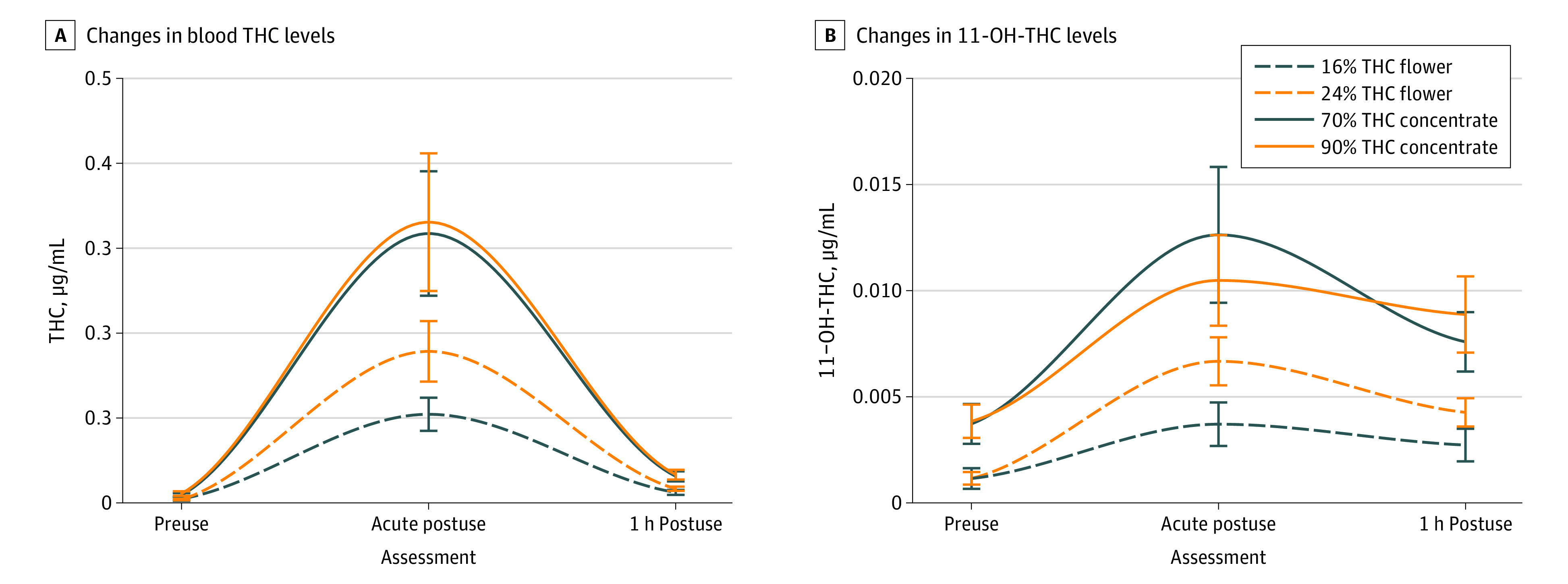
Figure 1.. Blood Levels by Cannabis Form and Potency During Acute Mobile Laboratory Session
A, Changes in blood tetrahydrocannabinol (THC) (μg/mL [to convert to micromoles per liter, multiply by 3.18]) (A) and blood THC metabolite 11-Hydroxy-Δ9-THC (11-OH-THC) levels (μg/mL) (B) before cannabis use (preuse), immediately after cannabis use (acute postuse), and 1 hour postuse. A. Baseline median = 0.003; range = 0.0 to 0.05. B, Baseline median = 0.001; range = 0.0 to 0.03. For form, dashed lines indicate flower groups (16%, 24%) and solid lines indicate concentrate groups (70%, 90%). For potency, blue lines indicate lower potency within each form (16% flower, 70% concentrate) and orange lines indicate higher potency (24% flower, 90% concentrate). Across both forms of cannabis, THC and 11-OH-THC were acutely elevated after cannabis administration. The concentrates group had higher levels of the 2 cannabinoids across all assessments, as well as a stronger quadratic effect for THC (ie, a higher relative peak at the acute assessment).
Figure 2.
Figure 2.. Subjective Drug Effects After Use of Cannabis by Cannabis Form and Potency During Acute Mobile Laboratory Session
Changes in the Addiction Research Center Inventory (ARCI) marijuana scale (A), self-reported intoxication (average of feeling high, mentally stoned, and physically stoned) (B), self-reported tension (Profile of Mood States [POMS] tension subscale) (C), and self-reported positive mood (POMS vigor subscale) (D) before cannabis use (preuse), immediately after cannabis use (acute postuse), and 1-hour postuse. B, Baseline median, 0; range, 0 to 2. C, Baseline median, 0; range, 0 to 2. D, Baseline median, 1; range, 0 to 4. The ARCI assessed the endorsement rate of 12 subjective effects of cannabis (ie, range 0-1) (A). All scales had a range of 0 to 4 (B-D). For form, dashed lines indicate flower groups (16%, 24%) and solid lines indicate concentrate groups (70%, 90%). For potency, blue lines indicate lower potency within each form (16% flower, 70% concentrate) and orange lines indicate higher potency (24% flower, 90% concentrate). The effect of cannabis use assessed by all 4 measures peaked immediately after use and was generally sustained 1 hour postuse, indicated by significant effects of quadratic change. Additionally, the flower group reported higher levels of tension and vigor across all assessments, indicated by a main effect of form (flower vs concentrates). THC indicates tetrahydrocannabinol.
Figure 3.
Figure 3.. Cognitive and Motor Function After Use of Cannabis by Cannabis Form and Potency During Acute Mobile Laboratory Session
A, Number of verbal recall errors on the International Shopping List Task (A) and balance task performance with eyes closed (B) immediately before cannabis use (preuse), immediately after cannabis use (acute postuse), and 1 hour postuse. A, Baseline median = 0; range = 0 to 11. B, Baseline median = 0.6; range = 0.3 to 1.3. For form, dashed lines indicate flower groups (16%, 24%) and solid lines indicate concentrate groups (70%, 90%). For potency, blue lines indicate lower potency within each form (16% flower, 70% concentrate) and orange lines indicate higher potency (24% flower, 90% concentrate). The number of errors on the delayed verbal recall task increased in the flower and concentrate groups over time. There was a marginal effect suggesting that acute cannabis impairment was more pronounced in the flower group, which performed worse than the concentrates group on the delayed verbal recall task. During the eyes closed balance task, there was a quadratic effect of time with balance, with sway increasing acutely after use and then decreasing back to original levels 1 hour after use. There were no balance differences observed between the concentrate and flower groups. THC indicates tetrahydrocannabinol.

References

    1. Vergara D, Bidwell LC, Gaudino R, et al. . Compromised external validity: federally produced cannabis does not reflect legal markets. Sci Rep. 2017;7(March):46528. doi:10.1038/srep46528 - DOI - PMC - PubMed
    1. Orens A, Light M, Lewandowski B, Rowberry J, Saloga C 2017 market update. Accessed August 20, 2018. https://www.colorado.gov/pacific/sites/default/files/MED%20Demand%20and%...

    1. Stogner JM, Miller BL. Assessing the dangers of “dabbing”: mere marijuana or harmful new trend? Pediatrics. 2015;136(1):1-3. doi:10.1542/peds.2015-0454 - DOI - PubMed
    1. Daniulaityte R, Lamy FR, Barratt M, et al. . Characterizing marijuana concentrate users: a web-based survey. Drug Alcohol Depend. 2017;178:399-407. doi:10.1016/j.drugalcdep.2017.05.034 - DOI - PMC - PubMed
    1. Raber JC, Elzinga S, Kaplan C. Understanding dabs: contamination concerns of cannabis concentrates and cannabinoid transfer during the act of dabbing. J Toxicol Sci. 2015;40(6):797-803. doi:10.2131/jts.40.797 - DOI - PubMed

Publication types

MeSH terms