


How can airborne transmission of COVID-19 indoors be minimised?
- PMID: 32521345
- PMCID: PMC7250761
- DOI: 10.1016/j.envint.2020.105832
How can airborne transmission of COVID-19 indoors be minimised?
Abstract
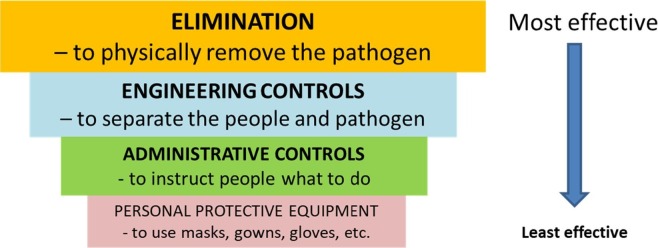
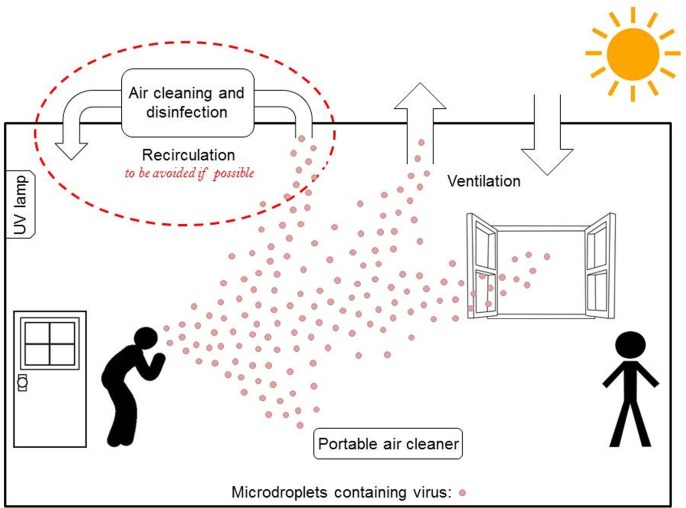
During the rapid rise in COVID-19 illnesses and deaths globally, and notwithstanding recommended precautions, questions are voiced about routes of transmission for this pandemic disease. Inhaling small airborne droplets is probable as a third route of infection, in addition to more widely recognized transmission via larger respiratory droplets and direct contact with infected people or contaminated surfaces. While uncertainties remain regarding the relative contributions of the different transmission pathways, we argue that existing evidence is sufficiently strong to warrant engineering controls targeting airborne transmission as part of an overall strategy to limit infection risk indoors. Appropriate building engineering controls include sufficient and effective ventilation, possibly enhanced by particle filtration and air disinfection, avoiding air recirculation and avoiding overcrowding. Often, such measures can be easily implemented and without much cost, but if only they are recognised as significant in contributing to infection control goals. We believe that the use of engineering controls in public buildings, including hospitals, shops, offices, schools, kindergartens, libraries, restaurants, cruise ships, elevators, conference rooms or public transport, in parallel with effective application of other controls (including isolation and quarantine, social distancing and hand hygiene), would be an additional important measure globally to reduce the likelihood of transmission and thereby protect healthcare workers, patients and the general public.
Copyright © 2020 The Author(s). Published by Elsevier Ltd.. All rights reserved.
Conflict of interest statement
Declaration of Competing Interest The authors declare that they have no known competing financial interests or personal relationships that could have appeared to influence the work reported in this paper.
Figures
References
-
- Ai Z., Hashimoto K., Melikov A.K. Airborne transmission between room occupants during short-term events: Measurement and evaluation. Indoor Air. 2019;29:563–576. - PubMed
-
- AIVC . Air Infiltration and Ventilation Centre; Brussels: 1996. A Guide to Energy Efficient Ventilation.
-
- ASHRAE, 2017. ASHRAE Standard 52.2‐2017 Method of testing general ventilation air‐cleaning devices for removal efficiency by particle size.
-
- ASHRAE, 2020a. COVID-19 (CORONAVIRUS) PREPAREDNESS RESOURCES. American Society of Heating, Ventilating, and Air-Conditioning Engineers.
-
- ASHRAE, 2020b. Position Document on Airborne Infectious Diseases, Approved by the Board of Directors, January 19, 2014. Reaffirmed y the Technology Council, February 5, 2020. Atlanta, Georgia.
Publication types
MeSH terms
Substances
LinkOut - more resources
Full Text Sources
Other Literature Sources
