Review
. 2020 Jun 8;9(6):1777.
doi: 10.3390/jcm9061777.

Pathogenesis and Clinical Management of Mesenteric Fibrosis in Small Intestinal Neuroendocine Neoplasms: A Systematic Review

Affiliations
Review

Pathogenesis and Clinical Management of Mesenteric Fibrosis in Small Intestinal Neuroendocine Neoplasms: A Systematic Review

Anna Koumarianou et al. J Clin Med. .

Abstract

Mesenteric fibrosis (MF) constitutes an underrecognized sequela in patients with small intestinal neuroendocrine neoplasms (SI-NENs), often complicating the disease clinical course. The aim of the present systematic review, carried out by Preferred Reporting Items for Systematic Reviews and Meta-Analyses (PRISMA) methodology, is to provide an update in evolving aspects of MF pathogenesis and its clinical management in SI-NENs. Complex and dynamic interactions are present in the microenvironment of tumor deposits in the mesentery. Serotonin, as well as the signaling pathways of certain growth factors play a pivotal, yet not fully elucidated role in the pathogenesis of MF. Clinically, MF often results in significant morbidity by causing either acute complications, such as intestinal obstruction and/or acute ischemia or more chronic conditions involving abdominal pain, venous stasis, malabsorption and malnutrition. Surgical resection in patients with locoregional disease only or symptomatic distant stage disease, as well as palliative minimally invasive interventions in advanced inoperable cases seem clinically meaningful, whereas currently available systemic and/or targeted treatments do not unequivocally affect the development of MF in SI-NENs. Increased awareness and improved understanding of the molecular pathogenesis of MF in SI-NENs may provide better diagnostic and predictive tools for its timely recognition and intervention and also facilitates the development of agents targeting MF.

Keywords: CTGF; FGF; PDGF; TGF; VEGF; mesenteric fibrosis; neuroendocrine tumors; serotonin; small intestine.


Conflict of interest statement

The authors declare that there is no conflict of interest. The funder had no role in the design of the study; in the collection, analyses, or interpretation of data; in the writing of the manuscript, or in the decision to publish the results.

Figures
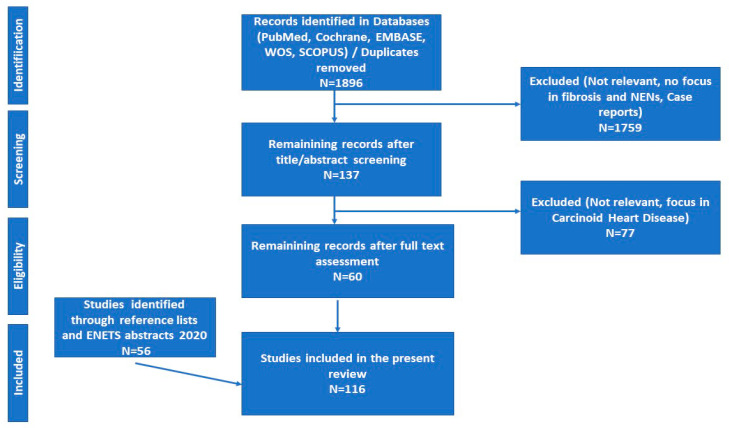
Figure 1
Figure 1
Preferred Reporting Items for Systematic Reviews and Meta-Analyses (PRISMA) flow diagram of study selection. Abbreviations: ENETS; European Neuroendocrine Tumor Society; NENs: Neuroendocrine Neoplasms.
Figure 2
Figure 2
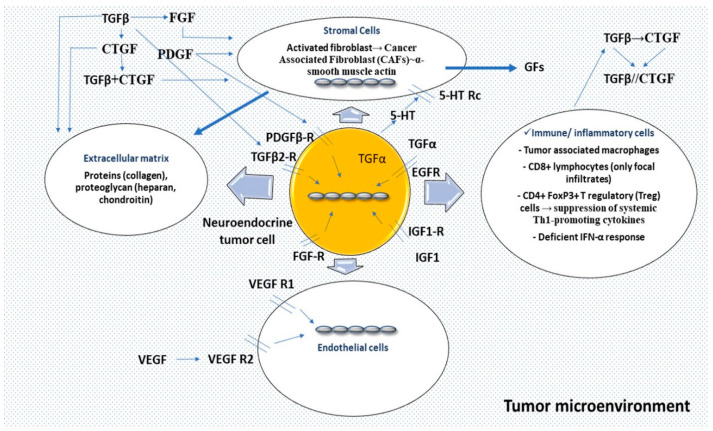
Tumor microenvironment represents an important functional unit comprising a cluster of endothelial and inflammatory cells, and mesenchymal stroma elements with fibroblasts interconnected and interacting. An initial event, an injury, induces fragmentation of extracellular matrix elements, chemo-attractant molecules with recruitment of immune cells acting as a pro-tumorigenic environment, followed by pro-angiogenic elements. In specific circumstances, serotonin (5-HT) via a receptor (5-HT Rc) may be mitogenic in stroma cells acting through a TGFβ-mediated mechanism or potentiating the effects of PDGF, β-FGF, or EGF and insulin. TGF-β represents a pro-fibrotic mediator; TGFβ1 and the receptor subtype-2 (TGFβr2) have been identified in SI-NEN. CTGF is transcriptionally activated principally through TGFβ1, acting as a downstream mediator of its profibrotic activities on fibroblasts; PDGF, EGF and FGF are also activating CTGF gene expression at the transcriptional level. PDGF is a mitogen for the fibroblasts and the smooth muscle cells. Infiltration of immune cells is not high in SI-NENS, but tumor-associated macrophages suppress the adaptive immune system and stimulate fibrosis by secretion of profibrotic factors such as TGFβ. Abbreviations: 5-HT: 5-hydroxytryptamine; 5-HT Rc: 5-hydroxytryptamine receptor; TGFβ: transforming growth factor-β; PDGF: platelet-derived growth factor; β-FGF: β-fibroblast growth factor; EGF: Epidermal growth factor; TGFβr2: transforming growth factor-β receptor subtype-2; CTGF: connective tissue growth factor; CAF: cancer-associated fibroblast; GFs: growth factors; IGF-1: insulin growth factor type 1; VEGF: vascular endothelial growth factor; VEGF R: vascular endothelial growth factor receptor; CD8: cluster of differentiation 8; CD4: cluster of differentiation 4; FoxP3: forkhead box P3; Th1: T helper type 1; IFN-α: Interferon alpha.
Figure 3
Figure 3
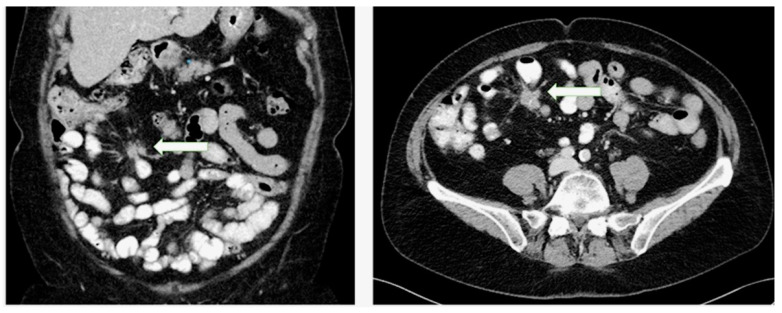
Presence of mesenteric fibrosis in a patient with a small intestinal neuroendocrine tumor as an enhancing soft-tissue mass with fibrotic bands radiating outward in the mesenteric fat in a stellate pattern around a lymph node metastasis in coronary and transverse planes.
Figure 4
Figure 4
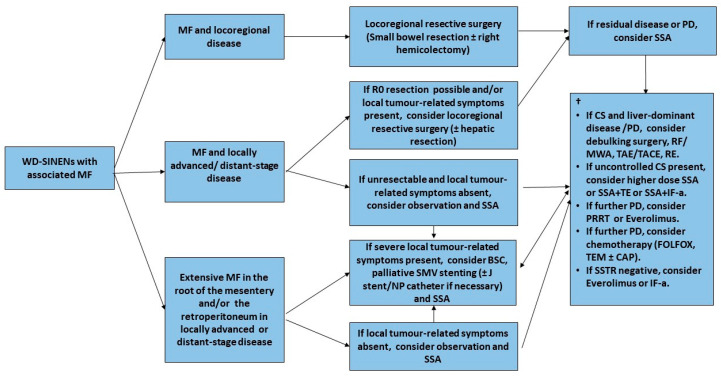
Management of Small Intestinal NENs with Mesenteric Fibrosis-Flow diagram. † Systemic treatment recommendations adapted from ESMO 2020 Clinical Practice Guidelines for diagnosis, treatment and follow-up of Gastroenteropancreatic Neuroendocrine Neoplasms [96]. Abbreviations. BSC: best supportive care; CAP: capecitabin; CS: carcinoid syndrome; FOLFOX: Folinic acid, Fluorouracil (5-FU) and Oxaliplatin; IF-a: interferon alpha; MF: mesenteric fibrosis; MWA: microwave ablation; NP: nephropyelostomy; PD: progressive disease; PRRT: Peptide Receptor Radionuclide Therapy; RE: radio-embolization; RF: Radiofrequency ablation; TACE: trans-arterial chemo-embolization; SMV: superior mesenteric vein; SSA: somatostatin analogue; SSTR: somatostatin receptor; TAE: trans-arterial embolization; TE: telotristat etiprate; TEM: temozolomide; WD-SINENs: well-differentiated small intestinal neuroendocrine neoplasms.

References

    1. Dasari A., Shen C., Halperin D., Zhao B., Zhou S., Xu Y., Shih T., Yao J.C. Trends in the incidence, prevalence, and survival outcomes in patients with neuroendocrine tumors in the United States. JAMA Oncol. 2017;3:1335–1342. doi: 10.1001/jamaoncol.2017.0589. - DOI - PMC - PubMed
    1. Eriksson J., Norlen O., Ogren M., Garmo H., Ihre-Lundgren C., Hellman P. Primary small intestinal neuroendocrine tumors are highly prevalent and often multiple before metastatic disease develops. Scand. J. Surg. 2019 doi: 10.1177/1457496919874484. - DOI - PubMed
    1. Zhang Z., Makinen N., Kasai Y., Kim G.E., Diosdado B., Nakakura E., Meyerson M. Patterns of chromosome 18 loss of heterozygosity in multifocal ileal neuroendocrine tumors. Genes Chromosomes Cancer. 2020 doi: 10.1002/gcc.22850. - DOI - PMC - PubMed
    1. Modlin I.M., Oberg K., Chung D.C., Jensen R.T., de Herder W.W., Thakker R.V., Caplin M., Delle Fave G., Kaltsas G.A., Krenning E.P., et al. Gastroenteropancreatic neuroendocrine tumours. Lancet Oncol. 2008;9:61–72. doi: 10.1016/S1470-2045(07)70410-2. - DOI - PubMed
    1. Daskalakis K., Karakatsanis A., Stalberg P., Norlen O., Hellman P. Clinical signs of fibrosis in small intestinal neuroendocrine tumours. Br. J. Surg. 2017;104:69–75. doi: 10.1002/bjs.10333. - DOI - PubMed

LinkOut - more resources