Clinical Trial
. 2020 Jun 10;22(1):139.
doi: 10.1186/s13075-020-02194-z.

Efficacy and safety of sarilumab in combination with csDMARDs or as monotherapy in subpopulations of patients with moderately to severely active rheumatoid arthritis in three phase III randomized, controlled studies

Affiliations
Clinical Trial

Efficacy and safety of sarilumab in combination with csDMARDs or as monotherapy in subpopulations of patients with moderately to severely active rheumatoid arthritis in three phase III randomized, controlled studies

Mark C Genovese et al. Arthritis Res Ther. .

Abstract

Background: The interleukin-6 receptor inhibitor sarilumab demonstrated efficacy in combination with conventional synthetic disease-modifying antirheumatic drugs (csDMARDs) or as monotherapy in patients with moderately to severely active rheumatoid arthritis (RA) with an inadequate response (IR) or intolerant (INT) to methotrexate (MTX) or tumour necrosis factor (TNF)-α inhibitors. This analysis investigated the efficacy and safety of sarilumab in patient subgroups.

Methods: Data were included from phase III studies: two placebo-controlled studies of subcutaneous sarilumab 150/200 mg every 2 weeks (q2w) either + MTX in MTX-IR patients (52 weeks) or + csDMARDs in TNF-IR/INT patients (24 weeks), and a monotherapy study of sarilumab 200 mg q2w vs. adalimumab 40 mg q2w in MTX-IR/INT patients (24 weeks). Prespecified and post hoc subgroups included patient demographics, disease characteristics, and prior treatments. Prespecified and post hoc endpoints included clinical, radiographic, and physical function measures, and p values are considered nominal. Safety was assessed during double-blind treatment.

Results: The superiority of sarilumab (either as monotherapy vs. adalimumab or in combination with csDMARDs vs. placebo + csDMARDs) across clinical endpoints was generally consistent across subgroups defined by patient demographics, disease characteristics, and prior treatments, demonstrating the benefit of sarilumab treatment for a wide range of patient types. Interaction p values of < 0.05 were consistently observed across studies only for baseline anti-cyclic citrullinated peptide antibody (ACPA) status for American College of Rheumatology 20% response, but not American College of Rheumatology 50% or 70% response. Adverse events and worsening laboratory parameters occurred more frequently in sarilumab-treated vs. placebo-treated patients and were more frequent in the small number of patients ≥ 65 years (n = 289) vs. patients < 65 years (n = 1819). Serious infections occurred in six patients aged ≥ 65 years receiving sarilumab, although the incidence of serious infections was generally higher in patients aged ≥ 65 years regardless of treatment.

Conclusions: Apart from ACPA status, there were no consistent signals indicating differential effects of sarilumab in any of the subpopulations assessed. Sarilumab demonstrated consistent efficacy and safety across a wide range of patients with RA.

Trial registration: ClinicalTrials.gov NCT01061736, registered on February 03, 2010; ClinicalTrials.gov NCT01709578, registered on October 18, 2012; ClinicalTrials.gov NCT02332590, registered on January 07, 2015.

Keywords: Adalimumab; Interleukin-6; Methotrexate; Rheumatoid arthritis; Sarilumab; Subpopulations; csDMARDs.


Conflict of interest statement

MCG has received research grants and consulting fees or other remuneration (payment) from Genentech, Roche, R-Pharm, and Sanofi Genzyme. RF has received research grants from AbbVie, Amgen, Ardea Biosciences, Bristol-Myers Squibb, Celgene, Eli Lilly, EMD Serono, GlaxoSmithKline, Novartis, Pfizer, Regeneron Pharmaceuticals, Inc., Roche, Sanofi Genzyme, and UCB, and has received consulting fees from AbbVie, Akros Pharma, Amgen, AstraZeneca, Bristol-Myers Squibb, Celltrion, Eli Lilly, GlaxoSmithKline, Janssen, Novartis, Pfizer, Roche, Sandoz, Sanofi Genzyme, Taiho Pharmaceutical, and UCB. AK has received consulting fees from Pfizer, Roche, Sanofi Genzyme, and UCB, and holds stock in Sanofi Genzyme and Regeneron Pharmaceuticals, Inc. EBL has received consulting fees from Pfizer. HvH is an employee of Sanofi Genzyme and may hold stock and/or stock options in the company. TK, GSJ, and EKM are employees of Regeneron Pharmaceuticals, Inc. and may hold stock and/or stock options in the company. GRB has received research grants from AbbVie, Pfizer, Roche, and UCB, and has received consulting fees or other remuneration (payment) or participated in speakers’ bureaus from/for AbbVie, Eli Lilly, Merck Sharp & Dohme, Pfizer, Roche, Sanofi Genzyme, and UCB.

Figures
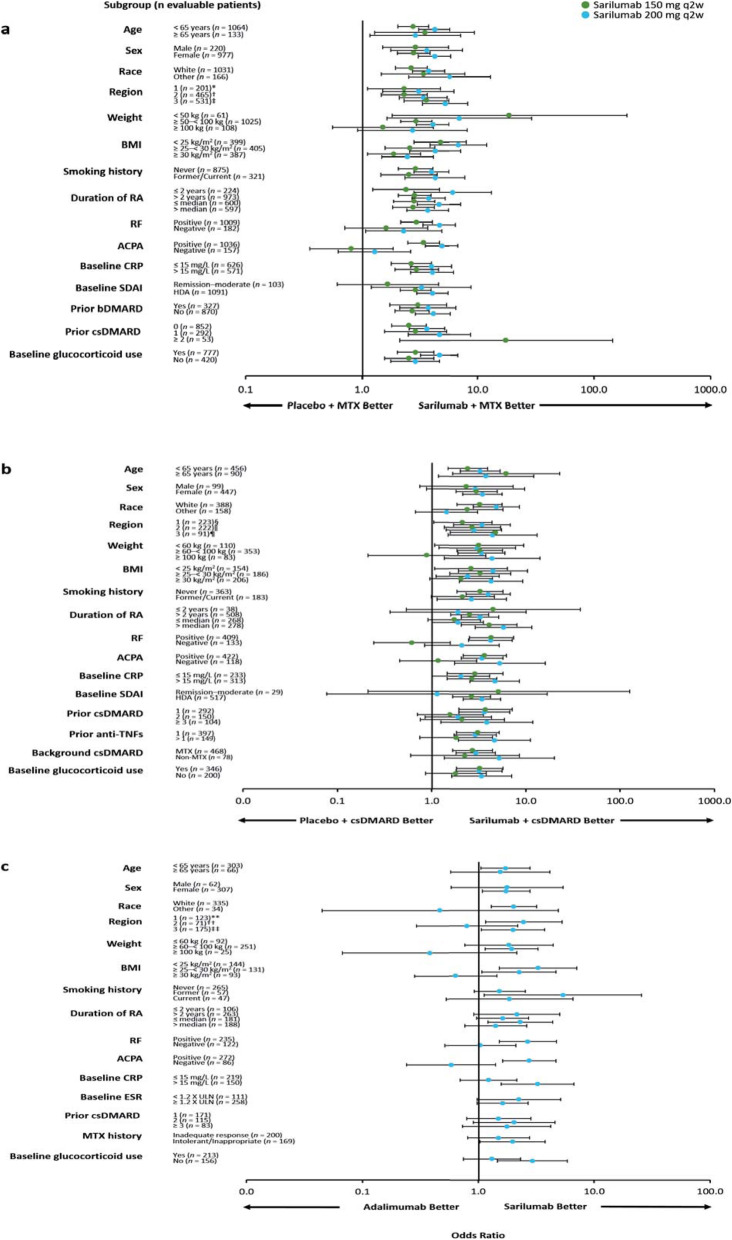
Fig. 1
Fig. 1
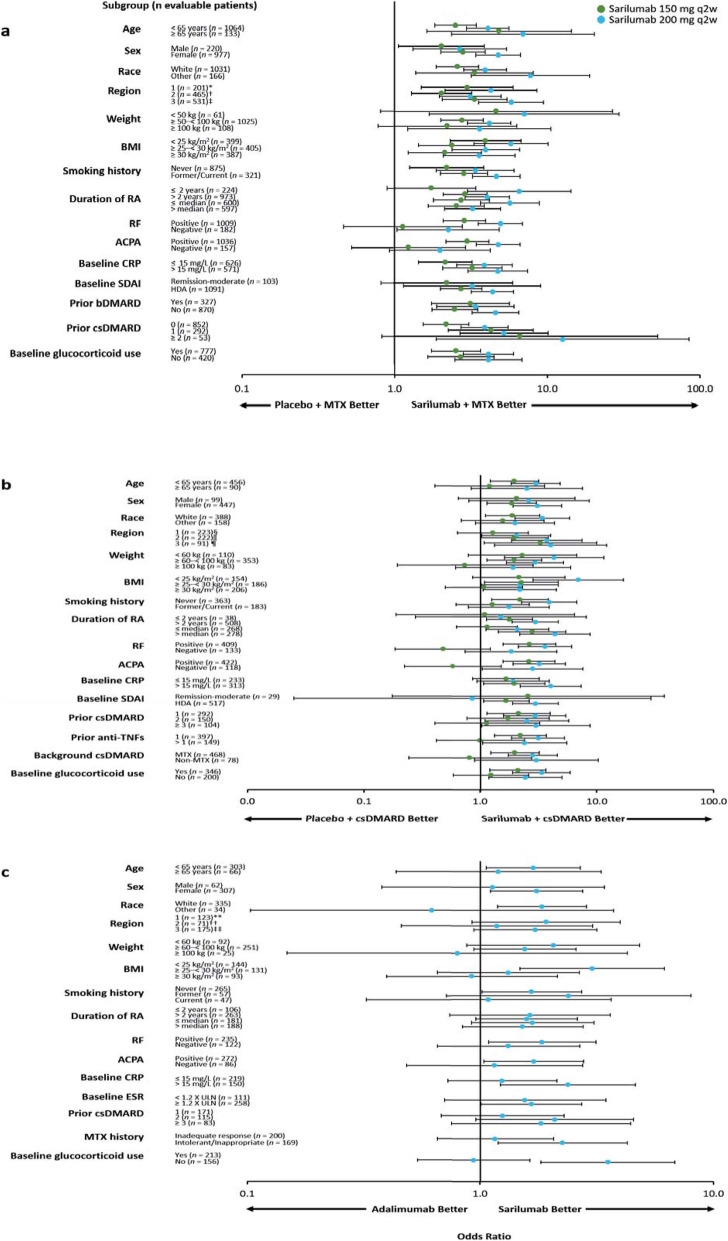
Odds ratio (95% CI) for ACR20 response by subpopulation at week 24. a Sarilumab 150/200 mg q2w + MTX vs. placebo + MTX in MTX-IR patients. b Sarilumab 150/200 mg q2w + csDMARDs vs. placebo + csDMARDs in TNF-IR/INT patients. c Sarilumab 200 mg q2w vs. adalimumab 40 mg q2w in MTX-IR/INT patients. Mantel-Haenszel estimate with terms of treatment: a treatment, prior biologic use, region, subpopulation, and treatment-by-subpopulation; b treatment, prior anti-TNF use, region, subpopulation, and treatment-by-subpopulation; and c treatment, region, subpopulation, and treatment-by-subpopulation. ACPA, anti-cyclic citrullinated peptide antibody; ACR20, American College of Rheumatology 20% response; bDMARD, biological and targeted disease-modifying antirheumatic drug; BMI, body mass index; CI, confidence interval; CRP, C-reactive protein; csDMARD, conventional synthetic disease-modifying antirheumatic drug; ESR, erythrocyte sedimentation rate; HDA, high disease activity; INT, intolerant; IR, inadequate response; MTX, methotrexate; n, number of evaluable patients regardless of the treatment group; q2w, every 2 weeks; RA, rheumatoid arthritis; RF, rheumatoid factor; SDAI, Simplified Disease Activity Index; TNF, tumour necrosis factor; ULN, upper limit of normal. *Austria, Australia, Belgium, Canada, Finland, Germany, Greece, Hungary, New Zealand, Norway, Portugal, Spain, and USA; Argentina, Brazil, Chile, Colombia, and Mexico; Belarus, Estonia, India, Malaysia, Philippines, Poland, Romania, Russia, South Africa, South Korea, Taiwan, Thailand, and Ukraine; §Australia, Canada, Czech Republic, Germany, Greece, Hungary, Israel, Italy, New Zealand, Portugal, Spain, and USA; Argentina, Brazil, Chile, Colombia, Ecuador, Guatemala, Mexico, and Peru; South Korea, Lithuania, Poland, Russia, Taiwan, Turkey, and Ukraine; **Czech Republic, Germany, Hungary, Israel, Spain, and USA; ††Chile and Peru; ‡‡South Korea, Poland, South Africa, Romania, Russia, and Ukraine
Fig. 2
Fig. 2
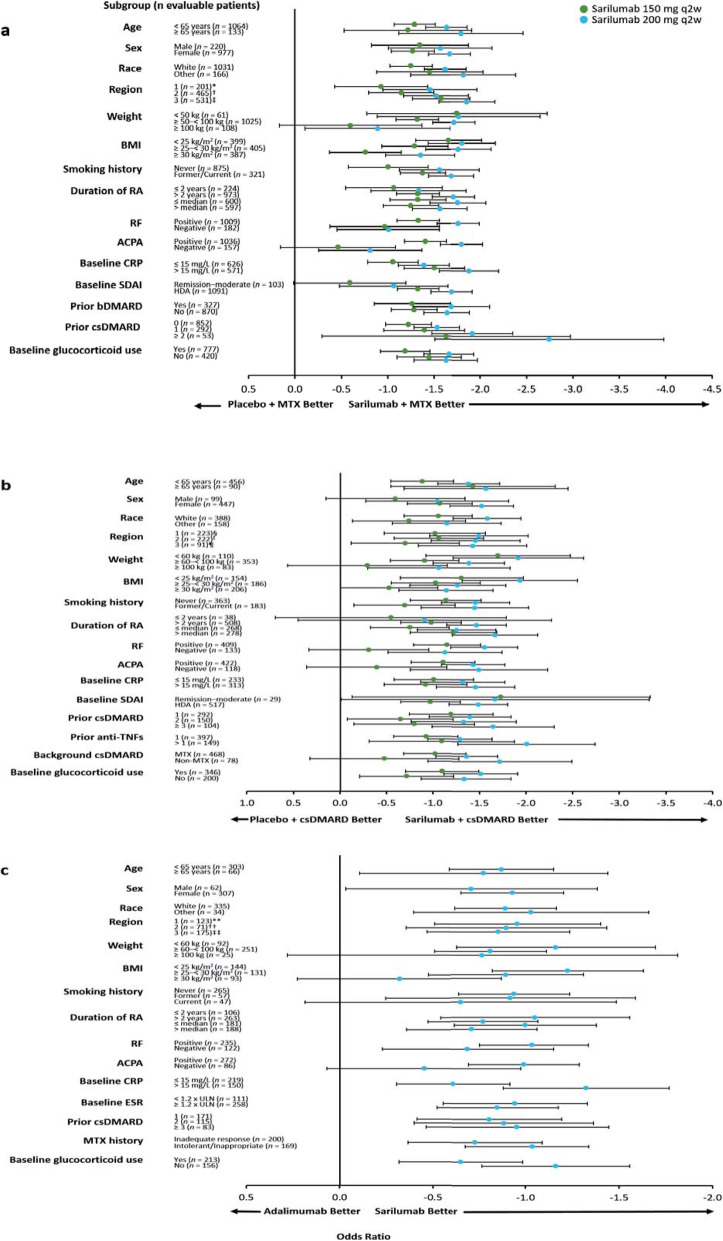
LSM (95% CI) treatment difference for change from baseline in DAS28-CRP at week 24. a Sarilumab 150/200 mg q2w + MTX vs. placebo + MTX in MTX-IR patients. b Sarilumab 150/200 mg q2w + csDMARDs vs. placebo + csDMARDs in TNF-IR/INT patients. c Sarilumab 200 q2w vs. adalimumab 40 mg q2w in MTX-IR/INT patients. Mixed-effect model for repeated measures with PROC MIXED assuming an unstructured covariance structure: a baseline, treatment, prior biologic use, region, visit, and treatment-by-visit interaction; b baseline, treatment, prior anti-TNF use, region, visit, and treatment-by-visit interaction; and c baseline, treatment, region, visit, and treatment-by-visit interaction. ACPA, anti-cyclic citrullinated peptide antibody; bDMARD, biological and targeted disease-modifying antirheumatic drug; BMI, body mass index; CI, confidence interval; CRP, C-reactive protein; csDMARD, conventional synthetic disease-modifying antirheumatic drug; DAS28-CRP, Disease Activity Score in 28 joints using CRP; ESR, erythrocyte sedimentation rate; HDA, high disease activity; INT, intolerant; IR, inadequate response; LSM, least squares mean; MTX, methotrexate; n, number of evaluable patients regardless of the treatment group; q2w, every 2 weeks; RA, rheumatoid arthritis; RF, rheumatoid factor; SDAI, Simplified Disease Activity Index; TNF, tumour necrosis factor; ULN, upper limit of normal. *Austria, Australia, Belgium, Canada, Finland, Germany, Greece, Hungary, New Zealand, Norway, Portugal, Spain, and USA; Argentina, Brazil, Chile, Colombia, and Mexico; Belarus, Estonia, India, Malaysia, Philippines, Poland, Romania, Russia, South Africa, South Korea, Taiwan, Thailand, and Ukraine; §Australia, Canada, Czech Republic, Germany, Greece, Hungary, Israel, Italy, New Zealand, Portugal, Spain, and USA; Argentina, Brazil, Chile, Colombia, Ecuador, Guatemala, Mexico, and Peru; South Korea, Lithuania, Poland, Russia, Taiwan, Turkey, and Ukraine; **Czech Republic, Germany, Hungary, Israel, Spain, and USA; ††Chile and Peru; ‡‡South Korea, Poland, South Africa, Romania, Russia, and Ukraine
Fig. 3
Fig. 3
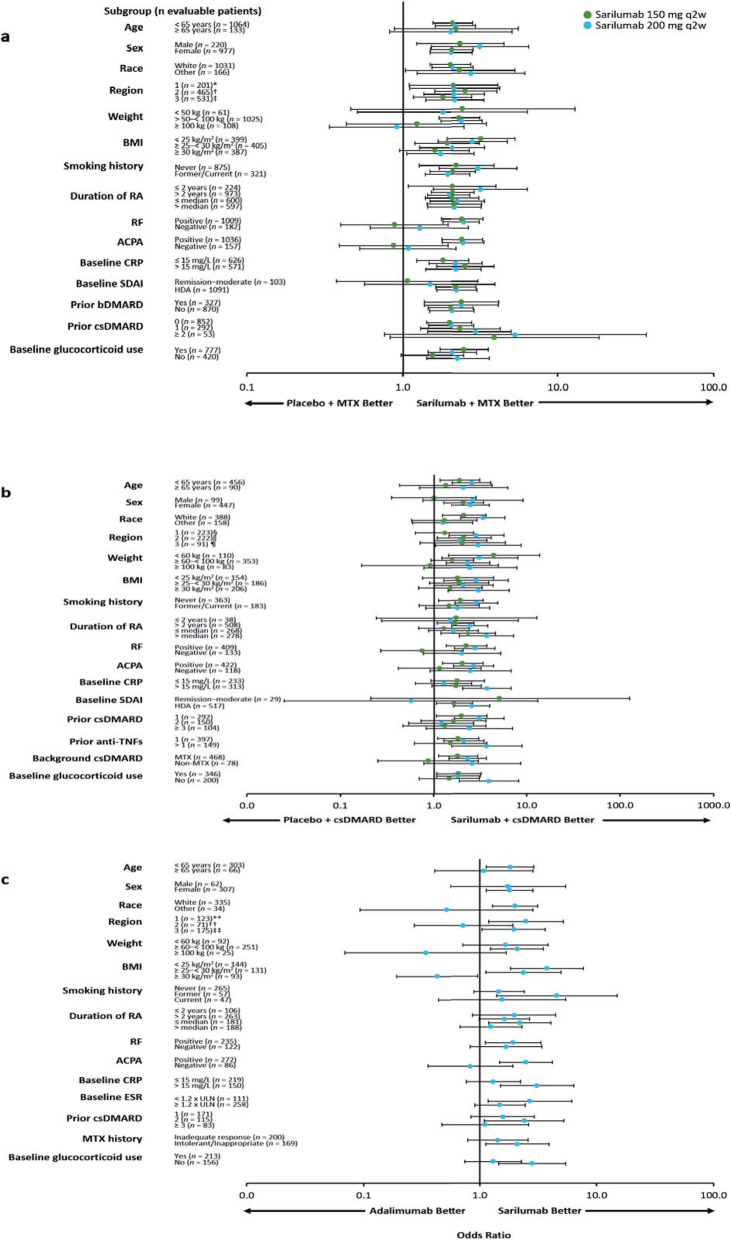
Odds ratio (95% CI) for improvement in CDAI ≥58% at week 24 by subpopulation. a Sarilumab 150/200 mg q2w + MTX vs. placebo + MTX in MTX-IR patients. b Sarilumab 150/200 mg q2w + csDMARDs vs. placebo + csDMARDs in TNF-IR/INT patients. c Sarilumab 200 mg q2w vs. adalimumab 40 mg q2w in MTX-IR/INT patients. Logistic regression model with terms of a treatment, prior biologic use, region, subpopulation, and treatment-by-subpopulation; b treatment, prior anti-TNF use, region, subpopulation, and treatment-by-subpopulation; and c treatment, region, subpopulation, and treatment-by-subpopulation. ACPA, anti-cyclic citrullinated peptide antibody; bDMARD, biological and targeted disease-modifying antirheumatic drug; BMI, body mass index; CI, confidence interval; CRP, C-reactive protein; csDMARD, conventional synthetic disease-modifying antirheumatic drug; CDAI, Clinical Disease Activity Index; ESR, erythrocyte sedimentation rate; HDA, high disease activity; INT, intolerant; IR, inadequate response; MTX, methotrexate; n, number of evaluable patients regardless of the treatment group; q2w, every 2 weeks; RA, rheumatoid arthritis; RF, rheumatoid factor; SDAI, Simplified Disease Activity Index; TNF, tumour necrosis factor; ULN, upper limit of normal. *Austria, Australia, Belgium, Canada, Finland, Germany, Greece, Hungary, New Zealand, Norway, Portugal, Spain, and USA; Argentina, Brazil, Chile, Colombia, and Mexico; Belarus, Estonia, India, Malaysia, Philippines, Poland, Romania, Russia, South Africa, South Korea, Taiwan, Thailand, and Ukraine; §Australia, Canada, Czech Republic, Germany, Greece, Hungary, Israel, Italy, New Zealand, Portugal, Spain, and USA; Argentina, Brazil, Chile, Colombia, Ecuador, Guatemala, Mexico, and Peru; South Korea, Lithuania, Poland, Russia, Taiwan, Turkey, and Ukraine; **Czech Republic, Germany, Hungary, Israel, Spain, and USA; ††Chile and Peru; ‡‡South Korea, Poland, South Africa, Romania, Russia, and Ukraine
Fig. 4
Fig. 4
Odds ratio (95% CI) for HAQ-DI improvement ≥ 0.22 units at week 24 by subpopulation. a Sarilumab 150/200 mg q2w + MTX vs. placebo + MTX in MTX-IR patients. b Sarilumab 150/200 mg q2w + csDMARDs vs. placebo + csDMARDs in TNF-IR/INT patients. c Sarilumab 200 mg q2w vs. adalimumab 40 mg q2w in MTX-IR/INT patients. Logistic regression model with terms of a treatment, prior biologic use, region, subpopulation, and treatment-by-subpopulation; b treatment, prior anti-TNF use, region, subpopulation, and treatment-by-subpopulation; and c treatment, region, subpopulation, and treatment-by-subpopulation. ACPA, anti-cyclic citrullinated peptide antibody; bDMARD, biological and targeted disease-modifying antirheumatic drug; BMI, body mass index; CI, confidence interval; CRP, C-reactive protein; csDMARD, conventional synthetic disease-modifying antirheumatic drug; ESR, erythrocyte sedimentation rate; HAQ-DI, Health Assessment Questionnaire-Disability Index; HDA, high disease activity; INT, intolerant; IR, inadequate response; MTX, methotrexate; n, number of evaluable patients regardless of the treatment group; q2w, every 2 weeks; RA, rheumatoid arthritis; RF, rheumatoid factor; SDAI, Simplified Disease Activity Index; TNF, tumour necrosis factor; ULN, upper limit of normal. *Austria, Australia, Belgium, Canada, Finland, Germany, Greece, Hungary, New Zealand, Norway, Portugal, Spain, and USA; Argentina, Brazil, Chile, Colombia, and Mexico; Belarus, Estonia, India, Malaysia, Philippines, Poland, Romania, Russia, South Africa, South Korea, Taiwan, Thailand, and Ukraine; §Australia, Canada, Czech Republic, Germany, Greece, Hungary, Israel, Italy, New Zealand, Portugal, Spain, and USA; Argentina, Brazil, Chile, Colombia, Ecuador, Guatemala, Mexico, and Peru; South Korea, Lithuania, Poland, Russia, Taiwan, Turkey, and Ukraine; **Czech Republic, Germany, Hungary, Israel, Spain, and USA; ††Chile and Peru; ‡‡South Korea, Poland, South Africa, Romania, Russia, and Ukraine

References

    1. Global Burden of Disease Study 2017 Disease and Injury Incidence and Prevalence Collaborators Global, regional, and national incidence, prevalence, and years lived with disability for 354 diseases and injuries for 195 countries and territories, 1990–2017: a systematic analysis for the Global Burden of Disease Study 2017. Lancet. 2018;392:1789–1858. - PMC - PubMed
    1. Singh JA, Saag KG, Bridges SL, Jr, Akl EA, Bannuru RR, Sullivan MC, et al. 2015 American College of Rheumatology guideline for the treatment of rheumatoid arthritis. Arthritis Rheumatol. 2016;68(1):1–26. - PubMed
    1. Sparks JA, Costenbader KH. Genetics, environment, and gene-environment interactions in the development of systemic rheumatic diseases. Rheum Dis Clin N Am. 2014;40(4):637–657. - PMC - PubMed
    1. Sivas F, Yurdakul FG, Kilicarslan A, Duran S, Baskan B, Bodur H. Relationship between smoking and structural damage, autoimmune antibodies, and disability in rheumatoid arthritis patients. Arch Rheumatol. 2018;33(1):45–51. - PMC - PubMed
    1. Courvoisier N, Dougados M, Cantagrel A, Goupille P, Meyer O, Sibilia J, et al. Prognostic factors of 10-year radiographic outcome in early rheumatoid arthritis: a prospective study. Arthritis Res Ther. 2008;10(5):R106. - PMC - PubMed

Publication types

MeSH terms

Associated data