Review
. 2020 Jun 10;18(1):90.
doi: 10.1186/s12964-020-00599-6.

Intestinal microbiota: a new force in cancer immunotherapy

Affiliations
Review

Intestinal microbiota: a new force in cancer immunotherapy

Zhujiang Dai et al. Cell Commun Signal. .

Abstract

Cancer displays high levels of heterogeneity and mutation potential, and curing cancer remains a challenge that clinicians and researchers are eager to overcome. In recent years, the emergence of cancer immunotherapy has brought hope to many patients with cancer. Cancer immunotherapy reactivates the immune function of immune cells by blocking immune checkpoints, thereby restoring the anti-tumor activity of immune cells. However, immune-related adverse events are a common complication of checkpoint blockade, which might be caused by the physiological role of checkpoint pathways in regulating adaptive immunity and preventing autoimmunity. In this context, the intestinal microbiota has shown great potential in the immunotherapy of cancer. The intestinal microbiota not only regulates the immune function of the body, but also optimizes the therapeutic effect of immune checkpoint inhibitors, thus reducing the occurrence of complications. Therefore, manipulating the intestinal microbiota is expected to enhance the effectiveness of immune checkpoint inhibitors and reduce adverse reactions, which will lead to new breakthroughs in immunotherapy and cancer management. Video abstract.

Keywords: CTLA-4; Cancer immunotherapy; Checkpoint; FMT; ICIs; Microbiota; PD-1; PD-L1.


Conflict of interest statement

The authors declare that there is no conflict of interest.

Figures
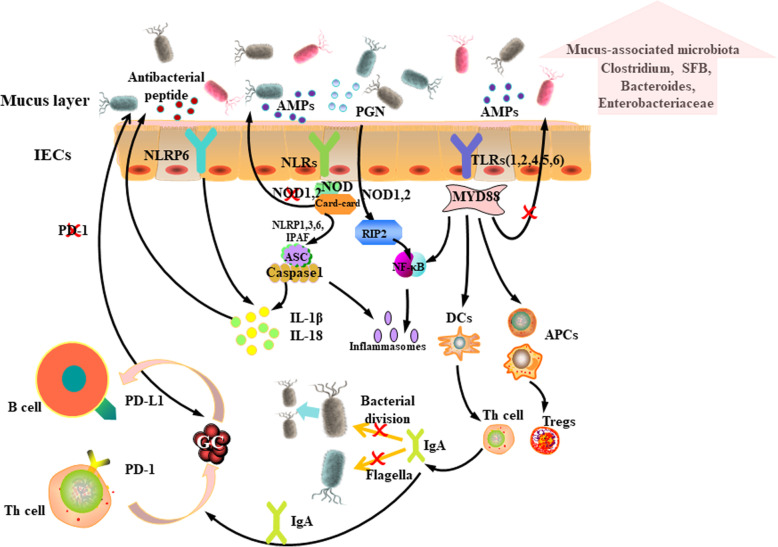
Fig. 1
Fig. 1
TLRs and NLRs effectively regulate intestinal immune function. The lack of the TLR adapter MYD88 will alter the composition of the microbiota, resulting in an increase in the amount of the mucus-associated microbiota. The lack of nucleoside-binding oligomeric domain protein 1 (NOD1) leads to an increase in the size of the of microbiota, including increased numbers of Clostridium, Bacteroides, segmented filamentous bacteria (SFB), and Enterobacteriaceae. Lack of NOD2 also leads to an increase in the size of the mucus-associated microbiota, which induces inflammation and colorectal cancer. The microbiota produce metabolites that activate NOD-, LRR-, and pyrin domain-containing 6 (NLRP6) and secretes interleukin (IL)-18, which maintains the stability of the mucus, and antimicrobial peptides. Activation of antigen-presenting cells (APCs) promotes the differentiation of CD4+ T cells into T helper (Th) cells and regulatory T cells (Tregs). Th cells regulate the function of the intestinal microbiota via the expression of immunoglobulin A (IgA). Furthermore, the secretion of IgA is regulated by the specific binding of PD-1 on the surface of Th cells to PD-L1 on the surface of B cells
Fig. 2
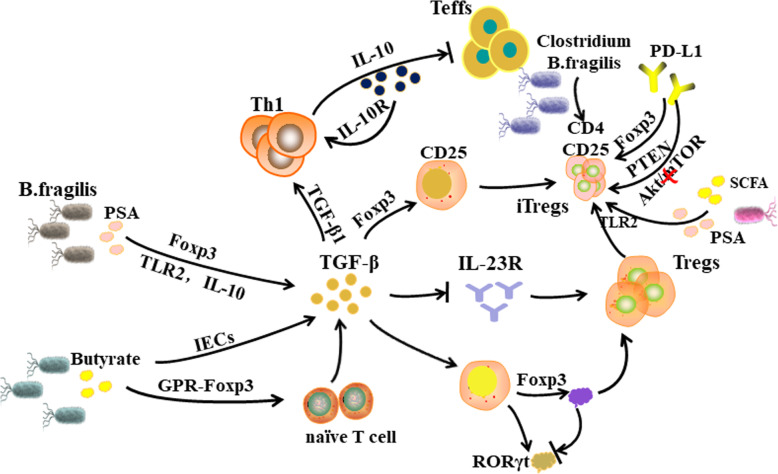
Fig. 2
The regulation of the microbiota in adaptive immunity. Bacteroides fragilis stimulates TLR2 on CD4+ T cells by producing polysaccharide A (PSA), thereby enhancing the expression of Forkhead Box P3 (Foxp3), IL-10, and TGF-β. Butyrate activates Foxp3 via a G protein-coupled receptor (GPCR), induces differentiation of Tregs, and inhibits anti-tumor immune responses. Butyrate also indirectly promotes Treg differentiation by inducing IECs to secrete TGF-β. High concentrations of TGF-β inhibit the expression of IL-23R and promote the differentiation of Tregs. TGF-β also induces RORγt to be expressed together with Foxp3 in CD4+ T cells, which in turn inhibits RORγt, leading to differentiation of Tregs. Microbial metabolites SCFA and PSA can promote the proliferation of induced regulatory T cells (iTregs); however, too many iTregs infiltrating tumor tissue will weaken cancer immunity. PD-L1 can also promote the conversion of Tregs to iTregs by increasing the expression of Foxp3 and PTEN, or by inhibiting the Akt/mTOR pathway
Fig. 3
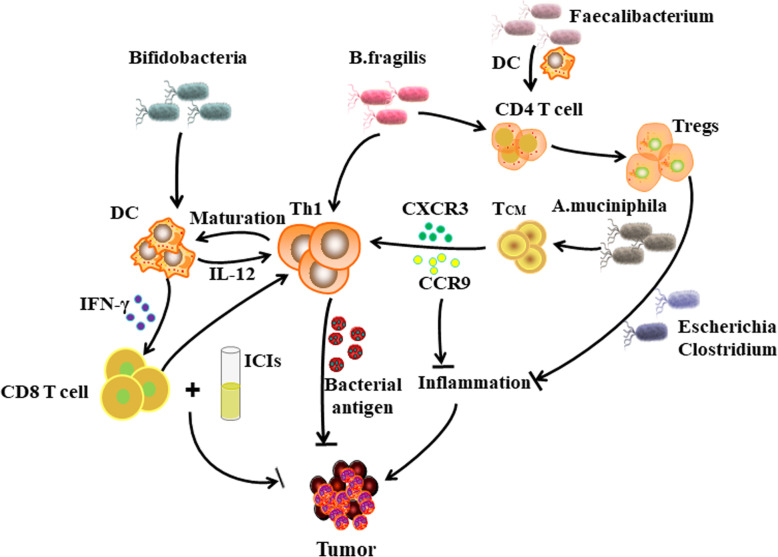
Fig. 3
The mechanism of multiple intestinal microbiota in cancer immunotherapy. Bifidobacteria activates and causes DCs to secrete IFN-γ, which initiates the anti-tumor effect of CD8+ T cells. B. fragilis promotes Th1 recognition of tumor antigens and is capable of inducing DC maturation. In addition, B. fragilis can promote the differentiation of CD4+ T cells into Tregs, which further participate in anti-tumor immunity. Faecalibacterium induces DC maturation and promotes CD4+ T cell proliferation. A. muciniphila promotes activation of the CXCR3/CCR9 axis and participates in the migration of CD4+ T cells. Escherichia and Clostridium enhance the expression of CTLA-4 in Tregs, which is beneficial to tumor immunity
Fig. 4
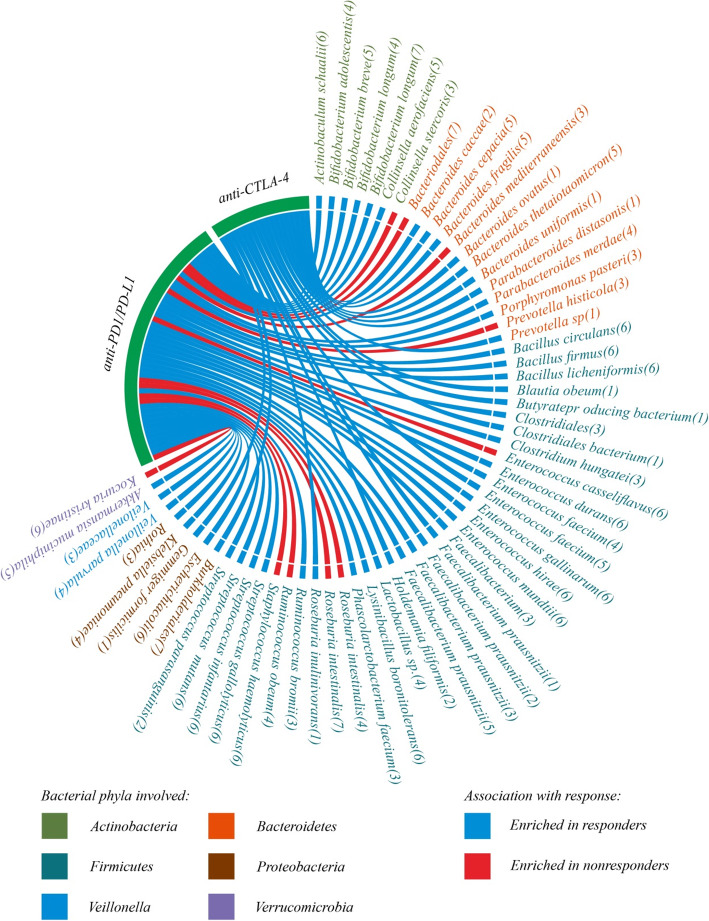
Fig. 4
Differences in microbial enrichment during immunotherapy. The Circos diagram illustrates the different effects of different members of the microbiota in the treatment of ICIs. Blue bands represent members of the microbiota that are enriched during the treatment of effective ICIs. Red bands represent members of the microbiota that are enriched during the treatment of ineffective ICIs. The numbers in parentheses are the source of the reference. (1) Chaput et al. [111] (2) Frankel et al. [115] (3) Gopalakrishnan et al. [123] (4) Matson et al. [122] (5) Routy et al. [155] (6) Routy et al. [113]. (7) Temraz et al. [156]

References

    1. Ge Z, Wu S, Zhang Z, Ding S. Mechanism of tumor cells escaping from immune surveillance of NK cells. Immunopharmacol Immunotoxicol. 2020:1–12. - PubMed
    1. Salmaninejad A, Valilou SF, Shabgah AG, Aslani S, Alimardani M, Pasdar A, Sahebkar A. PD-1/PD-L1 pathway: basic biology and role in cancer immunotherapy. J Cell Physiol. 2019;234:16824–16837. - PubMed
    1. Alsaab HO, Sau S, Alzhrani R, Tatiparti K, Bhise K, Kashaw SK, Iyer AK. PD-1 and PD-L1 checkpoint signaling inhibition for Cancer immunotherapy: mechanism, combinations, and clinical outcome. Front Pharmacol. 2017;8:561. - PMC - PubMed
    1. King-Kallimanis BL, Howie LJ, Roydhouse JK, Singh H, Theoret MR, Blumenthal GM, Kluetz PG. Patient reported outcomes in anti-PD-1/PD-L1 inhibitor immunotherapy registration trials: FDA analysis of data submitted and future directions. Clin Trials. 2019;16:322–326. - PubMed
    1. Wang Q, Xu R. Immunotherapy-related adverse events (irAEs): extraction from FDA drug labels and comparative analysis. JAMIA Open. 2019;2:173–178. - PMC - PubMed