. 2020 Sep;48(9):1080-1086.
doi: 10.1016/j.ajic.2020.06.003. Epub 2020 Jun 6.

South Korea's responses to stop the COVID-19 pandemic

Affiliations

South Korea's responses to stop the COVID-19 pandemic

JaHyun Kang et al. Am J Infect Control. 2020 Sep.

Abstract

Background: South Korea's aggressive responses to the coronavirus disease 2019 (COVID-19) have greatly slowed the epidemic without regional lockdowns.

Methods: The Korean Centers for Disease Control and Prevention's daily briefings were thoroughly reviewed. Information about hospital countermeasures and government coordination was collected via telephone interviews with 4 infection control team leaders, 1 emergency department nurse, and 1 infectious disease physician in Korea.

Results: After the 2015 Middle East Respiratory Syndrome outbreak, the government and hospitals prepared for the inevitable outbreak of emerging infectious diseases by reforming the epidemic preparedness system. As a result, COVID-19 diagnostic test kits were quickly developed, enabling extensive early detection of potential cases. Other key steps were tracking cases, finding exposed individuals, coordinating case assignments with health care facilities, and selective clinic screenings for visitors' entering hospitals with mandatory mask wearing. Consequently, after overcoming the initial peak of the outbreak, which was related to a religious group, Korea has been able to maintain daily new cases at around 100 and to less than 50 daily cases in the second week of April.

Conclusions: To counter the COVID-19 pandemic, which may persist, long-term, sustained response strategies must be prepared along with coordination between government and health systems.

Keywords: Countermeasures; Outbreak; Preparedness; Screening; Tracking.


Figures

Fig 1
Fig 1
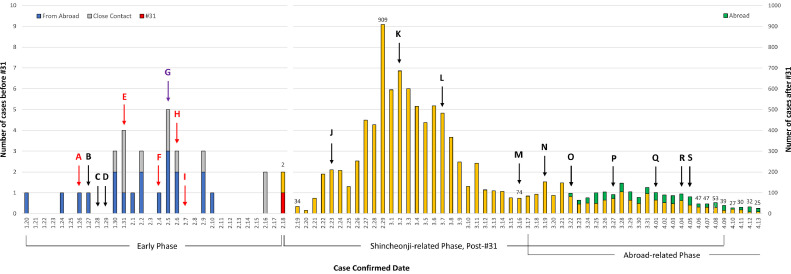
Coronavirus disease 19 outbreak curve and timeline of implementation of government interventions in South Korea. Note: This histogram is based on daily briefing reports from Korea Centers for Disease Control and Prevention. The report format of case numbers and related information has been changed several times depending on the situation. For example, specific information from travelers abroad became available from March 22 and is partially reflected in the histogram. (A) Expansion of suspected case definition from pneumonia or pneumonia-suspected symptoms after Wuhan visit within 14 days, to fever or respiratory symptoms after Hubei Province visit within 14 days. Expansion of patient under investigation definition from fever or respiratory symptoms after Wuhan visit within 14 days, to pneumonia after China visit within 14 days; (B) Changed the national infectious disease crisis level from “Alert” to “Warning,” started operating the COVID 19 Emergency Headquarters; (C) Started operating 288 selective care centers and screening all number of Wuhan tourists; (D) Expanded Korean Centers for Disease Control and Prevention call center (Tel: 1339) operation; (E) Started use of real time RT-PCR test kit at the 18 locations of Research Institutes of Public Health and Environment nationwide; (F) Changed contact definition from close contact and general contact to contact within 2 meters and 1:1 assignment of a public officer to the home self-contained people; (G) Isolated the COVID-19 Korean virus (BetaCoV/Korea/CDCD03/2020) and the Korean Ministry of Food and Drug Safety recommended use of KF94 and KF99 masks for healthcare personnel; (H) Expansion of case definition to fever of respiratory symptom within 14 days or physician's opinions; (I) Authorized emergency use of COVID-19 real-time RT-PCR test kits and expanded test centers to 46 private health care facilities; (J) Raised the national infectious disease crisis level from “Warning” to “Serious,” and declared the infectious disease special management zone with Daegu and Gyeongsangbuk-do; (K) Switched from the early detection and containment strategy to one of minimizing damage strategy, and provided updated response guidelines (7th edition); (L) Started mandatory reporting of symptoms at each facility with a designated staff; (M) Started an exit quarantine for travelers to the US and expanded a special entry procedure to travelers from Europe including mobile application report of self-monitoring of COVID-19 related symptoms; (N) Expanded the Special Entry Procedure to travelers from all countries; O) Started COVID-19 tests for all travelers from Europe and 15 days of “enhanced social distancing” until April 5; (P) Started COVID-19 tests for symptomatic travelers from USA; (Q) All travelers from abroad must self-isolate at home for 14 days and report daily symptoms using a self-isolation diagnostic application for smartphones; (R) Expanded the epidemiologic investigation scope of contact individuals from 1 day prior starting symptoms to 2 days prior; (S) Extended “enhanced social distancing” for 2 weeks more until April 19, and started legal enforcement in which violations of self-containment may result in imprisonment of not more than 1 year or a find not exceeding 10 million Korean won (ie, $8,250).
Fig 2
Fig 2
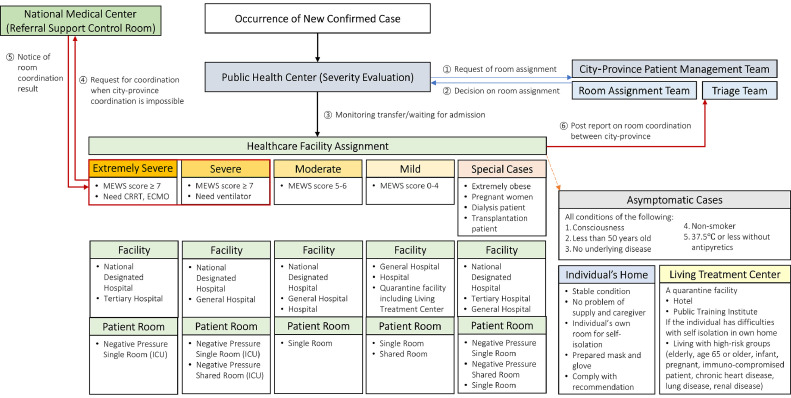
Facility and patient room assignment flow for confirmed cases of COVID-19. Note: MEWS, modified early warning system. This score is calculated based on pulse, systolic blood pressure, respiratory rate, body temperature, and level of consciousness; CRRT, continuous renal replacement therapies; ECMO, extracorporeal membrane oxygenation; ICU, intensive care unit. This flow is modified to reflect a Korean confirmed case's isolation assignment with severity categories based on an example of the bed assignment process from the COVID-19 Response Manual for Municipal (version 7-4, published on April 2, 2020) Appendix.
Fig 3
Fig 3
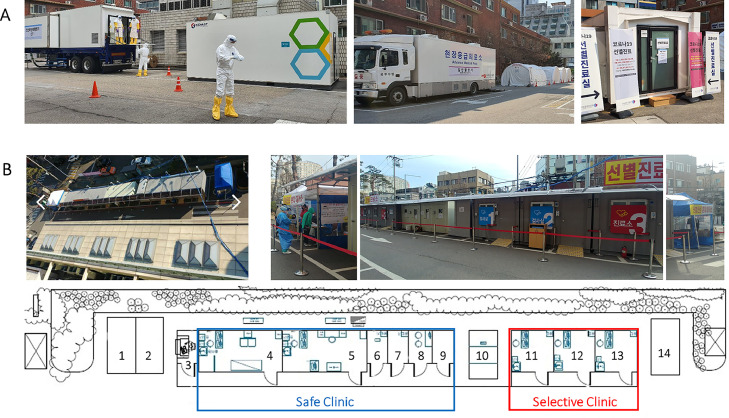
Examples of selective clinics in South Korea. Note: Picture A. A selective clinic outside the National Medical Center. From left to right, waiting rooms for the selective clinic; entrance of selective clinic; chest X-ray truck; and a computed tomography (CT) truck on the left and a generator for the CT truck. Picture B. A safe clinic and a selective clinic located outside Soonchunhyang University Seoul Hospital. Floor plan B. (1) Waiting area for a safe clinic, (2) Waiting area for a pediatric safe clinic, (3) Questionnaire checking and registration desk, (4) Negative-pressure safe clinic room, (5) Negative-pressure safe clinic room for pediatric patients, (6) Negative-pressure doffing personal protective equipment (PPE) room, (7) Negative-pressure sputum-collecting room, (8) Waiting room for health care personnel, (9) Donning PPE room, (10) Restrooms, (11) Negative-pressure test laboratory 1, (12) Negative-pressure test laboratory 2, (13) Negative-pressure selective clinic, and (14) Waiting area for selective clinic. All pictures were provided by coauthors at the above mentioned hospitals.
Fig 4
Fig 4
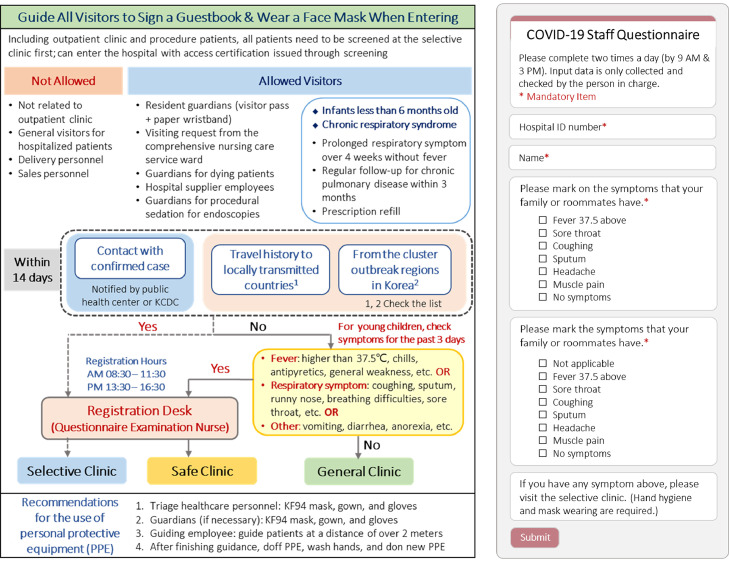
Examples of the process of screening all hospital visitors and the smartphone application screen for screening staff's daily symptoms. Note. The figure on the left is a modified English version of the process guideline for healthcare personnel from Soonchunhyang University Seoul Hospital. These guidelines are posted at the hospital entrance, and all hospital visitors must follow the screening process to the designated clinics as shown in Figure 2B. The questionnaire on the right is a modified English version of the smartphone application screen for hospital staff's daily symptom screening which is required to check twice a day from the Dankook University Hospital.
Fig 5
Fig 5
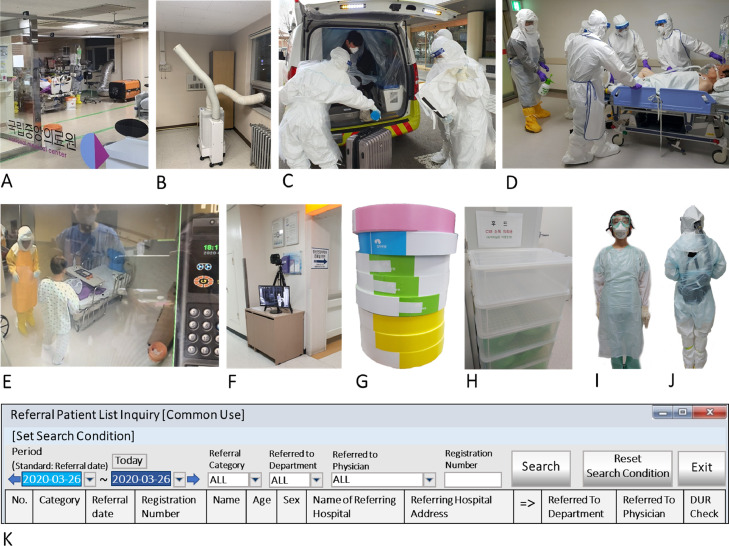
Examples of Korean hospitals’ COVID-19 response. Note: (A) A portable negative pressure machine with high efficiency particulate air (HEPA) filter was set up through the window to convert the intensive care unit to negative pressure. Pictures A through E were taken at the National Central Hospital; (B) A portable negative pressure machine with HEPA filter was installed at the isolated patient room. One vent is up toward the patient to draw in contaminated air and the other vent is linked to the outside through the window to emit the filtered air; (C) Health care personnel preparing to receive the arrival from the airport of a traveler who tested positive. A disinfection solution being sprayed is diluted sodium hypochlorite (500 ppm); (D) A case patient is transferred to an operating room for a surgery. In this picture, due to intubation, the patient could not wear a face mask. However, all patients must wear the mask inside a hospital building; (E) Monitoring an isolated patient room outside through CCTV; (F) All hospital visitors are screened for fever with an exothermic detector at one of the entrances at Daegu Catholic University Hospital; (G) For the daily screening of patients’ visitors (residents or frequent visitors), paper wrist bands with different colors are used at Soonchunhyang University Seoul Hospital. The color of the wrist band is changed every day to screen all visitors; H) Used hoods are collected for disinfection at the central supply room, by putting them inside double layered green bags at each plastic cabinet drawer. Pictures H to K were taken at Dankook University Hospital; (I) Four personal protective equipment (PPE) items (disposable gown, gloves, KF94 mask, and goggle) for taking care of probable cases; (J) Protecting the hose and battery for the powered air purifying respirator (PAPR) by wearing a disposable plastic gown back (also, front); (K) An English version of an electronic medical record (EMR) program screen for checking any missing travel information (including other hospitals using drug utilization review, DUR), for sharing information, and in case the patient doesn't provide the right information. All pictures were provided by coauthors at the above mentioned hospitals.

References

    1. Shaw J. Cooperating to combat coronavirus. Harvard Magazine. Published March 3, 2020 https://harvardmagazine.com/2020/03/fighting-sars-2 Available at: Accessed March 19, 2020.
    1. Ministry of Health and Welfare . 2016. The 2015 MERS outbreak in the Republic of Korea: Learning from MERS.
    1. GFID. Promotional brochure for the Government-wide R & D fund project for infectious diseases. Published 2018. Available at: https://www.gfid.or.kr/kr/customer/work_view.php?idx=466. Accessed March 26, 2020.
    1. KCDC. Information on the project for specialized regional infectious disease hospitals. Published 2017. Available at: http://www.cdc.go.kr/board.es?mid=a20504000000&bid=0014&act=view&list_no.... Accessed March 25, 2020.
    1. KCDC. In order to respond to the infectious disease crisis more quickly, the reporting system for communicable diseases will be changed from next year. Published 2019. Updated December 26, 2019. Available at: https://www.cdc.go.kr/board/board.es?mid=a20501000000&bid=0015. Accessed March 13, 2020.

Publication types

MeSH terms