Review
. 2020 May 25:8:465.
doi: 10.3389/fbioe.2020.00465. eCollection 2020.

Antimicrobial Mechanisms and Effectiveness of Graphene and Graphene-Functionalized Biomaterials. A Scope Review

Affiliations
Review

Antimicrobial Mechanisms and Effectiveness of Graphene and Graphene-Functionalized Biomaterials. A Scope Review

Hiba Mohammed et al. Front Bioeng Biotechnol. .

Abstract

Bacterial infections represent nowadays the major reason of biomaterials implant failure, however, most of the available implantable materials do not hold antimicrobial properties, thus requiring antibiotic therapy once the infection occurs. The fast raising of antibiotic-resistant pathogens is making this approach as not more effective, leading to the only solution of device removal and causing devastating consequences for patients. Accordingly, there is a large research about alternative strategies based on the employment of materials holding intrinsic antibacterial properties in order to prevent infections. Between these new strategies, new technologies involving the use of carbon-based materials such as carbon nanotubes, fullerene, graphene and diamond-like carbon shown very promising results. In particular, graphene- and graphene-derived materials (GMs) demonstrated a broad range antibacterial activity toward bacteria, fungi and viruses. These antibacterial activities are attributed mainly to the direct physicochemical interaction between GMs and bacteria that cause a deadly deterioration of cellular components, principally proteins, lipids, and nucleic acids. In fact, GMs hold a high affinity to the membrane proteoglycans where they accumulate leading to membrane damages; similarly, after internalization they can interact with bacteria RNA/DNA hydrogen groups interrupting the replicative stage. Moreover, GMs can indirectly determine bacterial death by activating the inflammatory cascade due to active species generation after entering in the physiological environment. On the opposite, despite these bacteria-targeted activities, GMs have been successfully employed as pro-regenerative materials to favor tissue healing for different tissue engineering purposes. Taken into account these GMs biological properties, this review aims at explaining the antibacterial mechanisms underlying graphene as a promising material applicable in biomedical devices.

Keywords: antibacterial; biomaterials; graphene materials; graphene oxide; nanosheet; reduced graphene oxide.


Figures

FIGURE 1
FIGURE 1
AFM height images of GO sheets dried on mica surface after tip sonication for 0 (A), 10 (C), 30 (E), 50 (G), 120 (I), and 240 min (K). All scale bars are at 1 μm. The corresponding height profiles along red lines in AFM images: 0 (B), 10 (D), 30 (F), 50 (H), 120 (J), and 240 min (L). Reproduced with permission from Perreault et al. (2015a).
FIGURE 2
FIGURE 2
Representative fluorescence images of E. coli on a single (a), double (b), and triple (c) layers of GO-LB and bare PET (d). (e) Comparison of the antibacterial effect before and after ultrasonication. (f) UV-Vis absorbance of 3-layer GO-LB film before and after ultrasonication. Reproduced with permission from Akhavan et al. (2012).
FIGURE 3
FIGURE 3
Antimicrobial activity of graphene oxide nanowalls (GONWs) and reduced graphene oxide nanowalls (RGNWs). (a–c) SEM images of (a) the GONWs deposited on stainless steel substrate by electrophoretic deposition, (b) the nanowalls at higher magnification showing those are nearly perpendicular to the substrate, and (c) the cross-sectional view of the nanowalls. (d) Cytotoxicity of GONWs and RGNWs to S. aureus, and concentrations of RNA in the PBS of the S. aureus bacteria exposed to the nanowalls. Reproduced with permission from Ameen et al. (2013).
FIGURE 4
FIGURE 4
Effective reduction of graphene oxide (GO) with bacteria produces bacteria-reduced GO (BRGO). Peak deconvolution of C(1s) core level of XPS of the graphene (oxide) sheets: (a) before exposure to the bacteria, and after exposure to the bacteria for (b) 12 h, (c) 24 h, (d) 36 h, and (e) 48 h in panel (A), and after exposure to (f) only the culture medium of the bacteria (without the bacteria) and (g) the culture medium containing the bacteria but without any glucose, for 48 h in panel (B). (C) Shows the peak area (A) ratios of the oxygen-containing bonds to the C-C bonds (obtained by XPS) vs. contact time of the bacteria to the sheets. (C) Bioactivity of the E. coli bacteria on surfaces of the bare SiO2 substrate, GO and BRGO sheets at room temperature after 2 h. Reproduced with permission from Zhang et al. (2014).
FIGURE 5
FIGURE 5
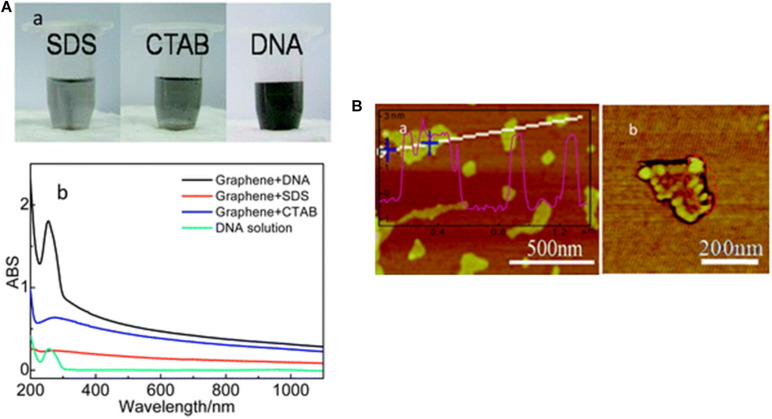
Adsorption of DNA on graphene. (A) Hybridization of graphene with ss-DNA strands. (a) digital photos of graphene suspensions with different dispersants (SDS, CTAB and DNA); (b) UV-vis spectra of DNA aqueous solution and graphene suspensions. (B) AFM images of graphene-DNA GN/DNA hybrids. (a) AFM image with a cross-section contour and (b) a phase image of a single GN/DNA sheet. Reproduced with permission from Li et al. (2013).
FIGURE 6
FIGURE 6
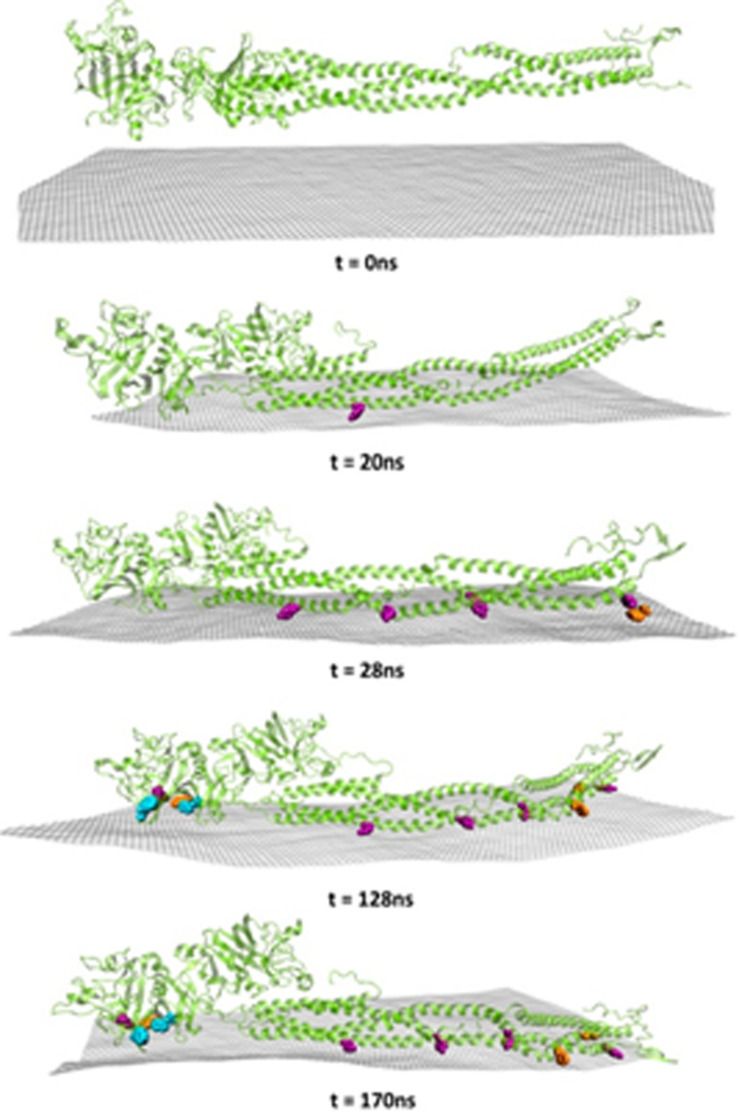
Molecular dynamics snapshots of the absorption of bovine fibrinogen onto graphene. Cartoon representations of the full protein are depicted in yellow, and hydrophobic Tyr (purple), Phe (orange), and Trp (blue) within 0.5 nm distance of the graphene surface are represented as van der Waals spheres. Atoms corresponding to the graphene sheet are colored in gray. Reproduced with permission from Yadav et al. (2013).
FIGURE 7
FIGURE 7
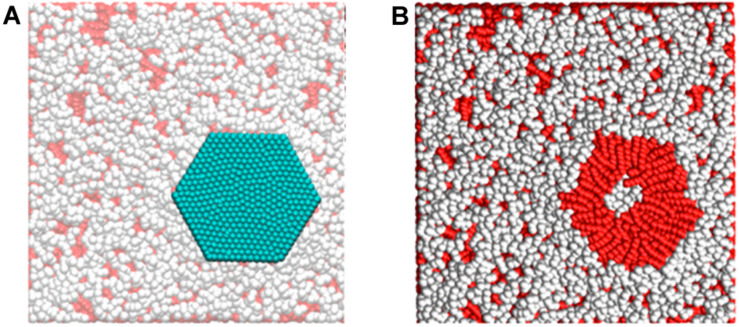
(A) Sheet adhering to the phospholipid membrane. (B) Peeling off the sheet shows that the hydrophobic tails directly interact with hydrophobic graphene. Reproduced with permission from Liu S. et al. (2011).

References

    1. Abou Neel E. A., Ahmed I., Pratten J., Nazhat S. N., Knowles J. C. (2005). Characterisation of antibacterial copper releasing degradable phosphate glass fibres. Biomaterials 26 2247–2254. 10.1016/j.biomaterials.2004.07.024 - DOI - PubMed
    1. Akhavan O., Ghaderi E. (2010). Toxicity of graphene and graphene oxide nanowalls against bacteria. ACS Nano 4 5731–5736. 10.1021/nn101390x - DOI - PubMed
    1. Akhavan O., Ghaderi E. (2012). Escherichia coli bacteria reduce graphene oxide to bactericidal graphene in a self-limiting manner. Carbon 50 1853–1860. 10.1016/j.carbon.2011.12.035 - DOI
    1. Akhavan O., Ghaderi E., Akhavan A. (2012). Size-dependent genotoxicity of graphene nanoplatelets in human stem cells. Biomaterials 33 8017–8025. 10.1016/j.biomaterials.2012.07.040 - DOI - PubMed
    1. Akhavan O., Ghaderi E., Esfandiar A. (2011). Wrapping bacteria by graphene nanosheets for isolation from environment, reactivation by sonication, and inactivation by near-infrared irradiation. J. Phys. Chem. B 115 6279–6288. 10.1021/jp200686k - DOI - PubMed

LinkOut - more resources