


[Ocrelizumab for treatment of multiple sclerosis]
- PMID: 32524163
- PMCID: PMC7286209
- DOI: 10.1007/s00115-020-00937-6
[Ocrelizumab for treatment of multiple sclerosis]
Erratum in
-
[Erratum to: Ocrelizumab for treatment of multiple sclerosis].Nervenarzt. 2020 Aug;91(8):735-736. doi: 10.1007/s00115-020-00956-3. Nervenarzt. 2020. PMID: 32725489 Free PMC article. German. No abstract available.
Abstract
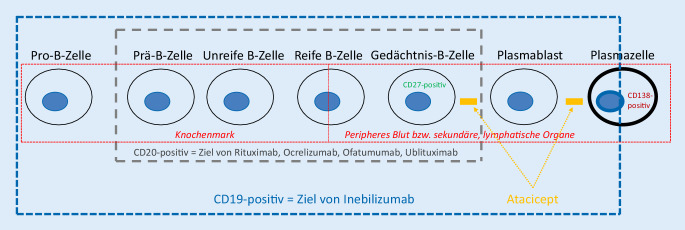
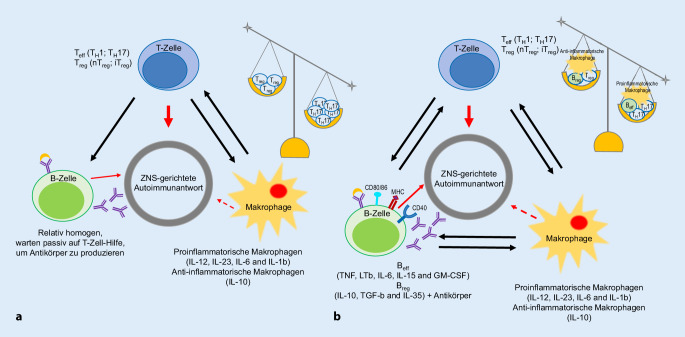
Ocrelizumab is a monoclonal antibody directed against the differentiation antigen CD20, which leads to an effective long-term depletion of lymphocytes, in particular B cells. Recently published phase 3 studies confirmed that ocrelizumab is effective in the treatment of both relapsing multiple sclerosis (RMS) and primary progressive multiple sclerosis (PPMS). Based on these results, ocrelizumab was the first drug to be approved for primary chronic progressive MS. To place this therapeutic breakthrough in the context of the current MS therapeutic landscape, it is worthwhile taking a look back at the development of antibody-mediated CD20 depletion, the studies underlying the approval of ocrelizumab and their open extension phases. This review article discusses the available data on the efficacy and safety of long-term B‑cell depletion in MS patients and reviews current knowledge on the role of B‑lymphocytes in the immunopathogenesis of MS.
Ocrelizumab ist ein monoklonaler Antikörper, der sich gegen das Differenzierungsantigen CD20 richtet und zu einer effektiven längerfristigen Depletion von Lymphozyten, insbesondere von B‑Zellen, führt. Unlängst publizierte Phase-3-Studien belegen, dass Ocrelizumab sowohl bei der Behandlung der schubförmigen als auch der primär progressiven Multiplen Sklerose (MS) wirksam ist. Darauf basierend wurde Ocrelizumab als erstes Medikament zur Behandlung der primär chronisch-progredienten MS zugelassen. Um diesen Durchbruch besser in den Kontext des heutigen MS-Therapiekanons einordnen zu können, lohnt sowohl ein Blick zurück auf die Entwicklung der antikörpervermittelten CD20-Depletion als auch auf die der Zulassung zugrunde liegenden Studien sowie deren Extensionsphasen. Diese Übersichtsarbeit diskutiert die verfügbaren Daten zur Wirksamkeit und Sicherheit der langfristigen B‑Zell-Depletion bei MS-Patienten und erörtert den aktuellen Kenntnisstand zur Rolle von B‑Lymphozyten in der Immunpathogenese der MS.
Keywords: B cell depleting monoclonal antibodies; B cells; Clinical neuroimmunology; Immunosuppression; Neuroinflammation.
References
Publication types
MeSH terms
Substances
LinkOut - more resources
Full Text Sources
Other Literature Sources
Medical
