


New Medications Are Needed for Children With Juvenile Idiopathic Arthritis
- PMID: 32524767
- PMCID: PMC7722045
- DOI: 10.1002/art.41390
New Medications Are Needed for Children With Juvenile Idiopathic Arthritis
Abstract
Objective: To document the need for additional Food and Drug Administration (FDA)-approved medications for the treatment of juvenile idiopathic arthritis (JIA).
Methods: The electronic medical records of JIA patients treated at Cincinnati Children's Hospital Medical Center (CCHMC) and data from JIA patients enrolled in the Childhood Arthritis and Rheumatology Research Alliance (CARRA) Registry were included in this study. Unmet medication need was defined in 2 ways: (a) the presence of chronically uncontrolled JIA, defined as a physician global assessment of JIA activity ≥3 (on a 0-10 scale, where 0 = inactive) OR ≥3 joints with active arthritis OR a patient global assessment of well-being ≥3 (on a 0-10 scale, where 0 = very well), despite sequential use of ≥2 biologic disease-modifying antirheumatic drugs (bDMARDs); and (b) the use of ≥1 bDMARD not approved for any JIA category.
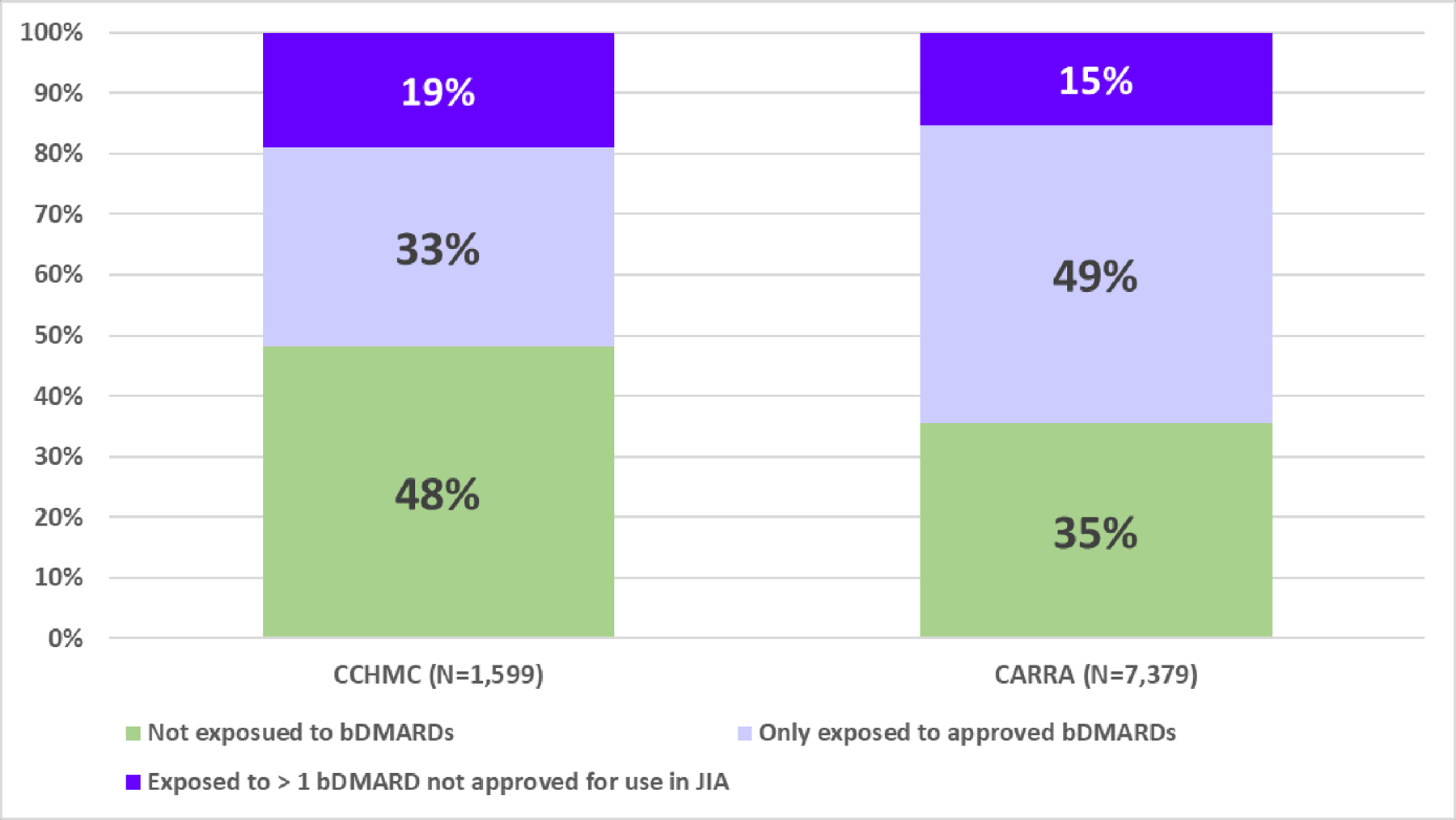
Results: At CCHMC, 829 of 1,599 JIA patients (52%) were treated with ≥1 bDMARD, and 304 (19%) had been exposed to ≥1 unapproved bDMARD. In the CARRA Registry, 4,766 of 7,379 children (65%) had received ≥1 bDMARD, and 1,122 (15%) had been prescribed ≥1 unapproved bDMARD. Of those children treated with ≥2 bDMARDs for whom complete data were available, 52% (255 of 487) at CCHMC and 45% (527 of 1,159) in the CARRA Registry had chronically uncontrolled JIA despite the use of ≥2 bDMARDs.
Conclusion: Despite the availability of bDMARDs currently approved for JIA, there is persistent need for additional therapies to control JIA signs and symptoms. Since FDA approval is critical to ensure access to bDMARDs, the study and licensing of new medications is critical to address the unmet medication need and to further improve JIA outcomes.
© 2020, American College of Rheumatology.
Figures
References
-
- Ringold S, Weiss PF, Beukelman T, DeWitt EM, Ilowite NT, Kimura Y, et al. 2013 update of the 2011 American College of Rheumatology recommendations for the treatment of juvenile idiopathic arthritis: recommendations for the medical therapy of children with systemic juvenile idiopathic arthritis and tuberculosis screening among children receiving biologic medications. Arthritis Rheum 2013;65(10):2499–512. - PMC - PubMed
-
- Angeles-Han ST, Ringold S, Beukelman T, Lovell D, Cuello CA, Becker ML, et al. 2019 American College of Rheumatology/Arthritis Foundation Guideline for the Screening, Monitoring, and Treatment of Juvenile Idiopathic Arthritis-Associated Uveitis. Arthritis Care Res (Hoboken) 2019;71(6):703–16. - PMC - PubMed
-
- Ringold S, Angeles-Han ST, Beukelman T, Lovell D, Cuello CA, Becker ML, et al. 2019 American College of Rheumatology/Arthritis Foundation Guideline for the Treatment of Juvenile Idiopathic Arthritis: Therapeutic Approaches for Non-Systemic Polyarthritis, Sacroiliitis, and Enthesitis. Arthritis Rheumatol 2019;71(6):846–63. - PMC - PubMed
-
- Best pharmaceuticals for children act of 2007. Food and Drug Administration Amendments Act (FDAAA), Title V
-
- Pediatric Research Equity Act. 2003:Pub L No. 108–55
Publication types
MeSH terms
Substances
Grants and funding
LinkOut - more resources
Full Text Sources
Medical
