


Robotic-Assisted Simple Prostatectomy: A Systematic Review
- PMID: 32527020
- PMCID: PMC7356910
- DOI: 10.3390/jcm9061798
Robotic-Assisted Simple Prostatectomy: A Systematic Review
Abstract
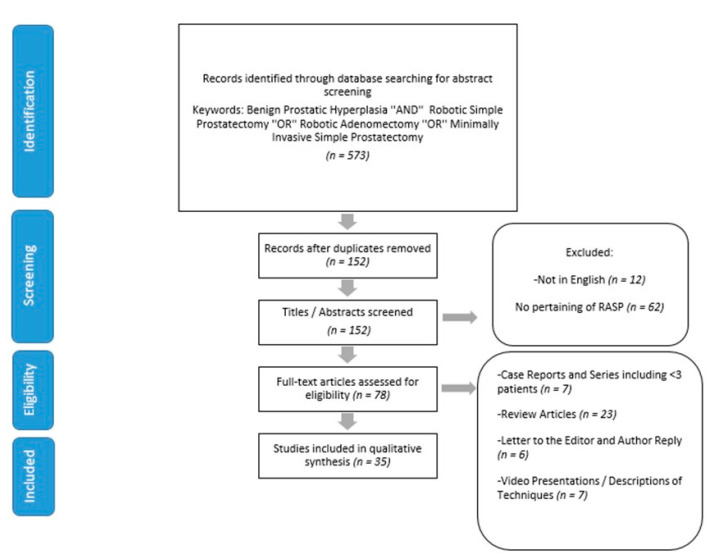
Contemporary minimally invasive surgical (MIS) treatment options of patients with male Lower Urinary Tract Symptoms (LUTS) in men with prostate glands >80 mL include Holmium Laser Enucleation Prostate (HoLEP), Thulium laser VapoEnucleation Prostate (ThuVEP), and Laparoscopic (LSP) or Robotic-Assisted Simple Prostatectomy (RASP). Implementing new laser technologies is costly, and the steep learning curve of these laser techniques limit their wide range use. This promoted the use of LSP and RASP in centers with readily established laparoscopy or robotic surgery programs. The aim of this study is to review case and comparative series of RASP. We systematically reviewed published data from 2008 to 2020 on RASP and have identified 26 non-comparative and 9 comparative case series. RASP has longer operation time but less time spent in hospital and less blood loss. The outcomes of improvements in symptom score, post-voiding residual urine (PVR), postoperative PSA decline, complications, and cost are similar when compared to open and laser enucleation techniques. These outcomes position RASP as a viable MIS treatment option for patients with male LUTS needing surgical treatment for enlarged prostates. Nevertheless, prospective, randomized controlled trials (RCTs) with multicenter and large sample size are needed to confirm the findings of this systematic review.
Keywords: benign prostate hyperplasia; miminally invasive simple prostatectomy; minimally invasive adenomectomy; robotic adenomectomy; robotic simple prostatectomy.
Conflict of interest statement
The authors declare no conflict of interest.
Figures
References
-
- Elshal A.M., El-Nahas A.R., Barakat T.S., Elsaadany M.M., El-Hefnawy A.S. Transvesical open prostatectomy for benign prostatic hyperplasia in the era of minimally invasive surgery: Perioperative outcomes of a contemporary series. Arab. J. Urol. 2013;11:362–368. doi: 10.1016/j.aju.2013.06.003. - DOI - PMC - PubMed
-
- Foster H.E., Barry M.J., Dahm P., Gandhi M.C., Kaplan S.A., Kohler T.S., Lerner L.B., Lightner D.J., Parsons J.K., Roehrborn C.G., et al. Surgical Management of Lower Urinary Tract Symptoms Attributed to Benign Prostatic Hyperplasia: AUA Guideline. J. Urol. 2018;200:612–619. doi: 10.1016/j.juro.2018.05.048. - DOI - PubMed
Publication types
LinkOut - more resources
Full Text Sources
Research Materials
Miscellaneous
