Randomized Controlled Trial
. 2020 Jun 11;17(1):72.
doi: 10.1186/s12984-020-00706-1.

Neurophysiological signatures of hand motor response to dual-transcranial direct current stimulation in subacute stroke: a TMS and MEG study

Affiliations
Randomized Controlled Trial

Neurophysiological signatures of hand motor response to dual-transcranial direct current stimulation in subacute stroke: a TMS and MEG study

I-Ju Kuo et al. J Neuroeng Rehabil. .

Abstract

Background: Dual transcranial direct current stimulation (tDCS) to the bilateral primary motor cortices (M1s) has potential benefits in chronic stroke, but its effects in subacute stroke, when behavioural effects might be expected to be greater, have been relatively unexplored. Here, we examined the neurophysiological effects and the factors influencing responsiveness of dual-tDCS in subacute stroke survivors.

Methods: We conducted a randomized sham-controlled crossover study in 18 survivors with first-ever, unilateral subcortical ischaemic stroke 2-4 weeks after stroke onset and 14 matched healthy controls. Participants had real dual-tDCS (with an ipsilesional [right for controls] M1 anode and a contralesional M1 [left for controls] cathode; 2 mA for 20mins) and sham dual-tDCS on separate days, with concurrent paretic [left for controls] hand exercise. Using transcranial magnetic stimulation (TMS) and magnetoencephalography (MEG), we recorded motor evoked potentials (MEPs), the ipsilateral silent period (iSP), short-interval intracortical inhibition, and finger movement-related cortical oscillations before and immediately after tDCS.

Results: Stroke survivors had decreased excitability in ipsilesional M1 with a relatively excessive transcallosal inhibition from the contralesional to ipsilesional hemisphere at baseline compared with controls, as quantified by decreased MEPs and increased iSP duration. Dual-tDCS led to increased MEPs and decreased iSP duration in ipsilesional M1. The magnitude of the tDCS-induced MEP increase in stroke survivors was predicted by baseline contralesional-to-ipsilesional transcallosal inhibition (iSP) ratio. Baseline post-movement synchronization in α-band activity in ipsilesional M1 was decreased after stroke compared with controls, and its tDCS-induced increase correlated with upper limb score in stroke survivors. No significant adverse effects were observed during or after dual-tDCS.

Conclusions: Task-concurrent dual-tDCS in subacute stroke can safely and effectively modulate bilateral M1 excitability and inter-hemispheric imbalance and also movement-related α-activity.

Keywords: Magnetoencephalography; Plasticity; Subacute stroke; Transcallosal inhibition; Transcranial direct current stimulation; Transcranial magnetic stimulation.


Conflict of interest statement

The authors declare that they have no competing interests.

Figures

Fig. 1
Fig. 1
Stroke lesion map and study design. a The overlapped lesion map of the stroke survivors (N = 18). The colour spectrum represents the number of patients containing lesions at the corresponding locations. b The crossover study design. Four dual-transcranial direct current stimulation (tDCS) sessions were performed (TMS + real tDCS, TMS + sham tDCS, MEG + real tDCS, MEG + sham tDCS) for each participant. The order of the sessions was counterbalanced across the groups. c Schematic illustration of dual-tDCS montage, with anodal electrode over right or ipsilesional hemispheric primary motor cortex (M1) and cathodal electrode over left or contralesional M1. d picture illustrating the wrist extension movement performed during tDCS stimulation or TMS measurements with surface EMG monitor. See Methods for details TMS = transcranial magnetic stimulation; MEG = magnetoencephalography; EMG = electromyography
Fig. 2
Fig. 2
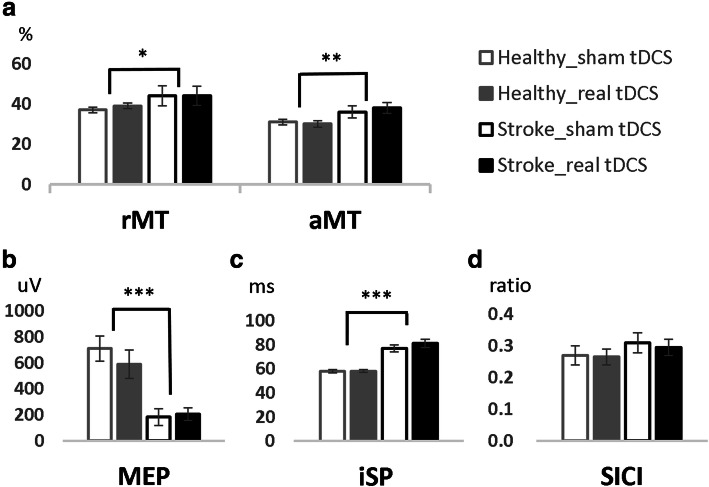
Transcranial magnetic stimulation (TMS) measurements before (baseline) real and sham tDCS. The data were recorded from paretic and non-dominant left extensor carpi radialis muscles in stroke survivors (n = 18) and healthy controls (n = 14), respectively. Mean and standard error across individuals is shown. a Resting and active motor threshold (rMT, aMT, % of maximum stimulator output). b Motor evoked potential (MEP). c Ipsilateral silent period (iSP). d Short-interval intracortical inhibition (SICI). Measures with statistical significance are indicated as: *p < 0.05, **p < 0.01, ***p < 0.001
Fig. 3
Fig. 3
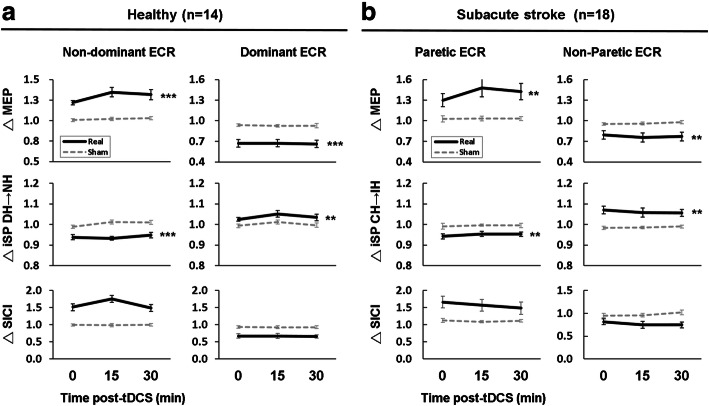
The effect of dual-tDCS on TMS measures over time. a Transcranial magnetic stimulation (TMS) metrics recorded from extensor carpi radialis (ECR) at 0, 15 and 30 min after real (solid line) and sham (dotted line) dual-transcranial direct current stimulation (tDCS) for healthy controls (n = 14) and (b) stroke survivors (n = 18). ΔMEP denotes normalised motor evoked potential (MEP), i.e. MEP post tDCS / MEP before tDCS. The same applies for ipsilateral silent period (iSP) and short-interval intracortical inhibition (SICI). Mean and standard error across individuals is shown. DH = dominant hemisphere; NH = non-dominant hemisphere; IH = ipsilesional hemisphere; CH = contralesional hemisphere. *p < 0.05, **p < 0.01, ***p < 0.001
Fig. 4
Fig. 4
The effect of dual-tDCS in movement-related neural power in stroke survivors (N = 11). a The baseline peak amplitude of ipsilesional (or right for healthy controls) primary motor cortex (M1) event-related desynchronization (ERD) and event-related synchronization (ERS) in α- and β-frequency band before transcranial direct current stimulation (tDCS) was applied. b Time course of movement-related power in the ipsilesional M1 in α (black) and β (gray) frequency band before (dashed) and after (solid) tDCS. The effects of modulation mostly occurred during ERS of α band as indicated by black arrowheads. c Same as A, but the average across individuals of the individuals’ strongest ERS deflection is shown. d Correlation between stimulation-related change of ipsilesional M1 α-ERS (difference between real and sham tDCS) and motor function (ARAT: closed circles and sloid regression line; FMA-UE: open circles and dashed regression line). * p < 0.025, ** p < 0.005, α = 0.025
Fig. 5
Fig. 5
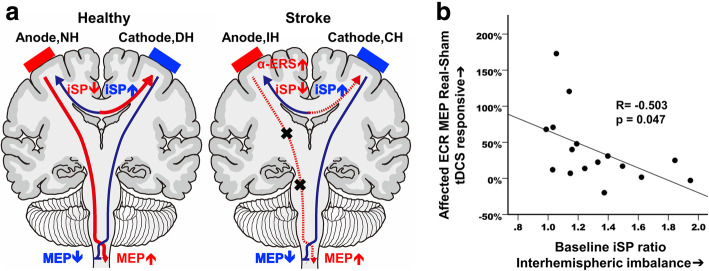
The modulation effects of dual-tDCS and its responsiveness prediction model. a The summarized modulation effects of dual-transcranial direct current stimulation (tDCS) in anodal and cathodal polarities in healthy controls and stroke survivors. b The dual-tDCS responsiveness in paretic hand of subacute stroke survivors could be predicted from baseline ipsilateral silent period (iSP) ratio. In linear regression analysis, the baseline iSP ratio, i.e. contralesional / ipsilesional hemispheric iSP before tDCS, could significantly and negatively predict changes of normalized motor evoked potentials (MEP), i.e. MEP post tDCS / MEP before tDCS in real relative to sham stimulation. α-ERS: Alpha band event related synchronization; NH: non-dominant hemisphere; DH: dominant hemisphere; IH: ipsilesional hemisphere; CH: contralesional hemisphere

References

    1. Kubis N. Non-invasive brain stimulation to enhance post-stroke recovery. Front Neural Circuits. 2016;10:56. - PMC - PubMed
    1. Stagg CJ, Nitsche MA. Physiological basis of transcranial direct current stimulation. Neuroscientist. 2011;17(1):37–53. - PubMed
    1. Nitsche MA, Paulus W. Excitability changes induced in the human motor cortex by weak transcranial direct current stimulation. J Physiol. 2000;527(Pt 3):633–639. - PMC - PubMed
    1. Takeuchi N, Izumi S. Noninvasive brain stimulation for motor recovery after stroke: mechanisms and future views. Stroke Res Treat. 2012;2012:584727. - PMC - PubMed
    1. Elsner B, Kugler J, Pohl M, Mehrholz J. Transcranial direct current stimulation (tDCS) for improving activities of daily living, and physical and cognitive functioning, in people after stroke. Cochrane Database Syst Rev. 2016;3:CD009645. - PMC - PubMed

Publication types