


Identifying airborne transmission as the dominant route for the spread of COVID-19
- PMID: 32527856
- PMCID: PMC7334447
- DOI: 10.1073/pnas.2009637117
Identifying airborne transmission as the dominant route for the spread of COVID-19
Erratum in
-
Correction for Zhang et al., Identifying airborne transmission as the dominant route for the spread of COVID-19.Proc Natl Acad Sci U S A. 2020 Oct 13;117(41):25942-25943. doi: 10.1073/pnas.2018637117. Epub 2020 Oct 5. Proc Natl Acad Sci U S A. 2020. PMID: 33020309 Free PMC article. No abstract available.
Abstract
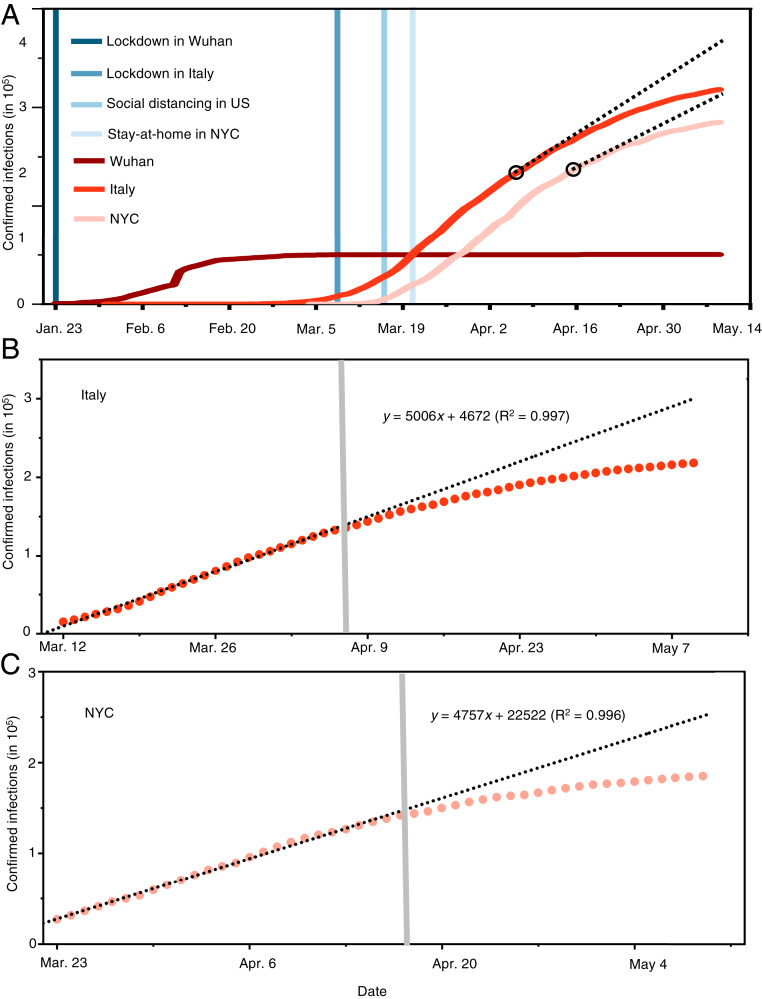
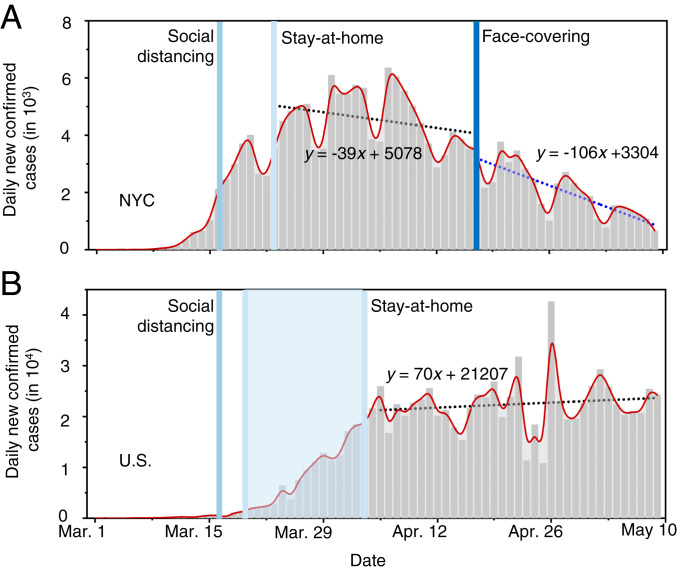
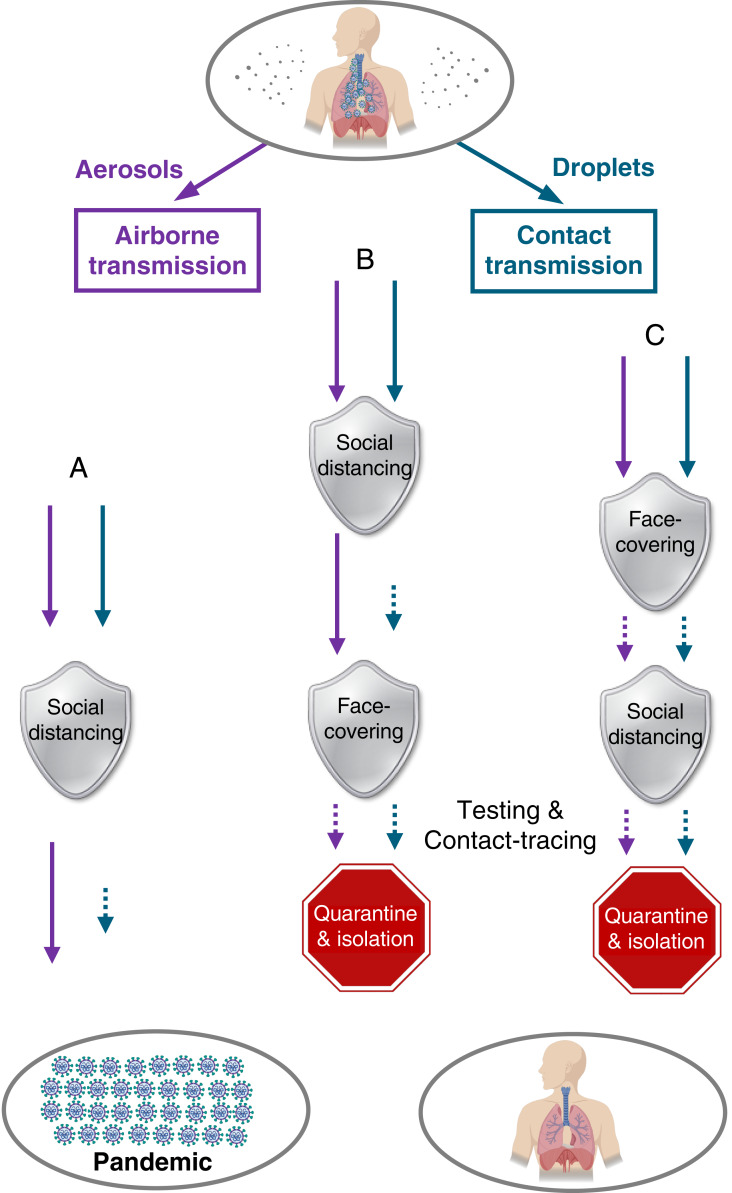
Various mitigation measures have been implemented to fight the coronavirus disease 2019 (COVID-19) pandemic, including widely adopted social distancing and mandated face covering. However, assessing the effectiveness of those intervention practices hinges on the understanding of virus transmission, which remains uncertain. Here we show that airborne transmission is highly virulent and represents the dominant route to spread the disease. By analyzing the trend and mitigation measures in Wuhan, China, Italy, and New York City, from January 23 to May 9, 2020, we illustrate that the impacts of mitigation measures are discernable from the trends of the pandemic. Our analysis reveals that the difference with and without mandated face covering represents the determinant in shaping the pandemic trends in the three epicenters. This protective measure alone significantly reduced the number of infections, that is, by over 78,000 in Italy from April 6 to May 9 and over 66,000 in New York City from April 17 to May 9. Other mitigation measures, such as social distancing implemented in the United States, are insufficient by themselves in protecting the public. We conclude that wearing of face masks in public corresponds to the most effective means to prevent interhuman transmission, and this inexpensive practice, in conjunction with simultaneous social distancing, quarantine, and contact tracing, represents the most likely fighting opportunity to stop the COVID-19 pandemic. Our work also highlights the fact that sound science is essential in decision-making for the current and future public health pandemics.
Keywords: COVID-19; aerosol; pandemic; public health; virus.
Copyright © 2020 the Author(s). Published by PNAS.
Conflict of interest statement
The authors declare no competing interest.
Figures
Comment in
-
COVID-19: in the uncertainty, do not try this at home.Intern Emerg Med. 2020 Nov;15(8):1599-1600. doi: 10.1007/s11739-020-02471-4. Epub 2020 Aug 17. Intern Emerg Med. 2020. PMID: 32803631 Free PMC article. No abstract available.
-
Do face masks help? is not the question.Proc Natl Acad Sci U S A. 2020 Nov 3;117(44):27078-27079. doi: 10.1073/pnas.2012241117. Epub 2020 Oct 6. Proc Natl Acad Sci U S A. 2020. PMID: 33024020 Free PMC article. No abstract available.
-
Protective effect of mandatory face masks in the public-relevant variables with likely impact on outcome were not considered.Proc Natl Acad Sci U S A. 2020 Nov 3;117(44):27076-27077. doi: 10.1073/pnas.2012415117. Epub 2020 Oct 13. Proc Natl Acad Sci U S A. 2020. PMID: 33051301 Free PMC article. No abstract available.
References
-
- World Health Organization , Coronavirus disease (COVID-2019) situation reports. https://www.who.int/emergencies/diseases/novel-coronavirus-2019/situatio.... Accessed 9 May 2020.
Publication types
MeSH terms
LinkOut - more resources
Full Text Sources
Other Literature Sources
Miscellaneous
