. 2020 Jun 11;10(1):9499.
doi: 10.1038/s41598-020-66012-x.

A treponemal genome from an historic plague victim supports a recent emergence of yaws and its presence in 15th century Europe

Affiliations

A treponemal genome from an historic plague victim supports a recent emergence of yaws and its presence in 15th century Europe

Karen Giffin et al. Sci Rep. .

Abstract

Developments in techniques for identification of pathogen DNA in archaeological samples can expand our resolution of disease detection. Our application of a non-targeted molecular screening tool for the parallel detection of pathogens in historical plague victims from post-medieval Lithuania revealed the presence of more than one active disease in one individual. In addition to Yersinia pestis, we detected and genomically characterized a septic infection of Treponema pallidum pertenue, a subtype of the treponemal disease family recognised as the cause of the tropical disease yaws. Our finding in northern Europe of a disease that is currently restricted to equatorial regions is interpreted within an historical framework of intercontinental trade and potential disease movements. Through this we offer an alternative hypothesis for the history and evolution of the treponemal diseases, and posit that yaws be considered an important contributor to the sudden epidemic of late 15th century Europe that is widely ascribed to syphilis.


Conflict of interest statement

The authors declare no competing interests.

Figures
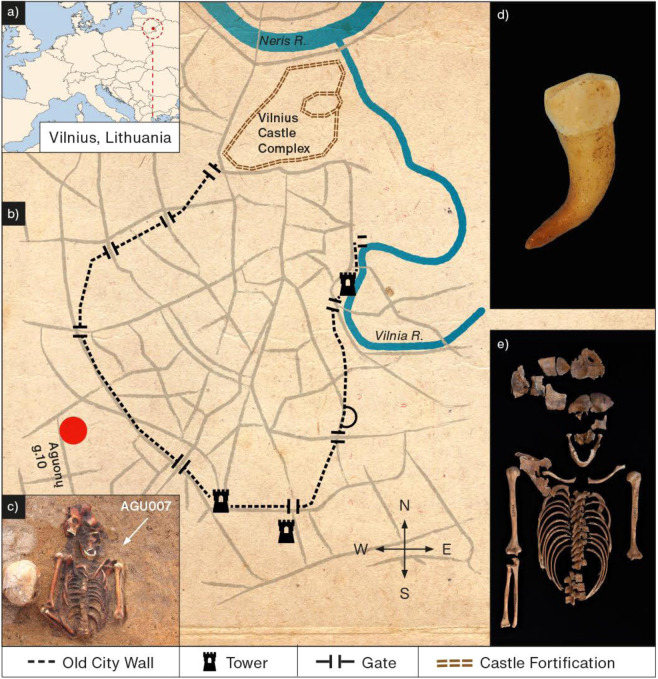
Figure 1
Figure 1
(a,b) Map showing the city of Vilnius, Lithuania, and the relative positions of the castle fortification, the ancient city wall, and the archaeological site, Aguonu g. 10 (red circle). (c) Multiple burial containing individual AGU007, indicated by the white arrow (photograph courtesy of Robertas Žukovskis). (d) Premolar from individual AGU007 used for molecular analyses. (e) exhumed skeleton of individual AGU007 (photograph courtesy of Justina Kozakaitė). Figure created by Hans Sell.
Figure 2
Figure 2
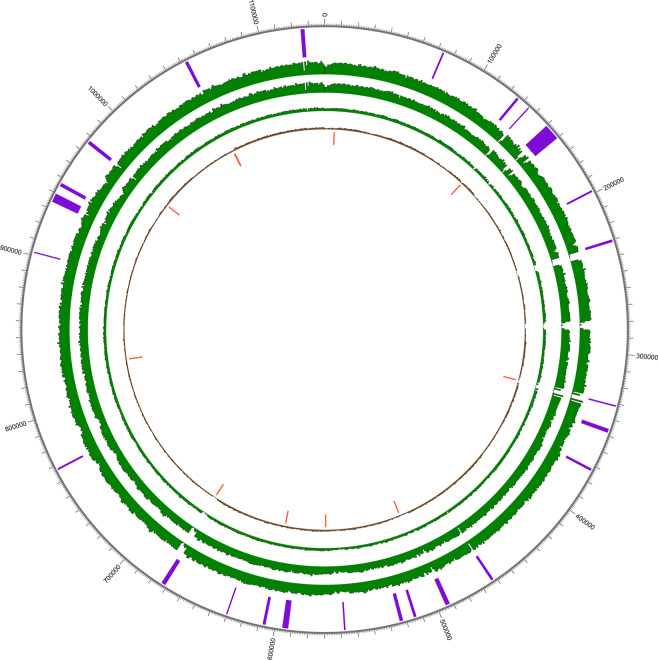
Circos coverage plot for ancient Treponema pallidum pertenue. The innermost circle represents 13 homoplastic sites (orange) detected between pallidum, pertenue and endemicum strains through SNP evaluation. Histogram showing the coverage of ancient pertenue genome 133 (Schuenemann et al., 2018) is shown in brown. Coverages of enriched data for AGU007 are shown in green for first enrichment (inner), second enrichment (middle) and merged set (outer). The outermost positions in purple highlight the recombining regions identified by ClonalFrameML.
Figure 3
Figure 3
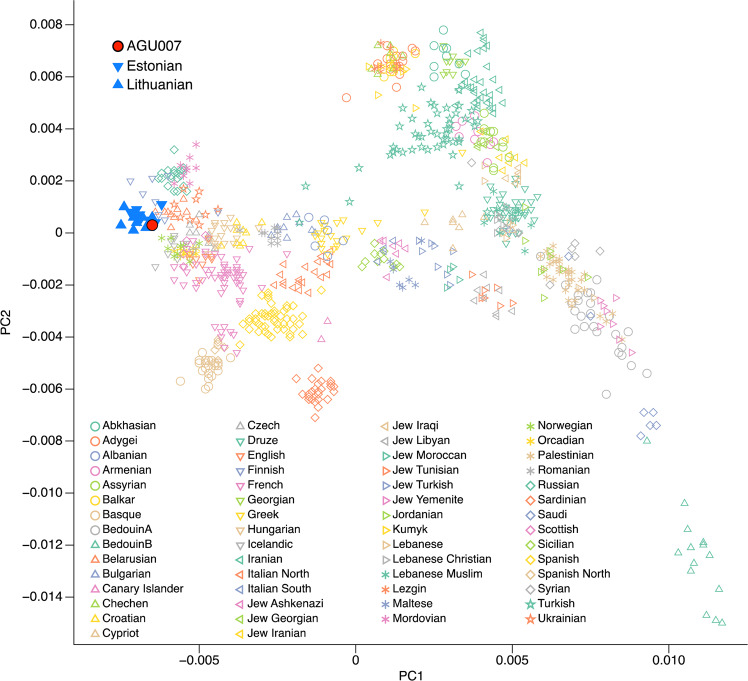
Principal component analysis based on 96,953 SNPs queried against the Human Origins dataset.
Figure 4
Figure 4
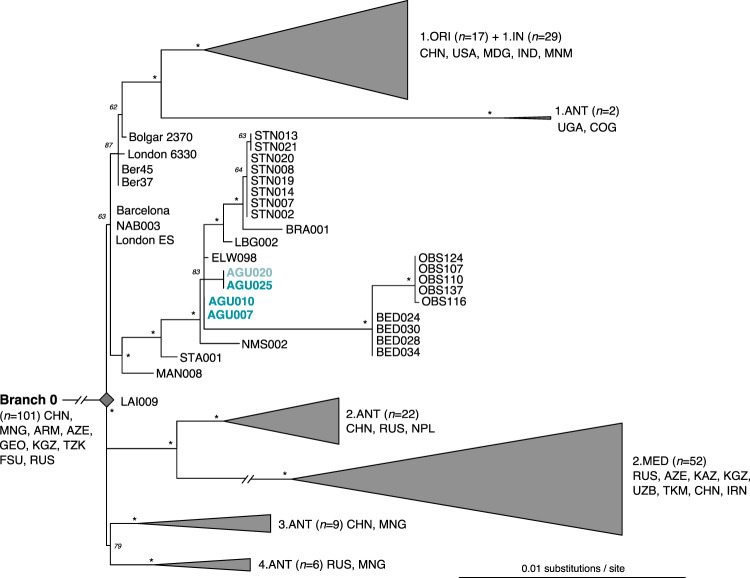
Maximum likelihood tree of post-Black Death genomes of Y. pestis. Constructed from 275 genomes with the Generalised Time Reversible (GTR) model, SNPs identified at 3-fold coverage, 1000 bootstrap replicates, and a 98% partial deletion filter (considering 5801 SNPs). Bootstraps with a value of 95 or greater are indicated with an asterisk (*), and all those lower than 95 are presented with their numeric value. A phylogeny showing all genomes considered in this analysis is presented in Figure S7. The extrapolated position for the low coverage genome from individual AGU020 is shown in faded text.
Figure 5
Figure 5
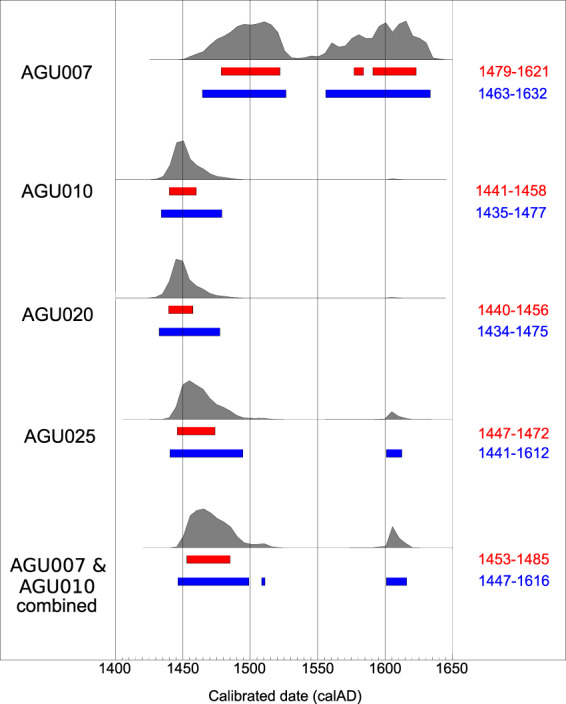
Comparative radiocarbon distribution plots for the individuals with confirmed plague infection. AGU007 (MAMS40889): 14C age = 353 ± 18 yrBP, AGU010 (MAMS40326): 14C age = 426 ± 19 yrBP, AGU020 (MAMS40328): 14C age = 428 ± 19 yrBP, AGU025 (MAMS40329): 14C age = 405 ± 18 yrBP. Sigma-1 ranges are shown in red, sigma-2 in blue. The curve for the combined plots of individuals AGU007 and AGU010 is also shown. (created with Oxcal v4.3.2).
Figure 6
Figure 6
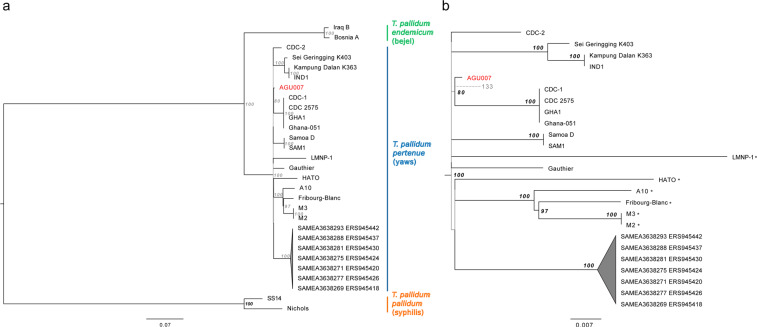
Maximum likelihood phylogenetic tree of T. pallidum with 1000 bootstrap replicates generated after removal of 13 homoplastic positions and 54 regions of recombination, followed by deletion of all sites with ambiguous bases. SNP calling was based on a coverage of 5-fold, and the tree was constructed from 929,012 positions of which 1223 were polymorphic. Figure 6a shows a phylogeny of the full treponemal dataset considered here and 6b shows a zoom of the monophyletic clade of pertenue strains, where all those isolated from non-human primates are distinguished with an asterisk (*). Branches with statistical support less than 80 are depicted in grey. The scale represents mean substitutions per site given a GTR + GAMMA substitution model. Genome AGU007 is shown in red. The dashed branch and faded text depicts the extrapolated position of ancient genome 133.

References

    1. Haak, W. et al. Massive migration from the steppe was a source for Indo-European languages in Europe. Nature522, 207, 10.1038/nature14317, https://www.nature.com/articles/nature14317-supplementary-information (2015). - PMC - PubMed
    1. Weyrich, L. S. et al. Neanderthal behaviour, diet, and disease inferred from ancient DNA in dental calculus. Nature544, 357, 10.1038/nature21674, https://www.nature.com/articles/nature21674-supplementary-information (2017). - PubMed
    1. Krause-Kyora B, et al. Neolithic and medieval virus genomes reveal complex evolution of hepatitis B. eLife. 2018;7:e36666. doi: 10.7554/eLife.36666. - DOI - PMC - PubMed
    1. Rasmussen S, et al. Early Divergent Strains of Yersinia pestis in Eurasia 5,000 Years Ago. Cell. 2015;163:571–582. doi: 10.1016/j.cell.2015.10.009. - DOI - PMC - PubMed
    1. Bos, K. I. et al. Pre-Columbian mycobacterial genomes reveal seals as a source of New World human tuberculosis. Nature514, 494, 10.1038/nature13591, https://www.nature.com/articles/nature13591-supplementary-information (2014). - PMC - PubMed

Publication types