Review
. 2020 Jul;20(7):442-447.
doi: 10.1038/s41577-020-0348-8. Epub 2020 Jun 11.

Considering how biological sex impacts immune responses and COVID-19 outcomes

Affiliations
Review

Considering how biological sex impacts immune responses and COVID-19 outcomes

Eileen P Scully et al. Nat Rev Immunol. 2020 Jul.

Abstract

A male bias in mortality has emerged in the COVID-19 pandemic, which is consistent with the pathogenesis of other viral infections. Biological sex differences may manifest themselves in susceptibility to infection, early pathogenesis, innate viral control, adaptive immune responses or the balance of inflammation and tissue repair in the resolution of infection. We discuss available sex-disaggregated epidemiological data from the COVID-19 pandemic, introduce sex-differential features of immunity and highlight potential sex differences underlying COVID-19 severity. We propose that sex differences in immunopathogenesis will inform mechanisms of COVID-19, identify points for therapeutic intervention and improve vaccine design and increase vaccine efficacy.


Conflict of interest statement

The authors declare no competing interests.

Figures
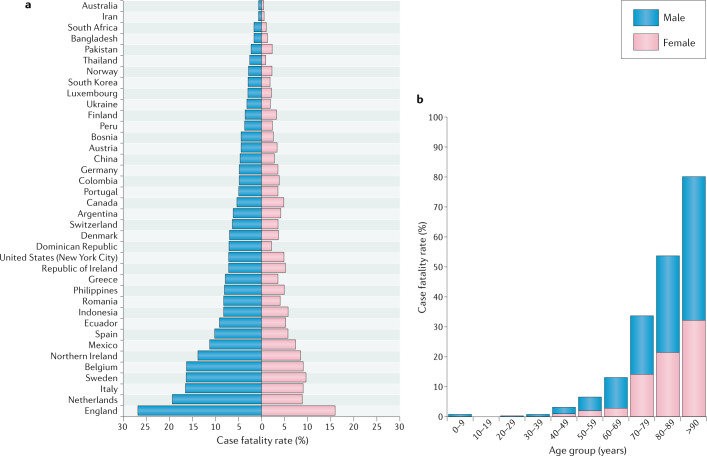
Fig. 1
Fig. 1. Comparative analyses of COVID-19 case fatality rates by country, sex and age.
a | COVID-19 case fatality rates (CFRs) for males and females across 38 countries or regions reporting sex-disaggregated data on COVID-19 cases and deaths. CFR was calculated as the total number of deaths divided by the total number of cases for each sex multiplied by 100. The male CFR is higher than the female CFR in 37 of the 38 regions, with an average male CFR 1.7 times greater than the average female CFR (P < 0.0001, Wilcoxon signed rank test). b | Average COVID-19 CFRs for males and females stratified by age. The data represent 12 countries currently reporting sex- and age-disaggregated data on COVID-19 cases and deaths (Australia, Columbia, Denmark, Italy, Mexico, Norway, Pakistan, Philippines, Portugal, Spain, Switzerland and England). The COVID-19 CFR increases for both sexes with advancing age, but males have a significantly higher CFR than females at all ages from 30 years (P < 0.05, Wilcoxon signed rank test). The data were obtained from Global Health 50/50 and official government websites of each respective country on 7 May and 8 May 2020. For more information on the data source for a specific country, please contact the corresponding author.
Fig. 2
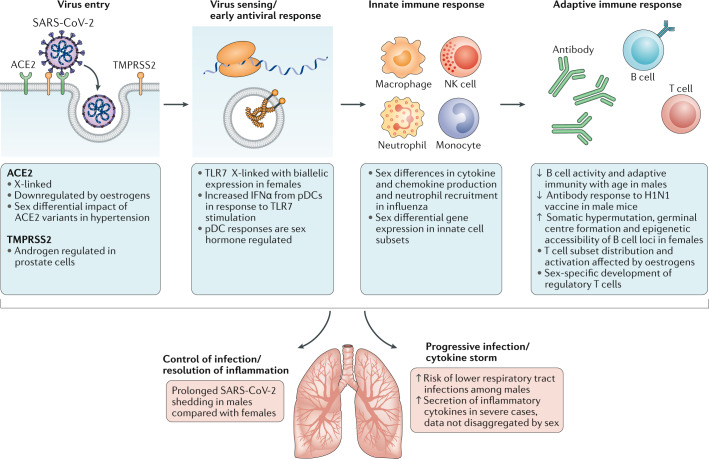
Fig. 2. Known sex differences that may impact immune responses to SARS-CoV-2 and COVID-19 progression.
An illustrative summary of the sequence of events in severe acute respiratory syndrome coronavirus 2 (SARS-CoV-2) infection and the associated immune responses. Broadly speaking (from left to right), there are the initial steps of virus entry, innate recognition of the virus with activation of antiviral programmes, the recruitment of innate immune cells and induction of an adaptive immune response. These major steps culminate either in successful control of infection and pathogen elimination or in a pathological inflammatory state. Sex differences that may be operative at multiple points along these pathways are indicated in the blue boxes. ACE2, angiotensin-converting enzyme 2; H1N1, H1N1 influenza virus; IFNα, interferon-α; NK, natural killer; pDC, plasmacytoid dendritic cell; TLR7, Toll-like receptor 7; TMPRSS2, transmembrane protease serine 2.

References

    1. Mehta P, et al. COVID-19: consider cytokine storm syndromes and immunosuppression. Lancet. 2020;395:1033–1034. doi: 10.1016/S0140-6736(20)30628-0. - DOI - PMC - PubMed
    1. Berlin DA, Gulick RM, Martinez FJ. Severe Covid-19. N. Engl. J. Med. 2020 doi: 10.1056/NEJMcp2009575. - DOI - PubMed
    1. Verdoni L, et al. An outbreak of severe Kawasaki-like disease at the Italian epicentre of the SARS-CoV-2 epidemic: an observational cohort study. Lancet. 2020;395:1771–1778. doi: 10.1016/S0140-6736(20)31103-X. - DOI - PMC - PubMed
    1. Centers for Disease Control and Prevention. Multisystem inflammatory syndrome in children (MIS-C) associated with coronavirus disease 2019 (COVID-19). CDChttps://emergency.cdc.gov/han/2020/han00432.asp (2020).
    1. Vabret N, et al. Immunology of COVID-19: current state of the science. Immunity. 2020 doi: 10.1016/j.immuni.2020.05.002. - DOI - PMC - PubMed

MeSH terms