Review
. 2020 May 26:8:345.
doi: 10.3389/fcell.2020.00345. eCollection 2020.

Ran GTPase: A Key Player in Tumor Progression and Metastasis

Affiliations
Review

Ran GTPase: A Key Player in Tumor Progression and Metastasis

Zied Boudhraa et al. Front Cell Dev Biol. .

Abstract

Ran (Ras-related nuclear protein) GTPase is a member of the Ras superfamily. Like all the GTPases, Ran cycles between an active (GTP-bound) and inactive (GDP-bound) state. However, Ran lacks the CAAX motif at its C-terminus, a feature of other small GTPases that ensures a plasma membrane localization, and largely traffics between the nucleus and the cytoplasm. Ran regulates nucleo-cytoplasmic transport of molecules through the nuclear pore complex and controls cell cycle progression through the regulation of microtubule polymerization and mitotic spindle formation. The disruption of Ran expression has been linked to cancer at different levels - from cancer initiation to metastasis. In the present review, we discuss the contribution of Ran in the acquisition of three hallmarks of cancer, namely, proliferative signaling, resistance to apoptosis, and invasion/metastasis, and highlight its prognostic value in cancer patients. In addition, we discuss the use of this GTPase as a therapeutic target in cancer.

Keywords: Ran GTPase; cancer; metastasis; proliferation; survival.


Figures

FIGURE 1
FIGURE 1
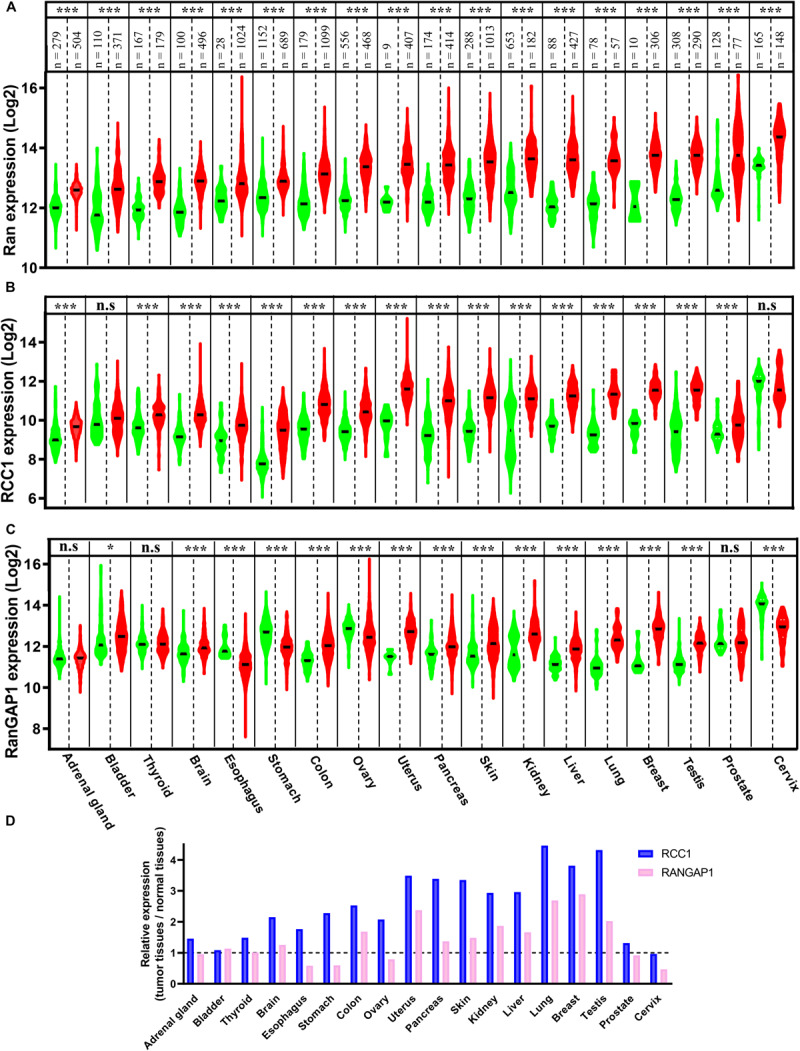
The expression of Ran, Regulator of Chromosome Condensation 1 (RCC1), and RanGAP1 in normal and tumor tissues. The expression of Ran (A), RCC1 (B), and RanGAP1 (C) in normal (green) and tumor tissues (red) was extracted from the Xenabrowser web site. *p < 0.05, ***p < 0.001 (Student’s t-test). (D) The expression of RCC1 (blue) and RanGAP1 (pink) in cancer tissues was expressed as the fold change over normal tissues.
FIGURE 2
FIGURE 2
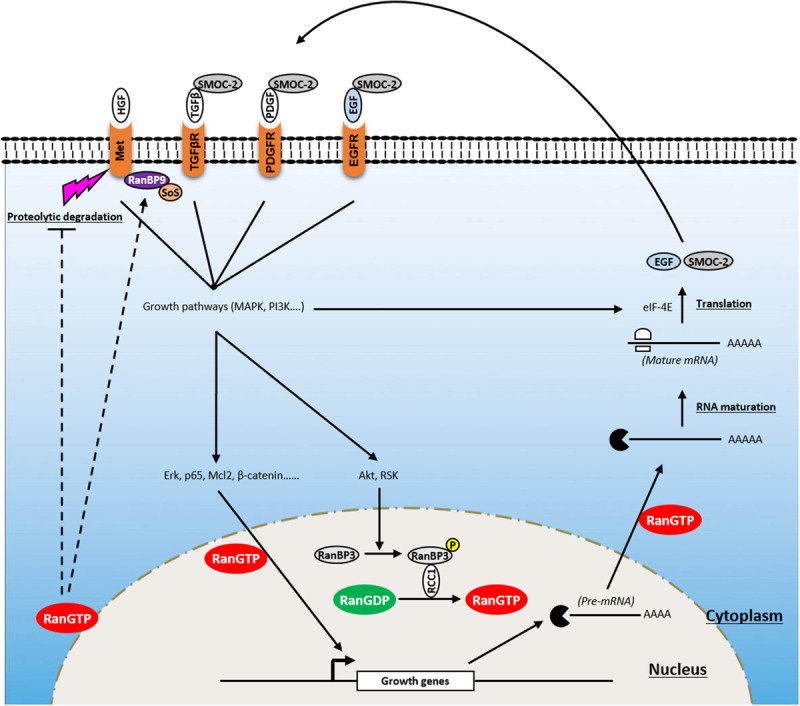
Involvement of Ran in proliferative signaling of cancer cells. Ran is a key player in a positive feedback loop that enhances growth signaling and promotes tumorigenesis. Owing to its ability to affect the import of critical transcription factors (i.e., Erk, p65, Mcl2, β-catenin), RanGTP transmits growth signals from the cytoplasm to the nucleus. RanGTP is also involved in the export of pre-mRNA which are further processed and translated into growth factors [i.e., epidermal growth factor (EGF), SMOC-2) which activate several tyrosine kinase receptors [i.e., EGF receptor (EGFR), platelet-derived growth factor receptor (PDGFR), transforming growth factor beta receptor (TGFβR)] after their release to the extracellular compartment. In addition, Ran is activated following the induction of growth signaling through the phosphorylation of RanBP3 by Akt and ribosomal protein S6 kinase (RSK). Furthermore, besides its ability to modulate the activity of these receptors, Ran is involved in supporting Met signaling through (i) its stabilization by blocking its proteolytic cleavage by metalloproteases and preventing receptor shedding and (ii) the activation of RanBP9 that recruits Son of Sevenless (SoS) which acts upstream of the GTPase Ras.
FIGURE 3
FIGURE 3
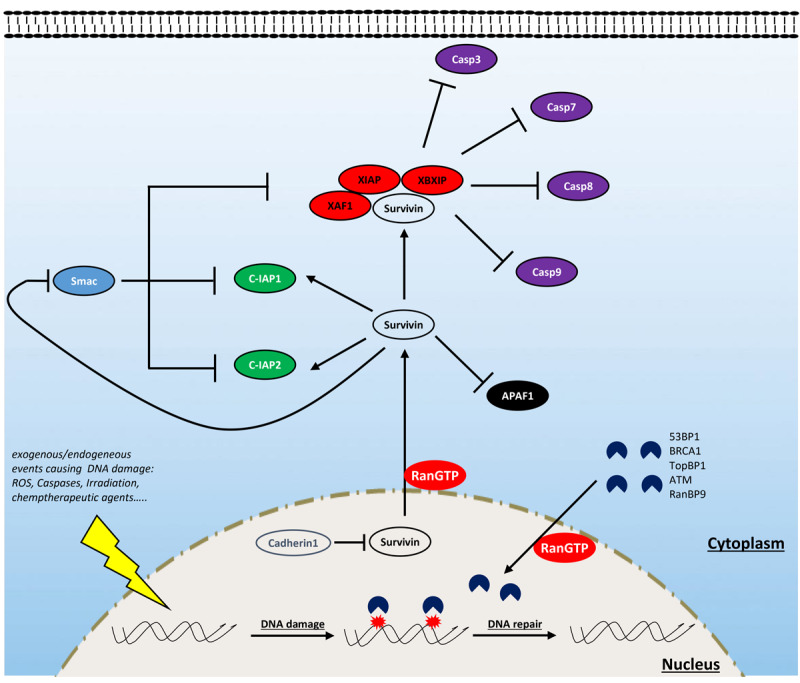
Involvement of Ran in resisting cell death. Ran is involved in resisting cell death through the interaction with survivin and some components of the DNA damage response (DDR). Ran participates in the export of survivin from the nucleus (which is rapidly destabilized by cadherin 1) to the cytoplasm. Cytoplasmic survivin plays a critical role in cell survival by inhibiting proapoptotic factors: while it participates in the formation of a complex with some inhibitors of apoptosis proteins (IAPs) (notably XAF1, XIAP, and XBXIP) to inhibit the activity of caspases 3, 7, 8, and 9, it enhances the activity of other factors such as C-IAP1 and C-IAP2. Furthermore, survivin antagonizes the release of apoptotic protease-activating factor 1 (APAF1) from the mitochondria and constrains the action of the IAP inhibitor Smac. Ran is also an active player of the DDR which is activated following the exposure of cells to endogenous or exogenous DNA-damaging factors [i.e., reactive oxygen species (ROS), caspases, irradiation, and chemotherapy]. During this process, Ran participates in the import of critical components of the DDR such as ATM, BRCA1, TopBP1, and 53BP1.
FIGURE 4
FIGURE 4
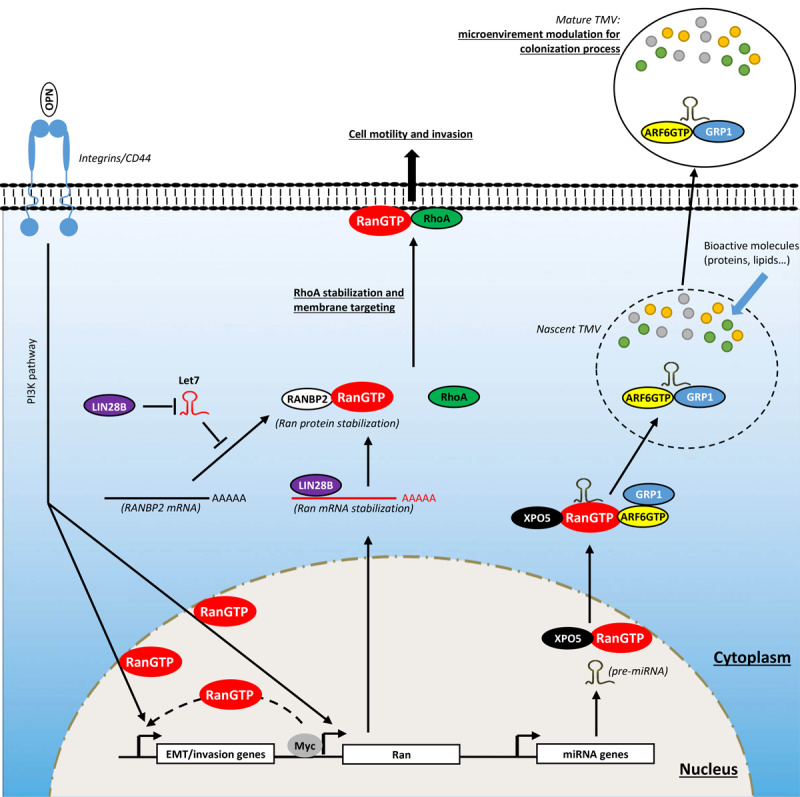
Involvement of Ran in activating invasion and metastasis. Ran, through direct and indirect interactions with oncogenes, is involved in cell invasion. Myc, which is overexpressed in several cancers, interacts directly with the promoter of Ran and induces its expression. The LIN28B oncogene stimulates the expression of Ran directly through the stabilization of its mRNA by direct interaction and indirectly the destabilization of Let7 which is known to destabilize Ran protein through RANBP2 degradation. The induction of Ran promotes cell invasion by different ways: (1) by inducing epithelial-to-mesenchymal transition (EMT); (2) by mediating the invasive signals originating from osteopontin (OPN), Myc, and LIN28B; (3) by stabilizing and targeting RhoA to the plasma membrane; and (4) by delivering oncogenic cargo such as pre-miRNAs to nascent tumor-derived microvesicles (TMVs).

References

    1. Abe H., Kamai T., Shirataki H., Oyama T., Arai K., Yoshida K. (2008). High expression of Ran GTPase is associated with local invasion and metastasis of human clear cell renal cell carcinoma. Int. J. Cancer 122 2391–2397. 10.1002/ijc.23400 - DOI - PubMed
    1. Abels E. R., Breakefield X. O. (2016). Introduction to extracellular vesicles: biogenesis, RNA cargo selection, content, release, and uptake. Cell Mol. Neurobiol. 36 301–312. 10.1007/s10571-016-0366-z - DOI - PMC - PubMed
    1. Anzalone A., Lizardi-Ortiz J. E., Ramos M., De Mei C., Hopf F. W., Iaccarino C., et al. (2012). Dual control of dopamine synthesis and release by presynaptic and postsynaptic dopamine D2 receptors. J. Neurosci. 32 9023–9034. 10.1523/JNEUROSCI.0918-12.2012 - DOI - PMC - PubMed
    1. Azuma K., Sasada T., Takedatsu H., Shomura H., Koga M., Maeda Y., et al. (2004). Ran, a small GTPase gene, encodes cytotoxic T lymphocyte (CTL) epitopes capable of inducing HLA-A33-restricted and tumor-reactive CTLs in cancer patients. Clin. Cancer Res. 10 6695–6702. 10.1158/1078-0432.CCR-04-0818 - DOI - PubMed
    1. Bai L., Michael W. M., Yan S. (2014). Importin beta-dependent nuclear import of TopBP1 in ATR-Chk1 checkpoint in Xenopus egg extracts. Cell. Signal. 26 857–867. 10.1016/j.cellsig.2014.01.006 - DOI - PMC - PubMed