Review
. 2020 May 4:6:100055.
doi: 10.1016/j.mtbio.2020.100055. eCollection 2020 Mar.

Advances in nanotechnology-based strategies for the treatments of amyotrophic lateral sclerosis

Affiliations
Review

Advances in nanotechnology-based strategies for the treatments of amyotrophic lateral sclerosis

G Y Wang et al. Mater Today Bio. .

Abstract

Amyotrophic lateral sclerosis (ALS), also known as motor neuron disease (MND), is a progressive neurodegenerative disease that affects both upper and lower motor neurons, which results in loss of muscle control and eventual paralysis [1]. Currently, there are as yet unresolved challenges regarding efficient drug delivery into the central nervous system (CNS). These challenges can be attributed to multiple factors including the presence of the blood-brain barrier (BBB), blood-spinal cord barrier (BSCB), as well as the inherent characteristics of the drugs themselves (e.g. low solubility, insufficient bioavailability/bio-stability, 'off-target' effects) etc. As a result, conventional drug delivery systems may not facilitate adequate dosage of the required drugs for functional recovery in ALS patients. Nanotechnology-based strategies, however, employ engineered nanostructures that show great potential in delivering single or combined therapeutic agents to overcome the biological barriers, enhance interaction with targeted sites, improve drug bioavailability/bio-stability and achieve real-time tracking while minimizing the systemic side-effects. This review provides a concise discussion of recent advances in nanotechnology-based strategies in relation to combating specific pathophysiology relevant to ALS disease progression and investigates the future scope of using nanotechnology to develop innovative treatments for ALS patients.

Keywords: Amyotrophic lateral sclerosis (ALS); Blood-brain barrier; Central nervous system (CNS); Nanotechnology; Neurodegenerative diseases.


Figures

Image 1
Graphical abstract
Fig. 1
Fig. 1
(A) Schematic illustration of the human corticospinal tract. The vulnerable and resistant motor neuron (MN) groups in ALS are shown in red and blue, respectively. Reproduced with permission from Ref. [4]. (B) The proposed cellular and molecular mechanisms involved in ALS. Reproduced with permission from Refs. [6]. Schematic structure of the blood–brain barrier (BBB) (C) and the blood–spinal cord barrier (BSCB) (D) that together comprise the blood–Central Nervous System (CNS) barrier. Reproduced with permission from Ref. [13,14].
Fig. 2
Fig. 2
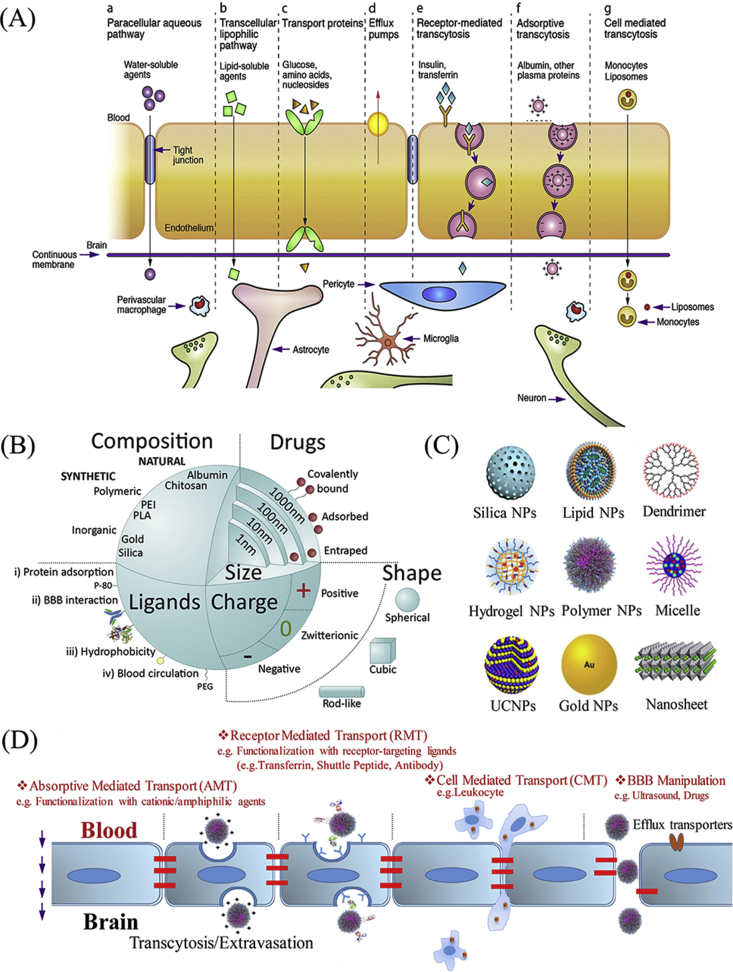
(A) Typical blood-brain barrier transport pathways for substances passing through the BBB. Reproduced with permission from Refs. [42]. (B) Major features of NPs which affect the permeability of NPs through the BBB. Reproduced with permission from Refs. [60]. (C) Typical nanostructures used for drug delivery or imaging. (D) Typical non-invasive nanotechnology-based CNS drug-delivery strategies to cross the BBB.
Fig. 3
Fig. 3
Schematic illustration of the formation of MBPC nanoparticles and their switchable assembly in vivo. a) Assembly of levodopa-quinone gold nanoparticles (GNP) and pro-drugs BPC and MPC to form MBPCs and the siRNA loading procedure. b) Switchable assembly of GNP in vivo: 1-1 drug-gene codelivery as MBPCS circulates in the blood; 1–2 MBPCS penetrate the BBB via B6 peptide-mediated transport; 1–3 Neuron targeting via Mazindol (MA); 2 ROS-mediated drug release; 2′ Aggregated Au clusters permit imaging via enhancing computed tomography (CT). Reproduced with permission from Refs. [114].
Fig. 4
Fig. 4
Schematic illustration of glutamate transporter 1 (GLT1) regulator loaded nanoparticles traversing the BBB to regulate GLT1 expression. GLT1 regulator loaded NPs can be facilitated to cross BBB through surface functionalization with brain targeting ligands. Drugs absorbed in astrocytes will regulate GLT1 expression and subsequently restore their role in regulation glutamate balance. Reproduced with permission from Refs. [117].
Fig. 5
Fig. 5
(A) Edaravone-encapsulated-agonistic micelles enhanced BBB penetration by temporarily triggering TJ opening to rescue ischemic brain tissue. Reproduced with permission from Ref. [129]. (B) Edaravone-loaded ceria nanoparticles penetrate the BBB and mediate neuroprotection in a model of stroke. Reproduced with permission from Ref. [84]. (C) Anti-inflammatory drug-loaded silica-based drug delivery system specifically targets brain injury and SCI sites. Reproduced with permission from Ref. [136].
Fig. 6
Fig. 6
(A) The application of Black Phosphorus Nanosheets for neurodegenerative disease therapy. BP nanosheets cross BBB via near-infrared laser irradiation and protect neurons by selectively capturing excess Cu2+. Reproduced with permission from Refs. [143]. (B) Different CeO2 nanostructures eradicate intracellular, extracellular, and mitochondria ROS, respectively. Reproduced with permission from Refs. [146]. (C) Schematic illustration of T-L5-CoQ10-NP and T-L5-(Asp)4-NP targeting mitochondria in astrocytes to facilitate neuroprotection by protecting astrocytes from mitochondrial dysfunction and oxidative damage. T-L5: TPP–(CH2)5–COOH. TPP: Tri-phenyl-phosphonium. Reproduced with permission from Ref. [105].
Fig. 7
Fig. 7
(A) Delivery of small interfering RNA (siRNA) to neurons via a polymer nanoparticle platform to improve the therapeutic efficacy of amyloid-targeting ligand (QSH) in Alzheimer's disease where CGN functions as a BBB targeting peptide. Reproduced with permission from Ref. [163]. (B) Schematic illustration showing the preparation of a nanoparticle platform to deliver neurotrophic factors to the brain. The surface of NPs can be engineered with brain-specific antibodies, proteins and efflux inhibitors that facilitate NPs penetration. Reproduced with permission from Refs. [167].
Fig. 8
Fig. 8
glycemic control of GLUT1 expression increases the ability of glycosylated nanocarriers to cross the BBB into the brain. (A) Visualize the process of glycemic controlled glycosylated nanocarriers cross the brain blood vessel; After fasting for 24 h, mice were intravenously injected with 25%Gluc(6)/m(red) and intraperitoneal injected with 20% glucose 30 min later. (B) Biodistribution of Null/m and Gluc(6)/m in mice after different feeding control. Data were collected at 48 h post the injection. Reproduced with permission from Refs. [180].
Fig. 9
Fig. 9
(A) Rabies virus mimicking silica-coated gold nanorods bypass the BBB via neuronal pathways to treat brain disease. Reproduced with permission from Ref. [181]. (B) Delivery of therapeutic siRNA to the mouse brain by systemic injection of exosomes. (a) Schematic illustration of the preparation of exosomes; (b) Gene silencing efficiency by different vehicles. Reproduced with permission from Refs. [184].

References

    1. Orsini M., Oliveira A.B., Nascimento O.J., Reis C.H.M., Leite M.A.A., de Souza J.A., Pupe C., de Souza O.G., Bastos V.H., de Freitas M.R. Amyotrophic lateral sclerosis: new perpectives and update. Neurol. Int. 2015;7(2) - PMC - PubMed
    1. Hardiman O., Al-Chalabi A., Chio A., Corr E.M., Logroscino G., Robberecht W., Shaw P.J., Simmons Z., Van Den Berg L.H. Amyotrophic lateral sclerosis. Nature Rev. Disease Prim. 2017;3:17071. - PubMed
    1. Oskarsson B., Gendron T.F., Staff N.P. Mayo Clinic Proceedings. Elsevier; 2018. Amyotrophic lateral sclerosis: an update for 2018; pp. 1617–1628. - PubMed
    1. Ragagnin A.M., Shadfar S., Vidal M., Jamali S., Atkin J.D. Motor neuron susceptibility in ALS/FTD. Front. Neurosci. 2019;13:532. - PMC - PubMed
    1. Chia R., Chiò A., Traynor B.J. Novel genes associated with amyotrophic lateral sclerosis: diagnostic and clinical implications. Lancet Neurol. 2018;17(1):94–102. - PMC - PubMed