Review
. 2020 Aug;63(8):1464-1474.
doi: 10.1007/s00125-020-05177-6. Epub 2020 Jun 11.

Exercise and metabolic health: beyond skeletal muscle

Affiliations
Review

Exercise and metabolic health: beyond skeletal muscle

John P Thyfault et al. Diabetologia. 2020 Aug.

Abstract

Regular exercise is a formidable regulator of insulin sensitivity and overall systemic metabolism through both acute events driven by each exercise bout and through chronic adaptations. As a result, regular exercise significantly reduces the risks for chronic metabolic disease states, including type 2 diabetes and non-alcoholic fatty liver disease. Many of the metabolic health benefits of exercise depend on skeletal muscle adaptations; however, there is plenty of evidence that exercise exerts many of its metabolic benefit through the liver, adipose tissue, vasculature and pancreas. This review will highlight how exercise reduces metabolic disease risk by activating metabolic changes in non-skeletal-muscle tissues. We provide an overview of exercise-induced adaptations within each tissue and discuss emerging work on the exercise-induced integration of inter-tissue communication by a variety of signalling molecules, hormones and cytokines collectively named 'exerkines'. Overall, the evidence clearly indicates that exercise is a robust modulator of metabolism and a powerful protective agent against metabolic disease, and this is likely to be because it robustly improves metabolic function in multiple organs. Graphical abstract.

Keywords: Adipose tissue; Endothelium; Exercise; Exerkines; Liver; Muscle; NAFLD; Pancreas; Review; Type 2 diabetes.


Figures
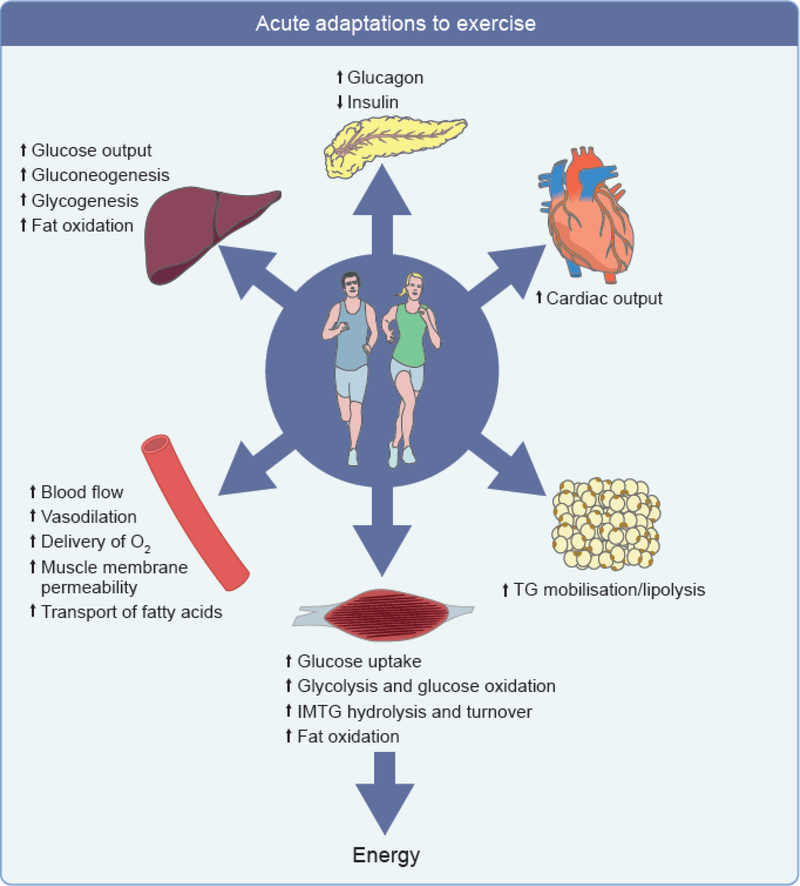
Fig. 1
Fig. 1
Acute metabolic effects of exercise on the key peripheral organs involved in the regulation of energy homeostasis. In response to acute exercise, muscle immediately mobilises stored glucose then fatty acids and takes up glucose and fatty acids from plasma to match energy demand. During sustained exercise, adipose tissue and the liver respectively mobilise NEFA and synthesise glucose to keep providing fuel to muscle. In the meantime, cardiac output is increased and microvascular perfusion of peripheral tissues, capillary recruitment, muscle membrane permeability and transport of substrates is increased. These changes are associated with changes in substrate fluxes and secretion of glucagon and insulin by the pancreas. IMTG, intramuscular triacylglyerols; TG, triacylglycerols.
Fig. 2
Fig. 2
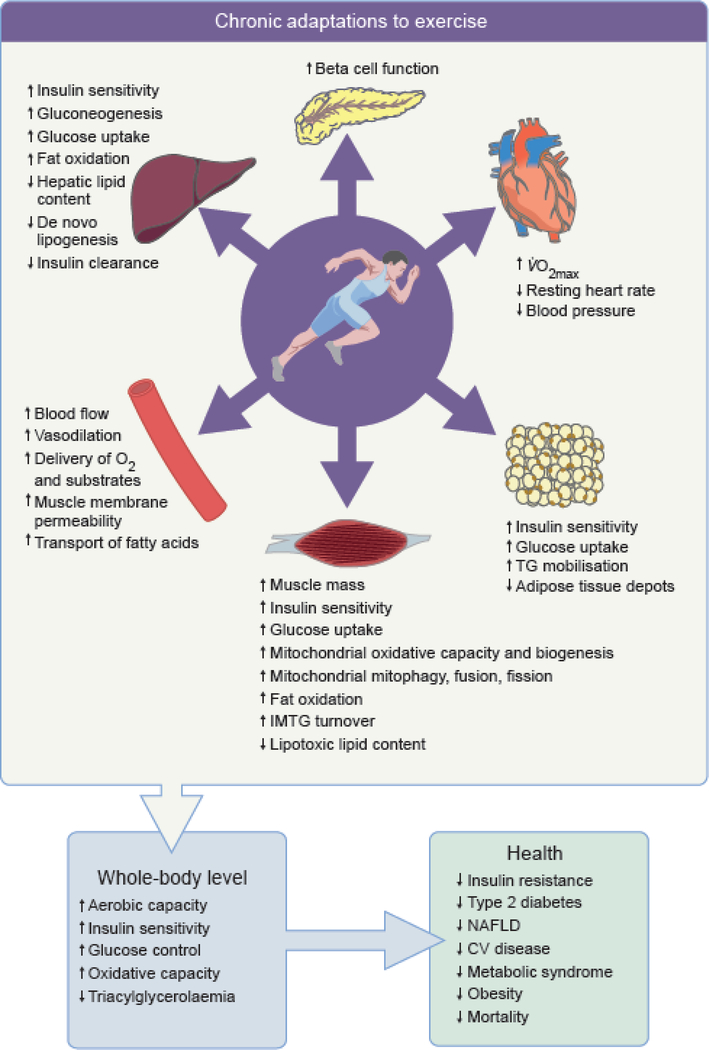
Chronic effects of exercise on key peripheral organs involved in the regulation of energy homeostasis and associated whole-body metabolic effects and systemic health effects. Exercise training improves VO2max, decreases resting heart rate and blood pressure, and increases total muscle mass. Microvascular network is expanded and microvascular dilatory response is improved. Beta cell function is improved along with a greater blood glucose uptake by muscle, adipose tissue and liver and peripheral tissue insulin sensitivity is ameliorated. Capacity for mobilisation of NEFA from adipose tissue is improved along with a greater capacity of liver for glucose production and decrease in de novo lipogenesis. Capacity for oxidising fat in liver and muscle in association with greater mitochondrial oxidative capacity, biogenesis and dynamic. This results in reduced visceral adipose tissue depots and ectopic fat storage. Altogether these structural, functional and metabolic adaptations improve aerobic capacity, whole-body insulin sensitivity, glucose control, oxidative capacity and reduce triglycerolaemia and chronic inflammation. These changes reduce the risk of developing insulin resistance, type 2 diabetes, NAFL and CV diseases, the metabolic syndrome, obesity and, ultimately, early mortality. CV, cardiovascular; IMTG, intramuscular triacylglycerols; TG, triacylglycerols.
Fig. 3
Fig. 3
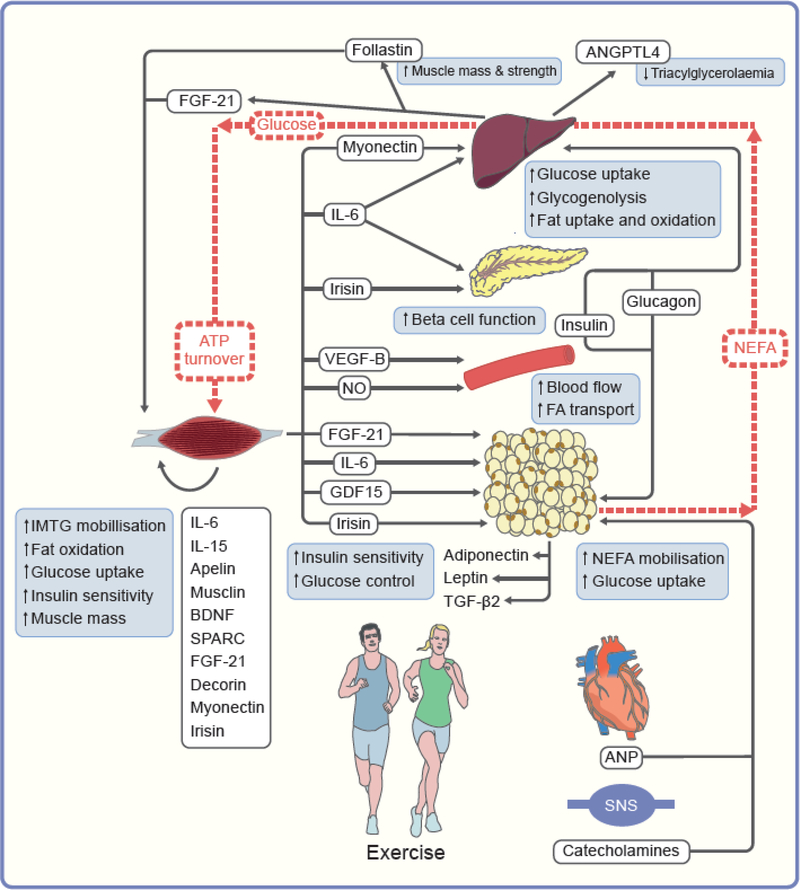
Inter-organ crosstalk and substrate fluxes during exercise. Based on recent data in animals and humans, the following cascade of events is hypothesised to occur during exercise. ATP turnover, glycogen depletion and/or muscle contraction trigger the secretion of myokines that will either act in a paracrine way and act on skeletal muscle mass and metabolism including IL-6 and IL-15, apelin, musclin and BDNF) or in an endocrine fashion on metabolism and function of liver (myonectin, IL-6), pancreas (IL-6), microvasculature (VEGF-B, NO) and adipose tissue (IL-6, FGF21, irisin, GDF15) or other tissues (SPARC and decorin). Pancreatic secretion of glucagon is increased and insulin is decreased, catecholamines are secreted by the sympathetic nervous system and ANP by the heart. These multiple actions concertedly contribute to activate skeletal muscle use of intramuscular fatty acid, fat oxidation, plasma glucose uptake and insulin sensitivity, stimulates adipose tissue NEFA mobilisation, and activates hepatic endogenous glucose production. Together these molecular factors are likely to contribute to the exercise health benefits, i.e. increase in muscle mass, reduced triacylglycerolaemia, improved insulin sensitivity and glucose control. Substrate fluxes are indicated by dotted red lines. ANGPTL4, angiopoietin-like 4;BDNF, brain-derived neurotrophic factor; FGF-21, fibroblast growth factor 21; GDF15, growth and differentiation factor 15; SNS, sympathetic nervous system; SPARC, secreted protein acidic and enriched in cysteine; TG, triacylglycerols; VEFG-B, vascular endothelial growth factor B.

References

    1. Donnelly JE, Blair SN, Jakicic JM, Manore MM, Rankin JW, Smith BK (2009) American College of Sports Medicine Position Stand. Appropriate physical activity intervention strategies for weight loss and prevention of weight regain for adults. Medicine and science in sports and exercise 41(2): 459–471. 10.1249/MSS.0b013e3181949333 - DOI - PubMed
    1. Hashida R, Kawaguchi T, Bekki M, et al. (2017) Aerobic vs. resistance exercise in nonalcoholic fatty liver disease: A systematic review. J Hepatol 66(1): 142–152. 10.1016/j.jhep.2016.08.023 - DOI - PubMed
    1. Katzmarzyk PT (2010) Physical activity, sedentary behavior, and health: paradigm paralysis or paradigm shift? Diabetes 59(11): 2717–2725. 10.2337/dbl0-0822 - DOI - PMC - PubMed
    1. Hodson L, Karpe F (2019) Hyperinsulinemia: does it tip the balance toward intrahepatic fat accumulation? Endocr Connect 8(10):R157–R168. 10.1530/EC-19-0350 - DOI - PMC - PubMed
    1. Meex RCR, Blaak EE, van Loon UC (2019) Lipotoxicity plays a key role in the development of both insulin resistance and muscle atrophy in patients with type 2 diabetes. Obes Rev 20(9): 1205–1217.10.1111/obr.l2862 - DOI - PMC - PubMed