Review
. 2020 Jun 10;9(6):459.
doi: 10.3390/pathogens9060459.

Biological Activity of Quaternary Ammonium Salts and Their Derivatives

Affiliations
Review

Biological Activity of Quaternary Ammonium Salts and Their Derivatives

Dobrawa Kwaśniewska et al. Pathogens. .

Abstract

Besides their positive role, microorganisms are related to a number of undesirable effects, including many diseases, biodeterioration and food spoilage, so when their presence is undesired, they must be controlled. Numerous biocides limiting the development of microorganisms have been proposed, however, in this paper the biocidal and inhibitory activity of quaternary ammonium salts (QASs) and their zwitterionic derivatives is addressed. This paper presents the current state of knowledge about the biocidal activity of QAS and their derivatives. Moreover, the known mechanisms of antimicrobial activity and the problem of emerging resistance to QAS are discussed. The latest trends in the study of surfactants and their potential use are also presented.

Keywords: biocidal activity; quaternary ammonium salts; sulfobetaines.


Conflict of interest statement

The authors declare no conflict of interest.

Figures
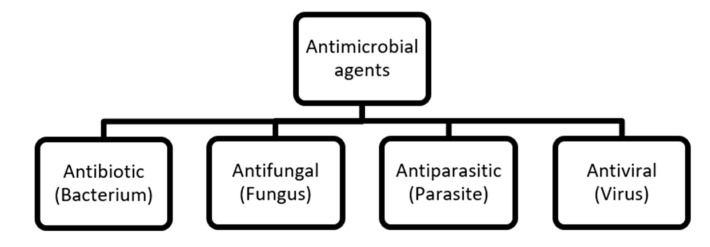
Figure 1
Figure 1
Classification of drug-based antimicrobial agents [11].
Figure 2
Figure 2
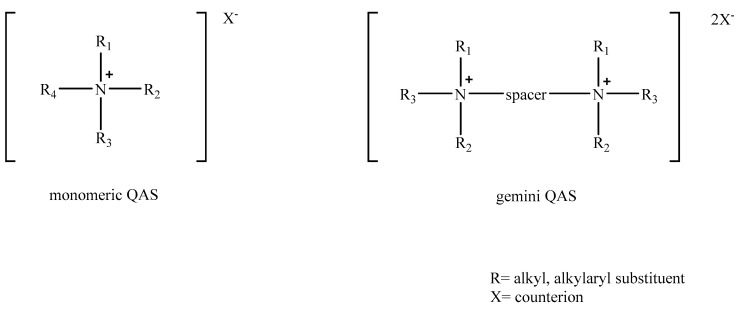
General formulas of the aliphatic quaternary ammonium salts (QAS) with monomeric and the gemini structure.

References

    1. Maillard J.Y. Bacterial target sites for biocide action. J. Appl. Microbiol. 2002;92:16–27. doi: 10.1046/j.1365-2672.92.5s1.3.x. - DOI - PubMed
    1. White D.G., McDermott P.F. Biocides, drug resistance and microbial evolution. Curr. Opin. Microbiol. 2001;4:313–317. doi: 10.1016/S1369-5274(00)00209-5. - DOI - PubMed
    1. Wales A.D., Davies R.H. Co-selection of resistance to antibiotics, biocides and heavy metals, and its relevance to foodborne pathogens. Antibiotics. 2015;4:567–604. doi: 10.3390/antibiotics4040567. - DOI - PMC - PubMed
    1. Diez B., Mellado E., Rodriguez M., Fouces R., Barredo J.L. Recombinant microorganisms for industrial production of antibiotics. Biotechnol. Bioeng. 1997;55:216–226. doi: 10.1002/(SICI)1097-0290(19970705)55:1<216::AID-BIT22>3.0.CO;2-I. - DOI - PubMed
    1. Guzmán-Trampe S., Ceapa C.D., Manzo-Ruiz M., Sánchez S. Synthetic biology era: Improving antibiotic’s world. Biochem. Pharmacol. 2017;134:99–113. doi: 10.1016/j.bcp.2017.01.015. - DOI - PubMed

LinkOut - more resources