


The HIV care continuum and HIV-1 drug resistance among female sex workers: a key population in Guinea-Bissau
- PMID: 32532294
- PMCID: PMC7291728
- DOI: 10.1186/s12981-020-00290-3
The HIV care continuum and HIV-1 drug resistance among female sex workers: a key population in Guinea-Bissau
Abstract
Introduction: Female sex workers (FSW) are considered a key group for HIV transmissions in sub-Saharan Africa. The HIV Care Continuum and HIV drug resistance (HIVDR) among FSW has not been well studied in most countries in West Africa. In the current study we describe the HIV Care continuum and prevalence of HIVDR among FSW in Guinea-Bissau.
Methods: A venue-based recruitment and peer-referral of FSW was used in seven cities in Guinea-Bissau from October 2014 to September 2017. We administered a questionnaire, performed discriminatory HIV-testing and collected blood specimens for CD4 count, viral load and HIVDR genotyping.
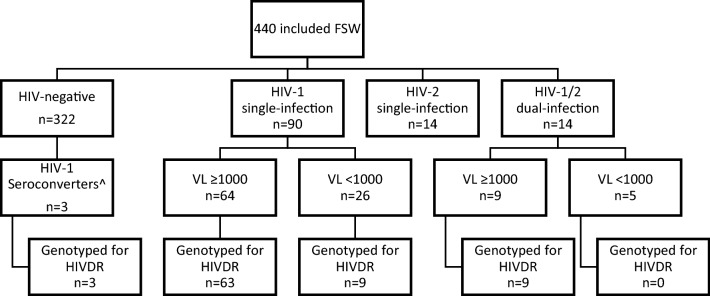
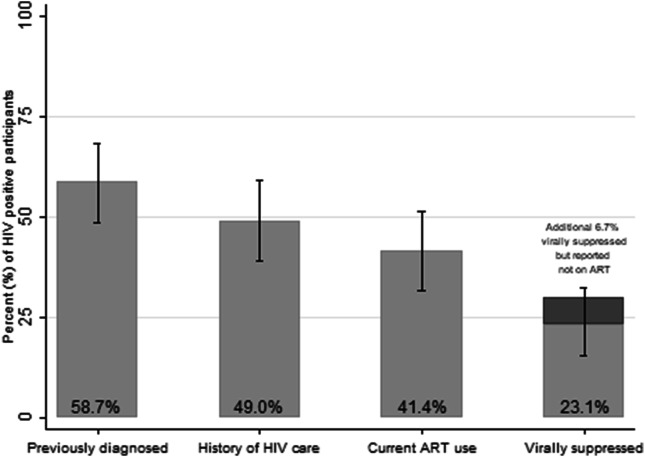
Results: The survey included 440 FSW. The overall HIV-prevalence among FSW was 26.8%. Of the HIV-1 (HIV-1 single- or dually HIV-1/HIV-2) infected FSW (N = 104), 58.7% were previously diagnosed with HIV-1 at enrolment and 41.4% reported taking antiretroviral therapy (ART) compared to 28.6% of the HIV-2 single-infected FSW (N = 14). Among HIV-1 infected FSW on ART (N = 43), 55.8% were virally suppressed (< 1000 copies/ml) and of all HIV-1 infected FSW, 29.8% were virally suppressed. Among ART experienced FSW (N = 22), 50.0% had HIVDR. HIVDR was also found in 9.4% of treatment naïve FSW (N = 53).
Conclusion: The majority of FSW who knew their HIV status received ART, however a large proportion of FSW were not aware of their HIV positive status. This translated into a great majority of the HIV-infected FSW not being virally suppressed. Amongst treatment naïve FSW nearly a tenth had HIVDR, suggesting that sexual transmission of HIVDR is occurring in this at-risk-population.
Keywords: Africa; Antiretroviral therapy; Drug resistance mutations; HIV care continuum; HIV seroprevalence; Sex workers.
Conflict of interest statement
The authors declare that they have no competing interests.
Figures
References
-
- Baral S, Beyrer C, Muessig K, Poteat T, Wirtz AL, Decker MR, et al. Burden of HIV among female sex workers in low-income and middle-income countries: a systematic review and meta-analysis. Lancet Infect Dis. 2012;12(7):538–549. - PubMed
-
- UNAIDS. Country factsheets Guinea-Bissau. 2018.
Publication types
MeSH terms
Substances
LinkOut - more resources
Full Text Sources
Medical
Research Materials
