


doi: 10.1038/s41577-020-0365-7.
Passive antibody therapy in COVID-19
Affiliations
- PMID: 32533109
- PMCID: PMC7290146
- DOI: 10.1038/s41577-020-0365-7
Item in Clipboard
Passive antibody therapy in COVID-19
Nat Rev Immunol.
2020 Jul.
Abstract
For over a century, transfusion of convalescent plasma from recovered individuals has been tried as a therapeutic approach when a novel pathogen emerges. As the world awaits SARS-CoV-2 vaccines to be tested and safely deployed, the rapidity with which antiviral monoclonal antibodies can be isolated and engineered offers an attractive alternative option for passive immunization.
Conflict of interest statement
The authors declare no competing interests.
Figures
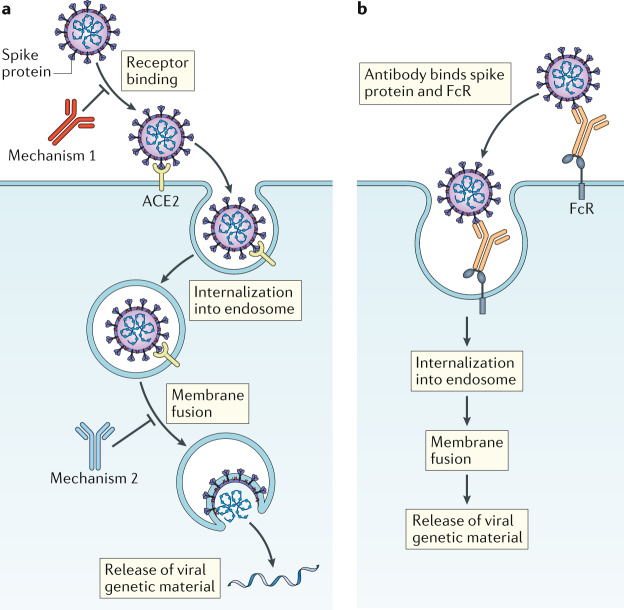
a | Mechanism 1: neutralizing antibodies could block viral infection by binding to the viral spike protein and preventing it from interacting with the cellular receptor angiotensin-converting enzyme 2 (ACE2). Mechanism 2: neutralizing antibodies could bind to the viral spike protein and block the conformational changes that the spike protein must undergo to facilitate fusion of the viral and host cell membranes. b | Antibodies could enhance viral entry into immune cells by binding to the viral spike protein with their Fab portion and to Fc receptors (FcRs) with their Fc domain.
References
MeSH terms
Substances
LinkOut - more resources
Full Text Sources
Other Literature Sources
Research Materials
Miscellaneous
