Review
. 2020 Sep;108(3):542-552.
doi: 10.1002/cpt.1947. Epub 2020 Jul 24.

Strategies for Testing Intervention Matching Schemes in Cancer

Affiliations
Review

Strategies for Testing Intervention Matching Schemes in Cancer

Nicholas J Schork et al. Clin Pharmacol Ther. 2020 Sep.

Abstract

Personalized medicine, or the tailoring of health interventions to an individual's nuanced and often unique genetic, biochemical, physiological, behavioral, and/or exposure profile, is seen by many as a biological necessity given the great heterogeneity of pathogenic processes underlying most diseases. However, testing and ultimately proving the benefit of strategies or algorithms connecting the mechanisms of action of specific interventions to patient pathophysiological profiles (referred to here as "intervention matching schemes" (IMS)) is complex for many reasons. We argue that IMS are likely to be pervasive, if not ubiquitous, in future health care, but raise important questions about their broad deployment and the contexts within which their utility can be proven. For example, one could question the need to, the efficiency associated with, and the reliability of, strategies for comparing competing or perhaps complementary IMS. We briefly summarize some of the more salient issues surrounding the vetting of IMS in cancer contexts and argue that IMS are at the foundation of many modern clinical trials and intervention strategies, such as basket, umbrella, and adaptive trials. In addition, IMS are at the heart of proposed "rapid learning systems" in hospitals, and implicit in cell replacement strategies, such as cytotoxic T-cell therapies targeting patient-specific neo-antigen profiles. We also consider the need for sensitivity to issues surrounding the deployment of IMS and comment on directions for future research.


Conflict of interest statement

Conflict of Interest

All authors have declared no competing interests for this work.

Figures
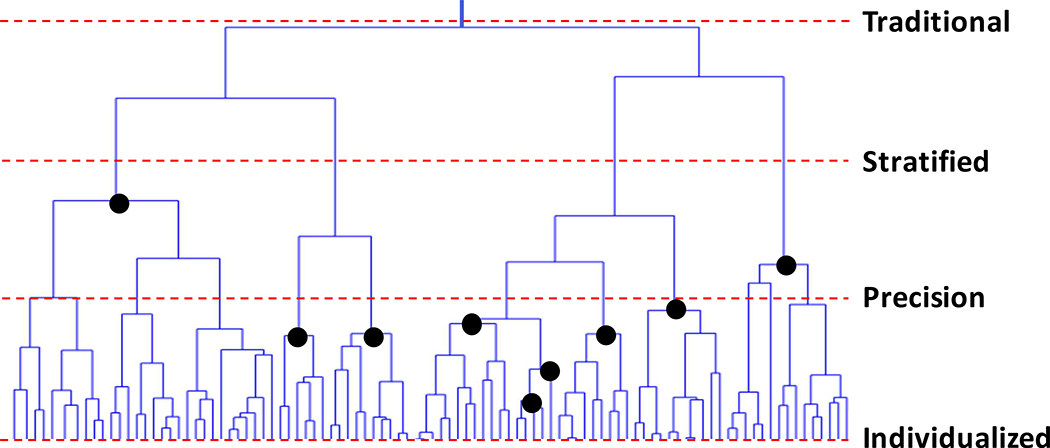
Figure 1.
Figure 1.
Graphical depiction of the similarity of patient profiles in the form of a dendrogram or tree. Patients with similar profiles cluster together. The dashed lines indicate positions in the tree where common interventions could be provided to the subgroup of patients reflected in the clusters below the line and the terms often used to define treatments at those positions: ‘traditional’ (or ‘one size fits all’ interventions), ‘stratified’ interventions where a few biomarkers are used to group patients into different treatment baskets, ‘precision’ interventions where multiple markers are used, and ‘personalized’ (or ‘individualized’) interventions where each patient is given a unique intervention or combination of interventions. The darkened circles indicate that treatments could be crafted for subgroups of patients that are not defined by a single slice of the tree. The question is what slices of the tree are practical given available interventions and the insights matching those interventions to patient profiles.
Figure 2.
Figure 2.
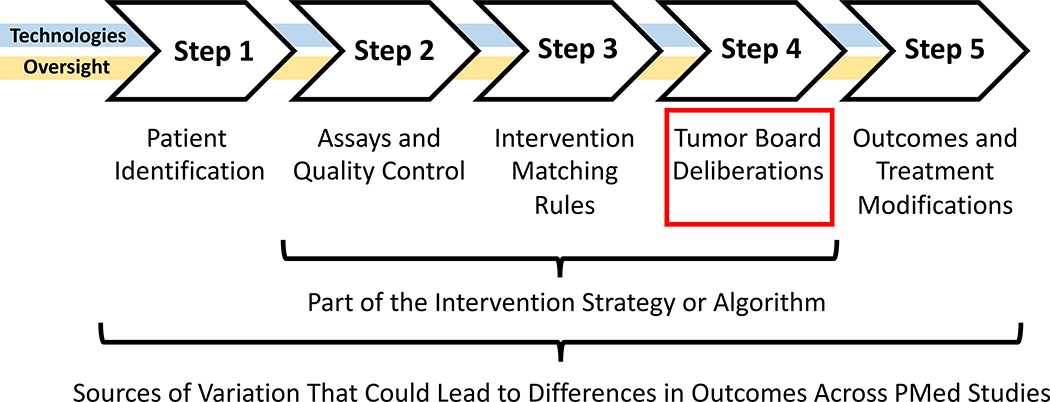
Paradigmatic workflow for advancing information in a typical basket trial in cancer settings. Note that the ‘algorithm’ matching interventions to patient profiles is one part of the workflow, with the assays being used to probe elements that could connect the interventions to the drugs as well as the tumor board deliberations having important roles to play in the outcomes of the trials. Note ‘PMed’ = ‘Precision Medicine.’
Figure 3.
Figure 3.
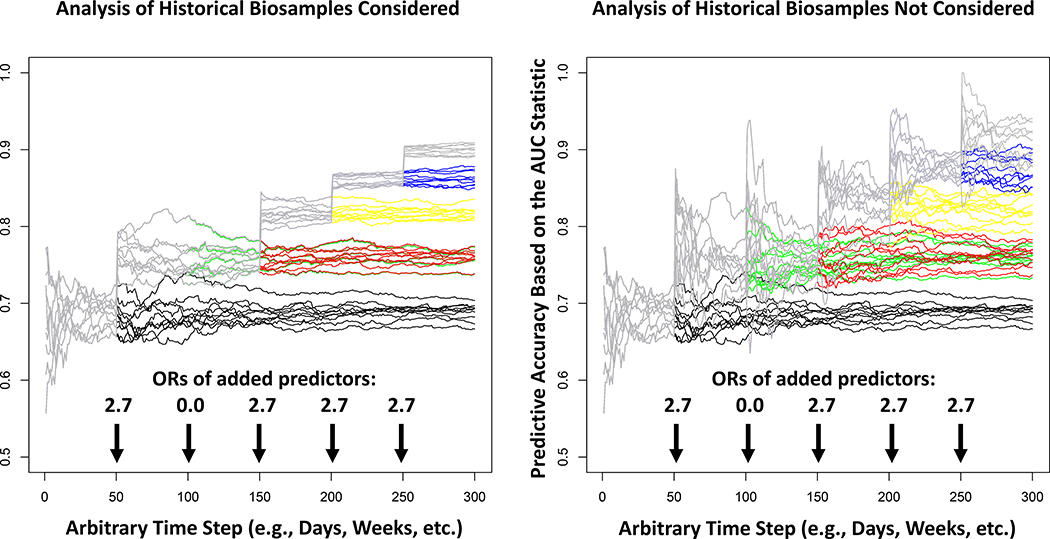
The behavior of the accuracy, in the form of the traditional area-under-the-receiver-operator-curve (AUC; y-axis), of the logistic regression-based predictions of patient response to an intervention over time for 10 simulated learning systems. The logistic regression models underlying the predictions are continuously updated based on 100 new patients’ worth of data every hypothetical day (x-axis). New predictors of response are added at the times indicated by the arrows with the odds ratios (ORs) of response associated with those predictors reflected by the numbers above those arrows. The left panel assumes that patients have stored biospecimens that can be assessed when a new assay is introduced and the right panel assumes that this is not the case, so the new models must be seeded with 100 patient’s worth of data that include the new assay and then allowed to evolve with new patient data going forward. The gray lines depict the behavior of the 10 simulated systems if all 5 predictors are used as they come online (note: the second predictor was assumed to have a 0 effect size and all others were assumed to have an OR of 2.7). The different colored lines indicate how the system would behave if the additional predictors were not added to the predictive models over time as they come online.

References

    1. Ginsberg GS and Willard HF, eds. Essentials of Genomic and Personalized Medicine. 2010, Academic Press.
    1. Schork NJ, Personalized medicine: Time for one-person trials. Nature, 2015. 520(7549): p. 609–11. - PubMed
    1. Senn S, Statistical pitfalls of personalized medicine. Nature, 2018. 563(7733): p. 619–621. - PubMed
    1. Apweiler R, et al., Whither systems medicine? Exp Mol Med, 2018. 50(3): p. e453. - PMC - PubMed
    1. Kreiter S, et al., Mutant MHC class II epitopes drive therapeutic immune responses to cancer. Nature, 2015. 520(7549): p. 692–6. - PMC - PubMed

Publication types