. 2020 Jun;12(2):126-146.
doi: 10.1111/jftr.12376. Epub 2020 May 27.

The Convoy Model and Later-Life Family Relationships

Affiliations

The Convoy Model and Later-Life Family Relationships

Heather R Fuller et al. J Fam Theory Rev. 2020 Jun.

Abstract

The convoy model of social relations was developed to provide a heuristic framework for conceptualizing and understanding social relationships. In this Original Voices article, we begin with an overview of the theoretical tenets of the convoy model, including its value in addressing situational and contextual influences, especially variability in family forms and cultural diversity across the life span, but particularly in older adulthood. We also consider the contributions of the convoy model to the field of family gerontology by illustrating concepts, methods, and measures used to test the model, as well as its usefulness and limitations in addressing contemporary issues facing older adults. Finally, we discuss opportunities for innovation and application of the convoy model to the study of later-life family relationships. In summary, we emphasize the benefits and inclusiveness of the convoy model for guiding current and future research to address challenges facing family gerontology now and in the future.

Keywords: aging families; convoy model; dynamic social networks.


Figures

Figure 1
Figure 1
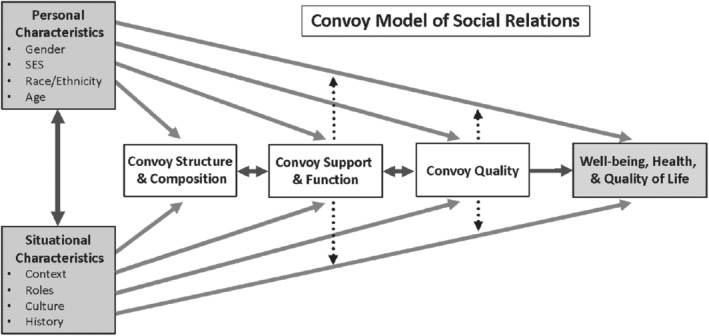
convoy model of social relations (adapted from kahn & antonucci,  1980 ; antonucci,  2001 ).
Figure 2
Figure 2
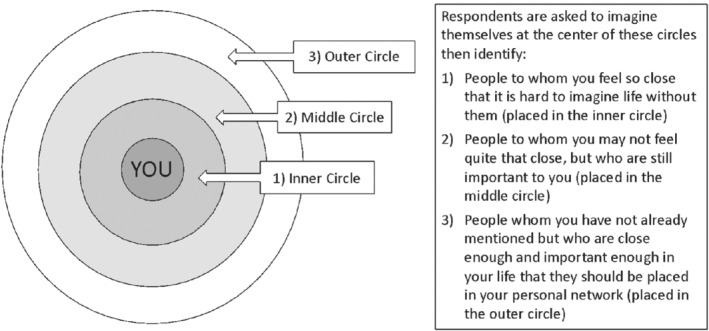
the hierarchical mapping technique (adapted from antonucci,  1986 ).
Figure 3
Figure 3
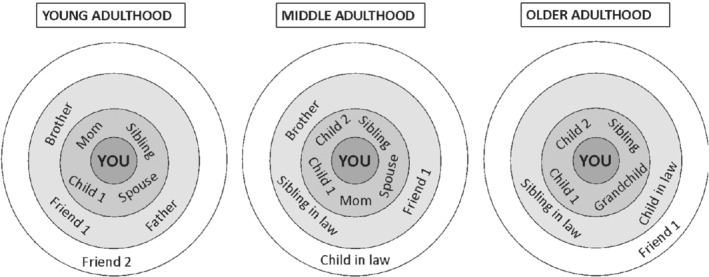
example of convoy change over time. Note. Hypothetical figures based on data for mean circle size and composition in 2015 (Survey Research Center, 2015) synthesized to represent a hypothetical average individual.

References

    1. Ajrouch, K. J. (2005). Arab‐American immigrant elders' views about social support. Ageing & Society, 25, 655–673. 10.1017/S0144686X04002934 - DOI
    1. Ajrouch, K. J. , Antonucci, T. C. , & Janevic, M. R. (2001). Social networks among Blacks and Whites: The interaction between race and age. Journals of Gerontology Series B: Psychological Sciences and Social Sciences, 56, S112–S118. 10.1093/geronb/56.2.S112 - DOI - PubMed
    1. Ajrouch, K. J. , Antonucci, T. C. , & Webster, N. J. (2016). Volunteerism: Social network dynamics and education. Journals of Gerontology Series B: Psychological Sciences and Social Sciences, 71, 309–319. 10.1093/geronb/gbu166 - DOI - PMC - PubMed
    1. Ajrouch, K. J. , Blandon, A. Y. , & Antonucci, T. C. (2005). Social networks among men and women: The effects of age and socioeconomic status. Journals of Gerontology Series B: Psychological Sciences and Social Sciences , 60, S311–S317. 10.1093/geronb/60.6.S311 - DOI - PubMed
    1. Ajrouch, K. J. , Fuller, H. R. , Akiyama, H. , & Antonucci, T. C. (2017). Convoys of social relations in cross‐national context. Gerontologist, 58, 488–499. 10.1093/geront/gnw204 - DOI - PMC - PubMed