Review
. 2021 Jan;156(2):145-161.
doi: 10.1111/jnc.15103. Epub 2020 Jul 5.

SUMOylation of synaptic and synapse-associated proteins: An update

Affiliations
Review

SUMOylation of synaptic and synapse-associated proteins: An update

Jeremy M Henley et al. J Neurochem. 2021 Jan.

Abstract

SUMOylation is a post-translational modification that regulates protein signalling and complex formation by adjusting the conformation or protein-protein interactions of the substrate protein. There is a compelling and rapidly expanding body of evidence that, in addition to SUMOylation of nuclear proteins, SUMOylation of extranuclear proteins contributes to the control of neuronal development, neuronal stress responses and synaptic transmission and plasticity. In this brief review we provide an update of recent developments in the identification of synaptic and synapse-associated SUMO target proteins and discuss the cell biological and functional implications of these discoveries.

Keywords: GTPases; SUMOylation; ion channels; synaptic plasticity; synaptic proteins.


Figures

FIGURE 1
FIGURE 1
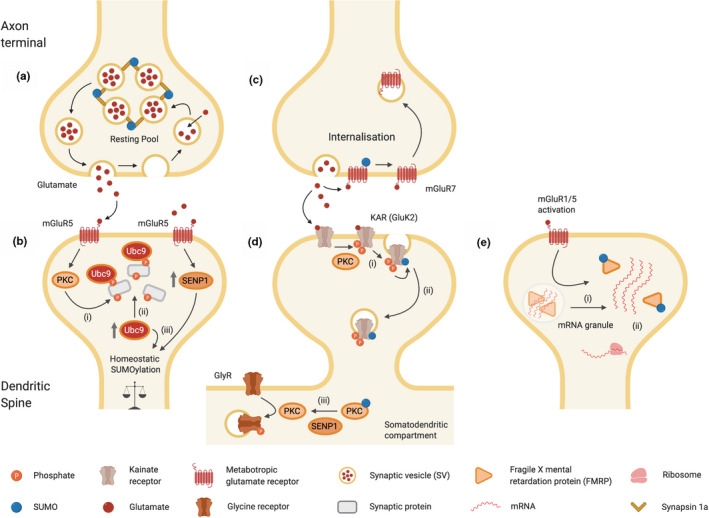
SUMOylation of synaptic receptor and receptor‐associated proteins. Schematic summarizing the functional effects of SUMOylation and deSUMOylation on selected synaptic proteins. (a) SUMOylation of the pre‐synaptic Synapsin 1a facilitates the re‐clustering/anchoring of synaptic vesicles after neurotransmitter release. (b) mGluR5‐dependent synaptic trapping of Ubc9 (i) Activity‐induced PKC activation phosphorylates synaptic proteins. (ii) Ubc9 binding to phospho‐proteins ‘traps’ Ubc9 in the synapse. (iii) Correspondingly, activation of mGluR5 increases dendritic SENP1, providing a homeostatic feedback mechanism. (c) SUMOylation of mGluR7 stabilizes its pre‐synaptic surface expression. Glutamate activation of mGluR7 results in deSUMOylation and internalization. (d) PKC phosphorylation of the Kainate receptor subunit GluK2 leads to SUMOylation (i) and internalization (ii). PKC SUMOylation inhibits its kinase activity whereas SENP1 deSUMOylation of PKC enhances activity leading to phosphorylation of glycine receptor (GlyR) and facilitates internalization (iii). (e) mGluR1/5 activation enhances SUMOylation of FMRP, facilitating dissociation from mRNA granules (i) and leading to increased local translation (ii)
FIGURE 2
FIGURE 2
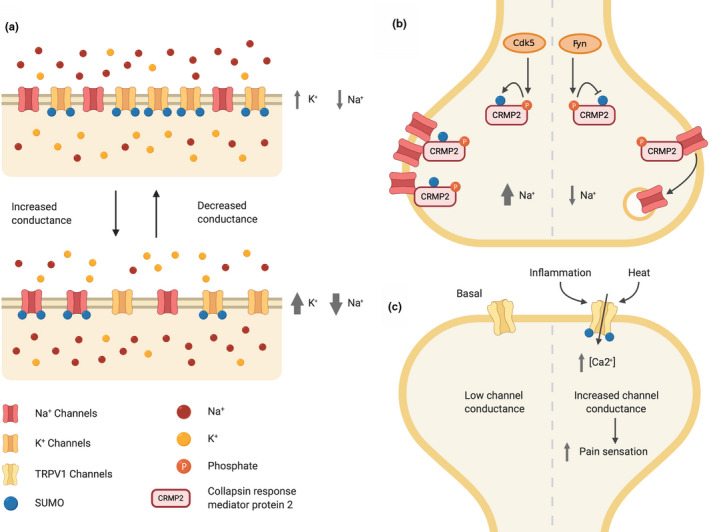
Ion channel SUMOylation. (a) Overall, SUMOylation of potassium channels reduces conductance, whereas SUMOylation of sodium channels increases conductance. (b) Cdk5 phosphorylation enhances CRMP2 SUMOylation, whereas Fyn phosphorylation antagonizes its SUMOylation. SUMOylated CRMP2 increases NaV1.7 sodium channel surface expression and current density. (c) Inflammation increases TRPV1 channel SUMOylation, which reduces the threshold of channel activation by heat and increases pain sensation
FIGURE 3
FIGURE 3
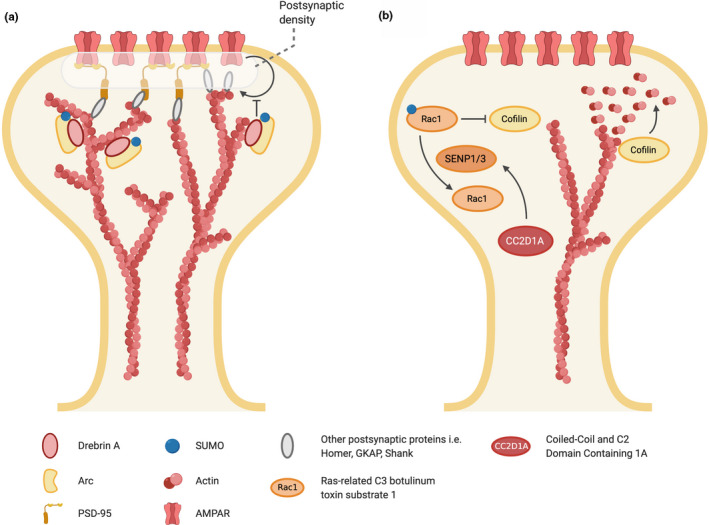
SUMOylation of GTPases during synaptic plasticity. During LTP, SUMOylated Arc associates with drebrin A, an actin‐binding protein. This impairs α‐amino‐3‐hydroxy‐5‐methyl‐4‐isoxazolepropionic acid receptor (AMPAR) internalization to promote increased surface expression. (a) CC2D1A deletion leads to reduced SENP 1/3 levels, which in turn, regulates the SUMOylation of Rac1. SUMOylated Rac1 enhanced Rac1 activity. Rac1 inhibits cofilin activity, which severs F‐actin. SUMOylation of Rac1 enhances activity, thus indirectly promotes actin stabilization by blocking cofilin in dendritic spine formation

References

    1. Al‐Tawashi, A. , Jung, S. Y. , Liu, D. , Su, B. , & Qin, J. (2012). Protein implicated in nonsyndromic mental retardation regulates protein kinase A (PKA) activity. Journal of Biological Chemistry, 287, 14644–14658. 10.1074/jbc.M111.261875 - DOI - PMC - PubMed
    1. Andresen, M. (2019). Understanding diverse TRPV1 signaling – an update. F1000Research, 8, 1978. 10.12688/f1000research.20795.1 - DOI - PMC - PubMed
    1. Arrasate, M. , & Finkbeiner, S. (2012). Protein aggregates in Huntington's disease. Experimental Neurology, 238, 1–11. 10.1016/j.expneurol.2011.12.013 - DOI - PMC - PubMed
    1. Benson, M. , Iniguez‐Lluhi, J. A. , & Martens, J. (2017). Sumo modification of ion channels. Advances in Experimental Medicine and Biology, 963, 127–141. - PubMed
    1. Benson, M. D. , Li, Q. J. , Kieckhafer, K. , Dudek, D. , Whorton, M. R. , Sunahara, R. K. , … Martens, J. R. (2007). SUMO modification regulates inactivation of the voltage‐gated potassium channel Kv1.5. Proceedings of the National Academy of Sciences, 104, 1805–1810. 10.1073/pnas.0606702104 - DOI - PMC - PubMed

Publication types