Review
. 2020 Jun 30;48(3):891-900.
doi: 10.1042/BST20190651.

Promiscuity and specificity of eukaryotic glycosyltransferases

Affiliations
Review

Promiscuity and specificity of eukaryotic glycosyltransferases

Ansuman Biswas et al. Biochem Soc Trans. .

Abstract

Glycosyltransferases are a large family of enzymes responsible for covalently linking sugar monosaccharides to a variety of organic substrates. These enzymes drive the synthesis of complex oligosaccharides known as glycans, which play key roles in inter-cellular interactions across all the kingdoms of life; they also catalyze sugar attachment during the synthesis of small-molecule metabolites such as plant flavonoids. A given glycosyltransferase enzyme is typically responsible for attaching a specific donor monosaccharide, via a specific glycosidic linkage, to a specific moiety on the acceptor substrate. However these enzymes are often promiscuous, able catalyze linkages between a variety of donors and acceptors. In this review we discuss distinct classes of glycosyltransferase promiscuity, each illustrated by enzymatic examples from small-molecule or glycan synthesis. We highlight the physical causes of promiscuity, and its biochemical consequences. Structural studies of glycosyltransferases involved in glycan synthesis show that they make specific contacts with 'recognition motifs' that are much smaller than the full oligosaccharide substrate. There is a wide range in the sizes of glycosyltransferase recognition motifs: highly promiscuous enzymes recognize monosaccharide or disaccharide motifs across multiple oligosaccharides, while highly specific enzymes recognize large, complex motifs found on few oligosaccharides. In eukaryotes, the localization of glycosyltransferases within compartments of the Golgi apparatus may play a role in mitigating the glycan variability caused by enzyme promiscuity.

Keywords: biosynthesis; glycosylation; promiscuity.


Conflict of interest statement

The authors declare that there are no competing interests associated with the manuscript.

Figures
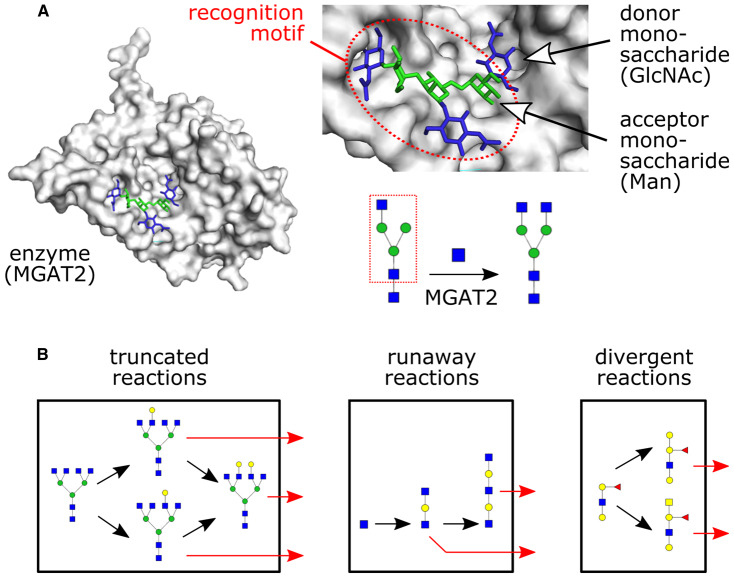
Figure 1.
Figure 1.. Attachment of a donor monosaccharide to an acceptor, catalyzed by a glycosyltransferase enzyme.
(A) The enzyme MGAT2 catalyzes the attachment of a GlcNAc donor monosaccharide to a mannose acceptor monosaccharide. Black arrows show monosaccharide addition reactions. The enzyme makes specific contacts with multiple moieties of the acceptor, which we term its ‘recognition motif’ (dotted red oval/box). The protein structure is based on PDB id: 5VCS; the position of the donor monosaccharide is modeled. (B) In eukaryotes, glycan synthesis by glycosyltransferase enzymes takes place within membrane-bounded reaction compartments (black boxes) such as the lumen of the ER or the cisternae of the Golgi apparatus. Growing oligosaccharides can exit the reaction compartment (red arrows). We highlight the three enzymatic causes of glycan microheterogeneity: truncated, runaway and divergent reactions.
Figure 2.
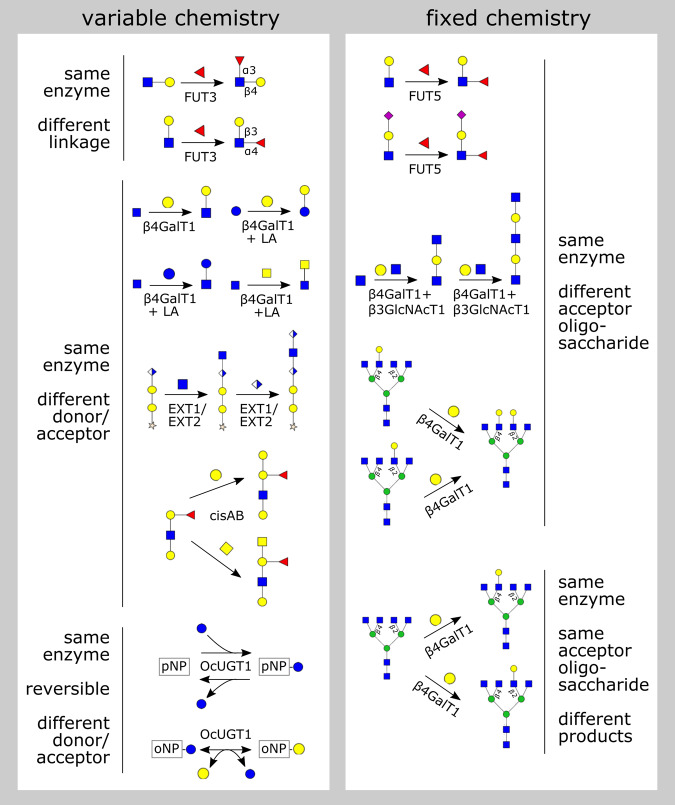
Figure 2.. Classes of glycosyltransferase promiscuity.
Each reaction (black arrow) is catalyzed by a specific enzyme (label on the arrow). We show the acceptor oligosaccharide on the left, the donor monosaccharide above or below the arrow (with the nucleotide omitted), and the product on the right. Reversible reactions are indicated with double arrows. See the text for details of each reaction.
Figure 3.
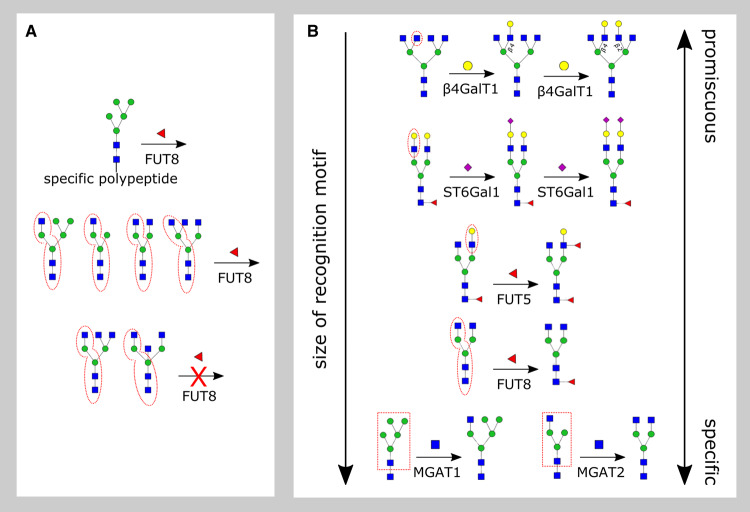
Figure 3.. Glycosyltransferase recognition motifs.
(A) To determine an enzyme's recognition motif, we require comprehensive data on all possible acceptor substrates on which it acts. Here we show the example of FUT8, which typically acts on any oligosaccharide acceptor containing its preferred motif (dashed red ovals). However, the enzyme can sometimes act when the motif is missing (top row) or fail to act when the motif is present (bottom row). (B) For each enzyme, we highlight its approximate recognition motif by dashed red ovals or boxes. Enzymes with small recognition motifs are highly promiscuous, those with large recognition motifs are highly specific.

References

    1. Varki A. (2017) Essentials of Glycobiology, 3rd edn, Cold Spring Harbor Laboratory Press - PubMed
    1. Gachon C.M.M., Langlois-Meurinne M. and Saindrenan P. (2005) Plant secondary metabolism glycosyltransferases: the emerging functional analysis. Trends Plant Sci. 10, 542–549 10.1016/j.tplants.2005.09.007 - DOI - PubMed
    1. Yao P., Deng R., Huang Y., Stael S., Shi J., Shi G. et al. (2019) Diverse biological effects of glycosyltransferase genes from Tartary buckwheat. BMC Plant Biol. 19, 339 10.1186/s12870-019-1955-z - DOI - PMC - PubMed
    1. Wang S., Alseekh S., Fernie A.R. and Luo J. (2019) The structure and function of major plant metabolite modifications. Mol. Plant 12, 899–919 10.1016/j.molp.2019.06.001 - DOI - PubMed
    1. Varki A. (2017) Biological roles of glycans. Glycobiology 27, 3–49 10.1093/glycob/cww086 - DOI - PMC - PubMed

Publication types