


Management of intraoperative acetabular fracture in primary total hip arthroplasty
- PMID: 32539748
- PMCID: PMC7296652
- DOI: 10.1186/s12891-020-03356-5
Management of intraoperative acetabular fracture in primary total hip arthroplasty
Abstract
Background: Intraoperative acetabular fracture(IAF) is a rare complication of primary total hip arthroplasty(THA). The previous reports have lacked a sufficiently large number of subjects to allow for an analysis of the causes and appropriate treatment of this problem.
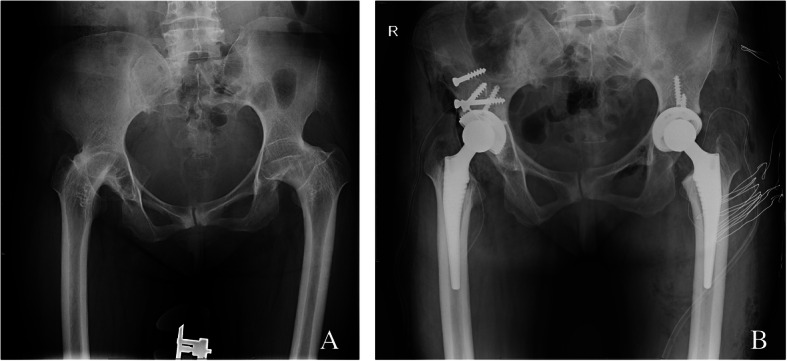
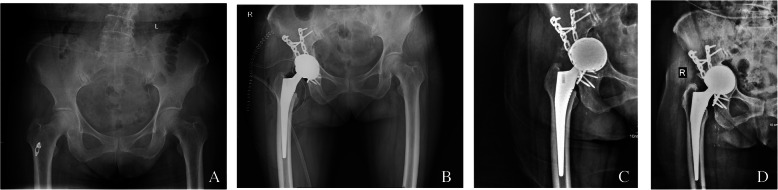
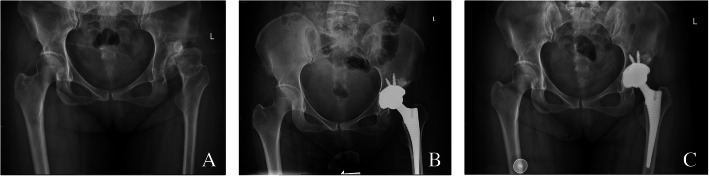
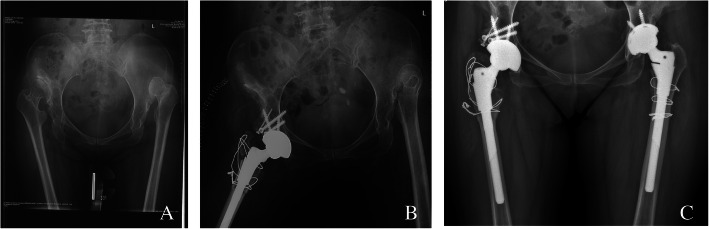
Methods: Between 2015 to 2018, 4888 primary THA were enrolled. We retrospectively reviewed the records in our Total Joint Registry Database and found that 24 patients (24 hips) had sustained intraoperative acetabular fractures. Twenty-four patients(16 females and 8males)were all treated with a posterolateral approach using uncemented components. Twenty patients(83.3%)underwent supplemental screw fixation, of which 2 patients were treated with steel plate fixation. Two patients' femoral heads were used as a graft. In 4 patients(16.7%), the acetabular components were judged to be stable despite the fracture and no additional treatment was performed. All patients were evaluated clinically with Harris Hip Scores (HHS) and radiographically with serial X-rays which follow up for a mean period of 34.0 ± 12.6 months. We evaluated the anatomic locations, causes, treatments, and outcome of the fractures to study the treatment method and effect of intraoperative acetabular fracture during operation.
Results: The fracture rate associated with uncemented components was 0.49%. In 17(70.8%) of these patients, the fracture was noted during the impaction of the real acetabular component. Six patients(25%)with Ankylosing Spondylitis had fractures, 4 in the anterior wall, and 1 in the anterior column, because the patient with hip joint fusion needs a to pre-osteotomy before the dislocation. The HHS score increased from 30.8 ± 9.7 preoperatively to 90.2 ± 4.2 postoperatively. All the latest x-ray showed that the fracture did not move, and there is no translucent line formed in the acetabular cup bone interface.
Conclusion: Intraoperative acetabular fractures are rare complications of THA, and most commonly occur during the implantation of the acetabular components. It is necessary to prevent the occurrence of fractures as much as possible even if the fractures are found during the operation. It should be noted that patients with ankylosing spondylitis involving hip joints during THA surgery must be careful to prevent IAFs during dislocation and pre-osteotomy.
Keywords: Ankylosing spondylitis involving hip joints; Intraoperative acetabular fracture; Primary total hip arthroplasty.
Conflict of interest statement
The authors declare that they have no competing interests.
Figures
References
-
- Adler E, Stuchin SA, Kummer FJ. Stability of press-fit acetabular cups. J Arthroplasty, 1992, 7(3):295–301. https://doi.org/10.1016/0883-5403(92)90052-R. - PubMed
-
- Curtis MJ, Jinnah RH, Wilson VD, et al. The initial stability of uncemented acetabular components. Bone Joint J, 1992, 74(3):372–376. https://doi.org/10.1302/0301-620X.74B3.1587880. - PubMed
-
- Kim Y S, Callaghan JJ, Ahn PB, et al. Fracture of the acetabulum during insertion of an oversized hemispherical component. J Bone Joint Surg Am, 1995, 77(1):111–117. https://doi.org/10.2106/00004623-199501000-00013. - PubMed
-
- Sharkey PF, Hozack WJ, Callaghan JJ, et al. Acetabular fracture associated with cementless acetabular component insertion: A report of 13 cases. J Arthroplasty, 1999, 14(4):426–431. https://doi.org/10.1016/s0883-5403(99)90097-9. - PubMed
-
- Stiehl JB, MacMillan E, Skrade DA. Mechanical stability of porous-coated acetabular components in total hip arthroplasty. J Arthroplasty, 1991, 6(4):295–300. https://doi.org/10.1016/s0883-5403(06)80179-8. - PubMed
MeSH terms
LinkOut - more resources
Full Text Sources
Medical
Research Materials
