Review
. 2020 Aug;68(3):93-104.
doi: 10.1016/j.retram.2020.05.004. Epub 2020 May 30.

A review of potential treatments to date in COVID-19 patients according to the stage of the disease

Affiliations
Review

A review of potential treatments to date in COVID-19 patients according to the stage of the disease

Tamim Alsuliman et al. Curr Res Transl Med. 2020 Aug.

Abstract

Introduction and motivation: Since the end of 2019, the COVID-19 pandemic has affected millions of people worldwide. With the rapid spread of this virus, an immense burden has fallen upon both healthcare and economic systems. As a consequence, there is an unprecedented urgency for researchers and scientific committees from all over the world to find an effective treatment and vaccine.

Review structure: Many potential therapies are currently under investigation, with some, like Hydroxychloroquine, being authorized for emergency use in some countries. The crucial issue is now clearly to find the suitable treatment strategy for patients given comorbidities and the timeline of the illness. Vaccines are also under development and phase 1 clinical trials are rolling. Despite all efforts, no single drug or vaccine has yet been approved. In this review, we aim at presenting the proposed pathophysiological mechanisms of SARS-CoV-2 and to provide clinicians with a brief and solid overview of the current potential treatments classified according to their use at the three different currently proposed disease stages. In light of pathogenesis and proposed clinical classification, this review's purpose is to summarize and simplify the most important updates on the management and the potential treatment of this emergent disease.

Keywords: COVID-19; Pathophysiology; Treatment.


Figures

Fig. 1
Fig. 1
Cumulative perspective of potential COVID-19 treatments based on three clinical stage classification. Symptomatic treatment is a basic step in all clinical stages of the disease, with oxygen therapy here reflecting all interventions that may be needed from nasal cannula to mechanical ventilation. While some argue that antiviral therapy (especially Remdesivir) could be considered for some patients in Stage I of the disease, other preserve it for the Stage II patients. Ribavirin and IFNα-2b in particular, in our opinion shouldn’t be considered in the management of Stage I. More severe cases (Stage III) need more extensive interventions by adding immunomodulatory treatments to the previous management steps in the attempt to contain the hyperinflammatory response. *These treatments might also be investigated in both stage II and III. **These treatments might also be investigated in stage III. ***These treatments are mainly investigated in stage III. Abbreviations: LPV/RTV, Lopinavir/Ritonavir, LMWH, low molecular weight heparin, IVIG, Intravenous Immunoglobulin, CP Convalescent Plasma.
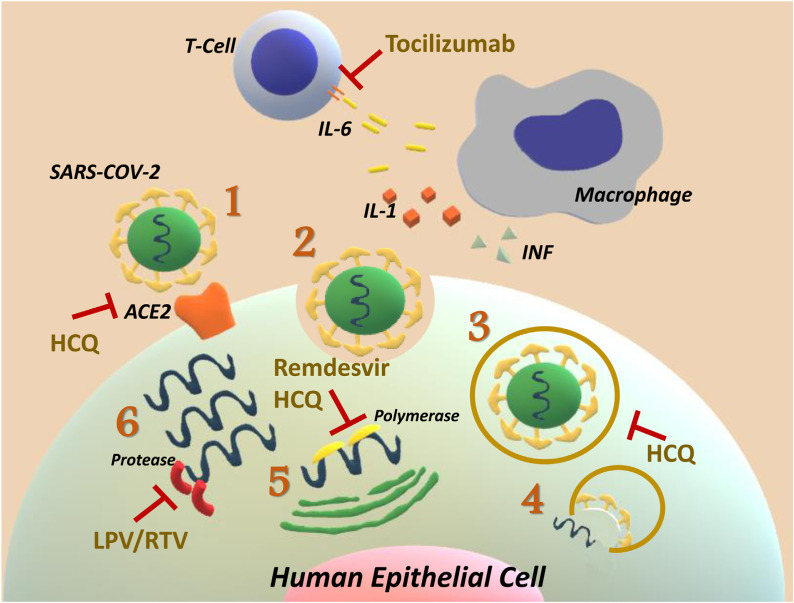
Fig. 2
Fig. 2
Mechanism of action of drugs under investigation: Lopinavir/Ritonavir, Hydroxychloroquine, Remdisivir, and Tocilizumab. 1: SARS-CoV-2 attaches to the ACE2 receptor on human epithelial cells in order to gain entry to them. Once attached, it activates the TMPRSS2 which leads towards S protein activation by proteolytic cleavage. Camostat Mesylate is a therapeutic agent that inhibits TMPRSS2. 2 and 3: Endosomes, then, transfer the complex (virus-receptor) into the cell and 4: releases the virus genome (RNA) which undergoes 5 and 6 translation and transcription using the targeted cell transcription system. Remdisivir inhibits polymerase, while Lopinavir/Ritonavir (LPV/RTV) inhibits protease; the two fundamental enzymes during viral replication. Hydroxychloroquine (HCQ) targets several levels of viral infection. It changes the glycosylation of ACE2 to inhibit virus entry. Being a weak base, it also affects endosomal activity by increasing, the pH of acidic intracellular organelles. Finally, it interferes with RNA replication by targeting the polymerase. In severe and critical cases, macrophage activation leads to an uncontrolled and lethal inflammatory process known as “cytokine storm syndromes” driven by the release of multiple cytokines; IL-6 plays a key role in this process. Tocilizumab is a monoclonal antibody that inhibits the IL-6 Receptor which might mitigate the inflammatory response.

References

    1. Wang D., Hu B., Hu C., Zhu F., Liu X., Zhang J. Clinical characteristics of 138 hospitalized patients with 2019 novel coronavirus–Infected pneumonia in Wuhan, China. JAMA. 2020;323:1061. doi: 10.1001/jama.2020.1585. - DOI - PMC - PubMed
    1. WHO . 2020. Coronavirus disease 2019 (COVID-19) Situation Report – 92.https://www.who.int/docs/default-source/coronaviruse/situation-reports/2... (Accessed April 21, 2020)
    1. Van Doremalen N., Bushmaker T., Morris D.H., Holbrook M.G., Gamble A., Williamson B.N. Aerosol and surface stability of SARS-CoV-2 as compared with SARS-CoV-1. N Engl J Med. 2020 doi: 10.1056/NEJMc2004973. - DOI - PMC - PubMed
    1. Lin L., Lu L., Cao W., Li T. Hypothesis for potential pathogenesis of SARS-CoV-2 infection—a review of immune changes in patients with viral pneumonia. Emerg Microbes Infect. 2020:1–14. doi: 10.1080/22221751.2020.1746199. - DOI - PMC - PubMed
    1. Hassan S.A., Sheikh F.N., Jamal S., Ezeh J.K., Akhtar A. Coronavirus (COVID-19): a review of clinical features, diagnosis, and treatment. Cureus. 2020 doi: 10.7759/cureus.7355. - DOI - PMC - PubMed

MeSH terms