


Reducing shock imminence eliminates poor avoidance in rats
- PMID: 32540916
- PMCID: PMC7301752
- DOI: 10.1101/lm.051557.120
Reducing shock imminence eliminates poor avoidance in rats
Abstract
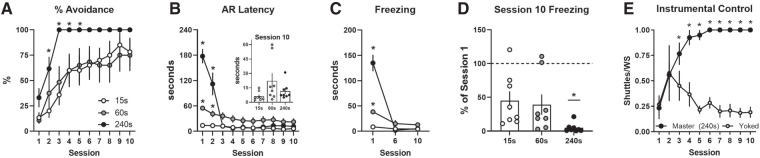
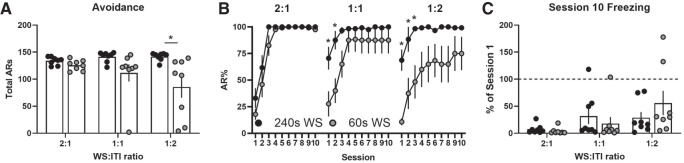
In signaled active avoidance (SigAA), rats learn to suppress Pavlovian freezing and emit actions to remove threats and prevent footshocks. SigAA is critical for understanding aversively motivated instrumental behavior and anxiety-related active coping. However, with standard protocols ∼25% of rats exhibit high freezing and poor avoidance. This has dampened enthusiasm for the paradigm and stalled progress. We demonstrate that reducing shock imminence with long-duration warning signals leads to greater freezing suppression and perfect avoidance in all subjects. This suggests that instrumental SigAA mechanisms evolved to cope with distant harm and protocols that promote inflexible Pavlovian reactions are poorly designed to study avoidance.
© 2020 Laughlin et al.; Published by Cold Spring Harbor Laboratory Press.
Figures
References
-
- APA. 2013. Diagnostic and statistical manual of mental disorders. American Psychiatric Publishing, Arlington, VA.
-
- Archer T, Ogren S, Johansson G. 1984. Stimulus conditions affecting the rate of acquisition in a computer-operated version of the two-way active avoidance procedure. Scand J Psychol 25: 89–95. 10.1111/j.1467-9450.1984.tb01003.x - DOI
-
- Blanchard RJ, Blanchard DC, Hori K. 1989. Ethoexperimental approaches to the study of defensive behavior. In Ethoexperimental approaches to the study of behavior (ed. Blanchard RJ, Brain PF, Blanchard DC, Parmigiani S), pp. 114–136. Kluwer Academic Publishers, Dordrecht.
Publication types
MeSH terms
Grants and funding
LinkOut - more resources
Full Text Sources
