. 2020 Jun 30;117(26):15242-15252.
doi: 10.1073/pnas.1915610117. Epub 2020 Jun 15.

Auditory representation of learned sound sequences in motor regions of the macaque brain

Affiliations

Auditory representation of learned sound sequences in motor regions of the macaque brain

Denis Archakov et al. Proc Natl Acad Sci U S A. .

Abstract

Human speech production requires the ability to couple motor actions with their auditory consequences. Nonhuman primates might not have speech because they lack this ability. To address this question, we trained macaques to perform an auditory-motor task producing sound sequences via hand presses on a newly designed device ("monkey piano"). Catch trials were interspersed to ascertain the monkeys were listening to the sounds they produced. Functional MRI was then used to map brain activity while the animals listened attentively to the sound sequences they had learned to produce and to two control sequences, which were either completely unfamiliar or familiar through passive exposure only. All sounds activated auditory midbrain and cortex, but listening to the sequences that were learned by self-production additionally activated the putamen and the hand and arm regions of motor cortex. These results indicate that, in principle, monkeys are capable of forming internal models linking sound perception and production in motor regions of the brain, so this ability is not special to speech in humans. However, the coupling of sounds and actions in nonhuman primates (and the availability of an internal model supporting it) seems not to extend to the upper vocal tract, that is, the supralaryngeal articulators, which are key for the production of speech sounds in humans. The origin of speech may have required the evolution of a "command apparatus" similar to the control of the hand, which was crucial for the evolution of tool use.

Keywords: auditory cortex; internal models; motor cortex; putamen.


Conflict of interest statement

The authors declare no competing interest.

Figures
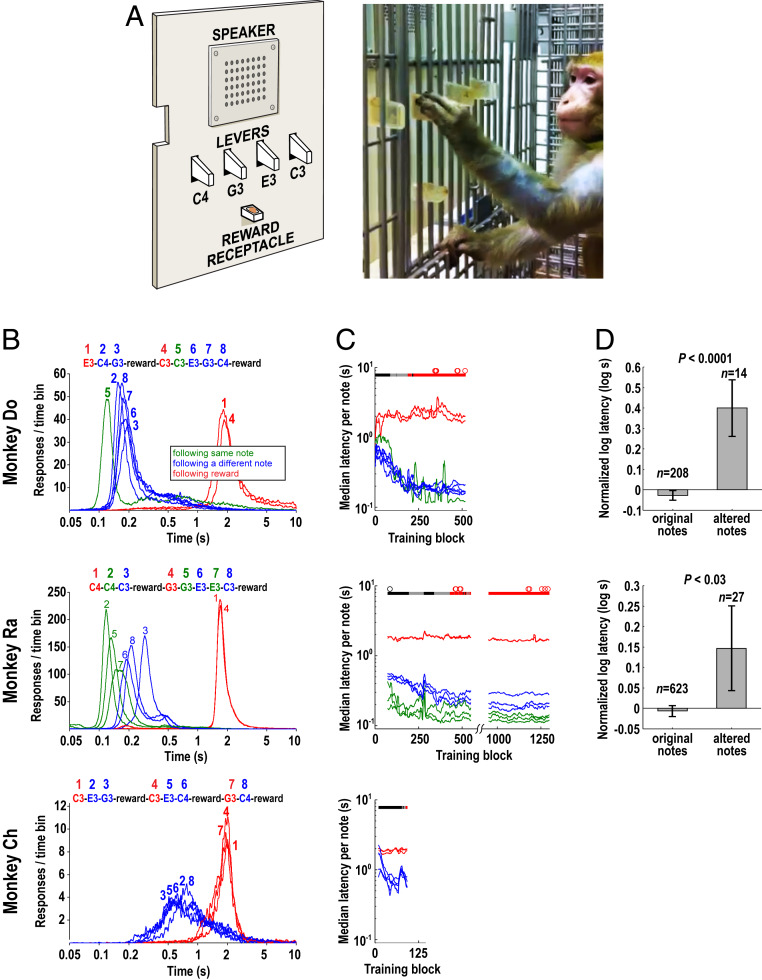
Fig. 1.
Fig. 1.
The monkey piano apparatus and behavioral results. (A) Panel with four levers used for in-cage training (Left). A musical sound (C3, E3, G3, C4) was played upon corresponding lever press. (Right) Monkey Do performing the task. (B) Latency distributions of correct lever presses (relative to previous lever press) for each note in the sequence. Self-produced (SP) sequences shown at the Top. Depending on behavioral context, latencies fell into three types (color-coded; see Inset). Distribution numbers indicate the note’s position in the sequence. (C) Progress of sequence training: median response latencies (see B for color-coding) in 50-sequence blocks. Black circles: scans performed early in sequence training (Ra only, SI Appendix, Fig. S7); red circles: scans in trained monkeys. The band below scan marks shows the amount of visual guidance: black, full (all eight presses in the sequence guided); gray, partial; red, final minimal. Latency data smoothed with a 10-block moving average. (D) Catch trials. Lever presses were programmed to occasionally produce a different sound. Latencies of lever presses following an altered note were significantly longer than following the original note. Error bars represent ±SEM. See Materials and Methods for details, and SI Appendix, Fig. S2.
Fig. 2.
Fig. 2.
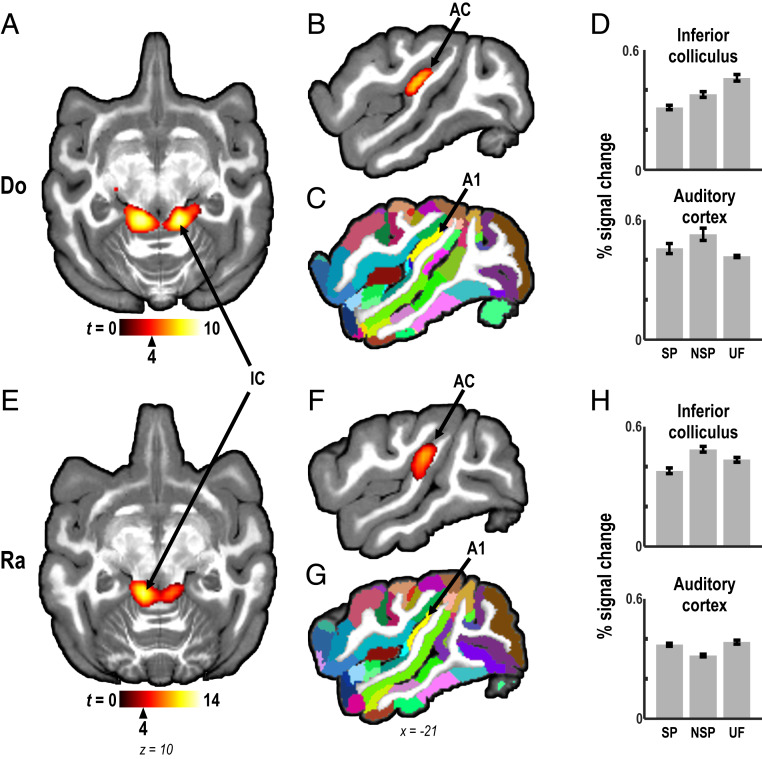
Mapping of activation by sound sequences in the auditory pathway. Auditory stimuli (all experimental conditions combined, and compared to silence) evoked bilateral activation in auditory brainstem (inferior colliculus [IC]) (A and E) and in auditory cortex (AC) (core and belt) (B and F), including primary auditory cortex (A1), in both monkeys (Do and Ra; q < 0.001, FDR corrected; cluster size k ≥ 10 voxels). (C and G) Color-coded D99 atlas segmentation (57), projected onto individual anatomy in the same monkeys, allowed assignment of BOLD activation to cortical areas. (D and H) AC and IC were reliably activated by stimuli of all three experimental conditions: self-produced sequences (SP), non–self-produced sequences (NSP), and unfamiliar sequences (UF). Bars show percent signal change relative to baseline within IC and AC foci defined by the “all stimuli vs. silence” contrast (mean ± SEM). In all figures showing MRI slices: Left side is shown on the left. Critical t values, associated with respective q and P values, for activation thresholds are shown next to the color bars with triangle markers.
Fig. 3.
Fig. 3.
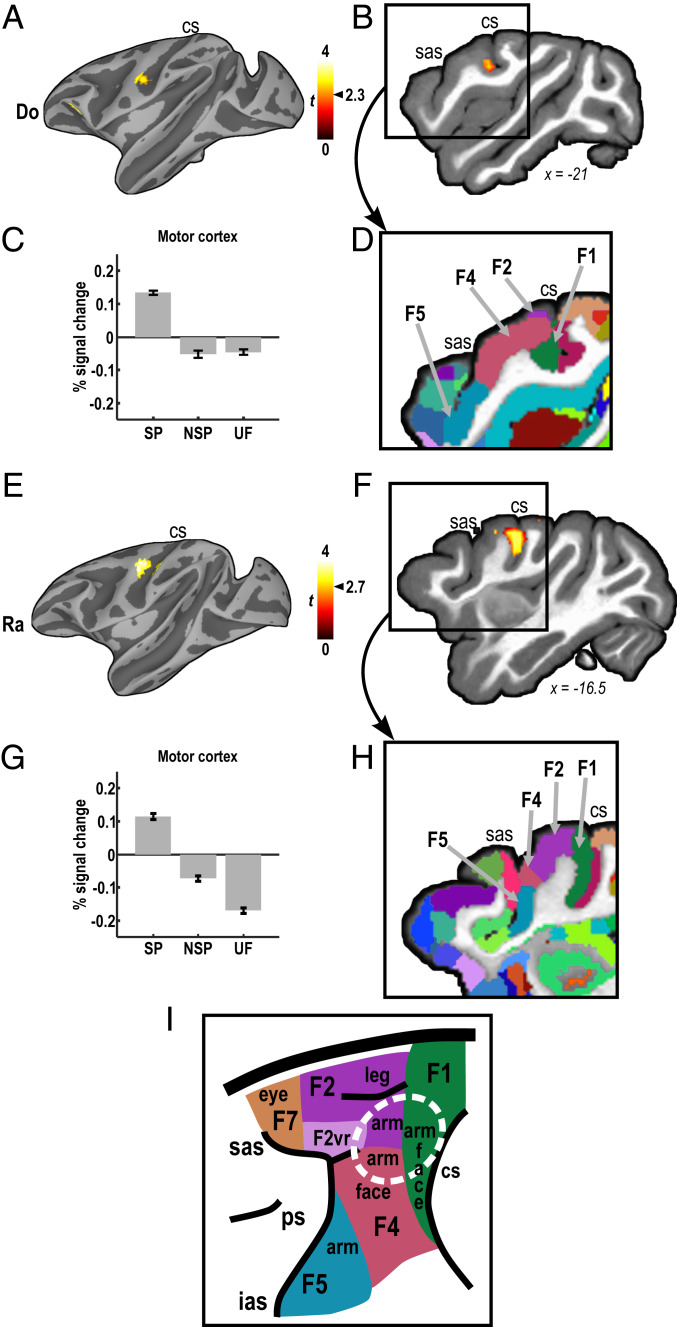
Activation of motor cortex by listening to self-produced (SP) sound sequences. (A) Comparison of BOLD responses evoked by a sound sequence that monkey Do had learned to produce (SP) vs. sound sequences she was passively familiar with (non–self-produced [NSP]) or that were completely unfamiliar (UF) found a peak of activation in the precentral gyrus (P < 0.01, uncorrected; k ≥ 10 voxels). (B) The same result shown in volume space. (C) Percent signal change evoked by SP, NSP, and UF sequences within the precentral focus defined by significant SP vs. NSP activation; see SI Appendix, Fig. S3 for activation by SP vs. NSP and SP vs. UF contrasts. (D) The activation mapped to primary motor (F1/M1) and ventral premotor cortex (F4) [D99 atlas segmentation of the same brain (57)]. (EH) Similar results in monkey Ra, including activation of dorsal premotor area F2 (q < 0.05, FDR-corrected; k ≥ 25 voxels; see also SI Appendix, Fig. S3). (I) Parcellation of the region in the macaque, according to Matelli and Luppino (59). Adjacent arm representations in areas F1, F2, and F4 marked with a white ellipse. F1, F2, F2vr, F4, F5, F7: frontal cortical areas; sulci: cs, central, ias, inferior arcuate, ps, principal, sas, superior arcuate.
Fig. 4.
Fig. 4.
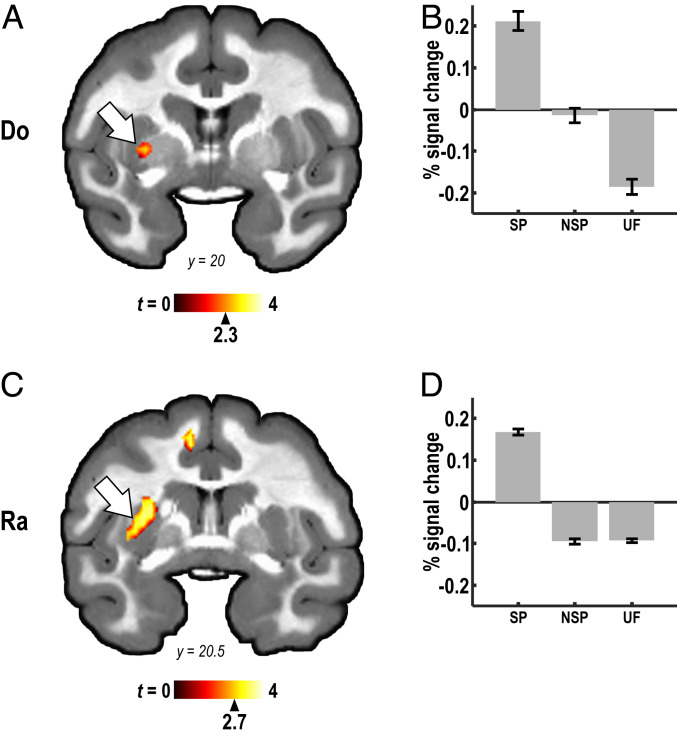
Putamen activation by listening to SP sequences. (A) Comparison of BOLD responses evoked by SP sequence vs. NSP and UF sequences in monkey Do found significant activation in the putamen (arrows; P < 0.01, uncorrected; k ≥ 10 voxels). (B) Relative BOLD signal evoked by SP, NSP, and UF sequences in the putamen locus, defined by the SP vs. NSP contrast. (C and D) Corresponding results for animal Ra (q < 0.05, FDR corrected; k ≥ 25 voxels). See SI Appendix, Fig. S5 for location of activation foci revealed by the SP vs., NSP and SP vs. UF contrasts analyzed separately.

References

    1. Levelt W. J. M., Speaking: From Intention to Articulation (MIT Press, 1989).
    1. Cusack R., Wild C. J., Zubiaurre-Elorza L., Linke A. C., Why does language not emerge until the second year? Hear. Res. 366, 75–81 (2018). - PubMed
    1. Jordan M. I., Rumelhart D. E., Forward models: Supervised learning with a distal teacher. Cogn. Sci. 16, 307–354 (1992).
    1. Smith C. R., Residual hearing and speech production in deaf children. J. Speech Hear. Res. 18, 795–811 (1975). - PubMed
    1. von Holst E., Mittelstaedt H., Das Reafferenzprinzip–Wechselwirkungen zwischen Zentralnervensystem und Peripherie. Naturwissenschaften 37, 464–476 (1950).

Publication types

LinkOut - more resources