


Review
doi: 10.1213/ANE.0000000000005059.
Revisiting the Protein C Pathway: An Opportunity for Adjunctive Intervention in COVID-19?
Affiliations
- PMID: 32541255
- PMCID: PMC7302080
- DOI: 10.1213/ANE.0000000000005059
Item in Clipboard
Review
Revisiting the Protein C Pathway: An Opportunity for Adjunctive Intervention in COVID-19?
Anesth Analg.
2020 Sep.
No abstract available
Conflict of interest statement
The authors declare no conflicts of interest.
Figures
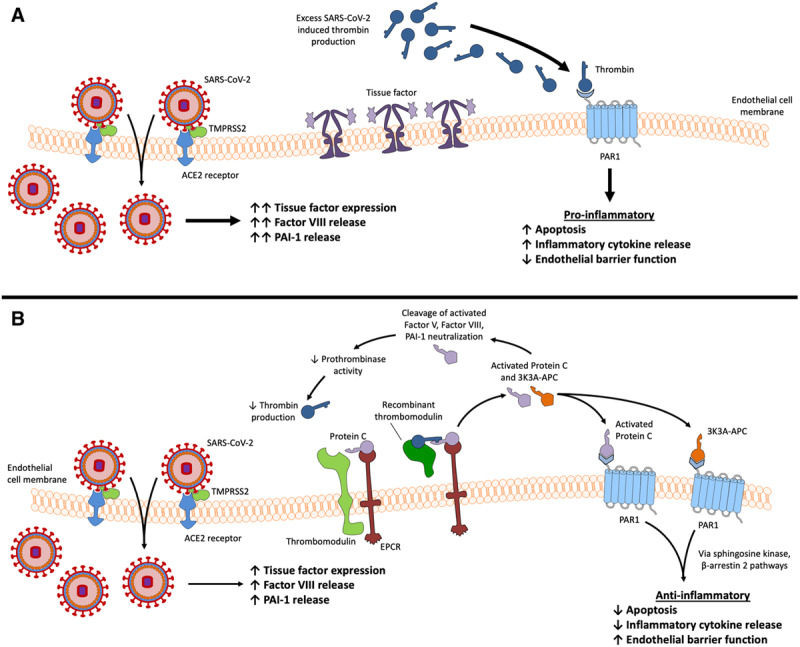
Procoagulant changes that occur with COVID-19 and potential therapeutics. A, SARS-CoV-2 entry leads to increased tissue factor expression on the endothelial cell surface, as well as factor VIII and PAI-1 release. Excessive thrombin generation leads to a proinflammatory state through PAR1 signaling. The net effect is an increase in apoptosis, propagation of proinflammatory signaling, and a decrease in endothelial cell barrier function. B, Recombinant thrombomodulin activates protein C and leads to anti-inflammatory signaling through PAR1, as well as anticoagulant actions including cleavage of activated factor V and factor VIII. Reduction of activated factor V reduces prothrombinase activity and subsequently thrombin production. APC and 3K3A-APC activate PAR1, which leads to anti-inflammatory actions via the sphingosine kinase and β-arrestin 2 pathways. These changes result in a decrease in apoptosis and reduced proinflammatory cytokine release, as well as enhanced endothelial cell barrier function. The Figure created with Motifolio Toolkit (Motifolio Inc, Ellicott City, MD). ACE2 indicates angiotensin-converting enzyme 2; APC, activated protein C; COVID-19, coronavirus disease 2019; PAI-1, plasminogen activator inhibitor-1; PAR1, protease-activated receptor 1; SARS-CoV-2, severe acute respiratory syndrome coronavirus-2; TMPRSS2, transmembrane protease serine 2.
References
-
- Poissy J, Goutay J, Caplan M, et al. Pulmonary embolismin COVID-19 patients: awarenessof an increased prevalence. Circulation. 2020. April 24 [Epub ahead of print].
Publication types
MeSH terms
Substances
LinkOut - more resources
Full Text Sources
Medical
