


Prevalence of high-risk human papillomavirus after HPV-vaccination in Denmark
- PMID: 32542644
- PMCID: PMC7689747
- DOI: 10.1002/ijc.33157
Prevalence of high-risk human papillomavirus after HPV-vaccination in Denmark
Abstract
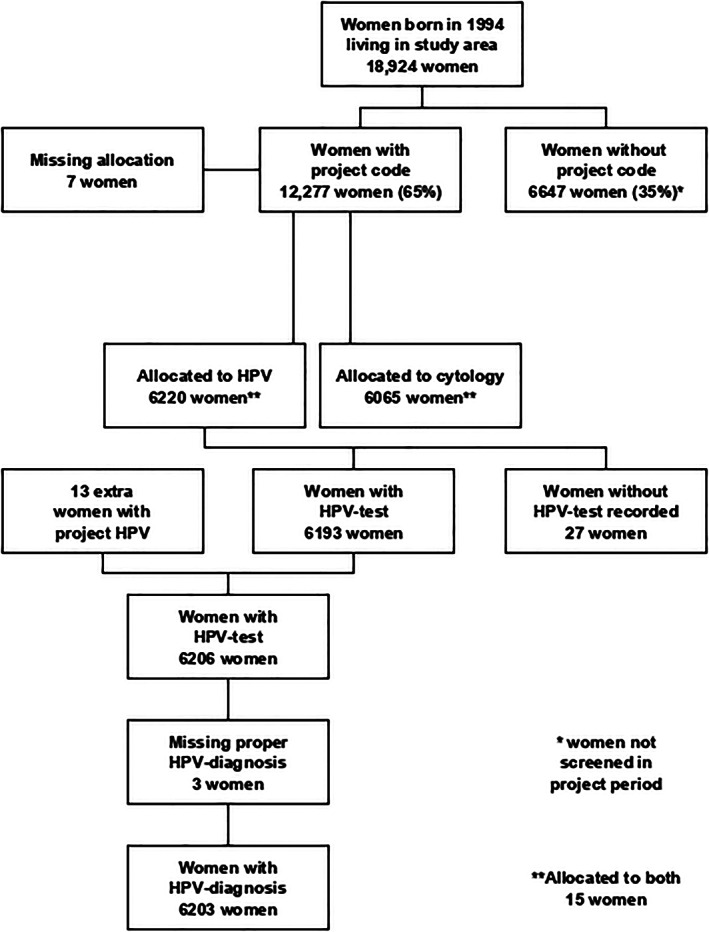
Vaccination against human papillomavirus (HPV) has been introduced as a public health initiative in many countries, including Denmark since October 2008. It is important to monitor postimplementation effectiveness of HPV-vaccination at the population-level. We studied HPV-prevalence after first invitation to screening at age 23 years in women offered the quadrivalent HPV-vaccine at the age of 14 years. Randomly selected screening samples from women born in 1994 in four out of five Danish regions were subjected to analysis for HPV in addition to routine cytology. Cobas4800 was used in all participating pathology departments. Data from a Danish prevaccination cross-sectional study using Hybrid Capture 2, and a Danish split-sample study using Cobas4800 were used for comparison. In the period from February 2017 to April 2019, 6233 screening samples from women born in 1994 were selected for HPV-analysis; 27 samples had no HPV-test and 3 samples had no HPV-diagnosis, leaving 6203 samples with an HPV-diagnosis. Prevalence of any high-risk (HR) HPV was 35%; only 0.9% were positive for vaccine HPV types 16/18 while the remaining 34% were positive for other HR HPV. When comparing with prevaccination prevalence data, HPV-16/18 decreased by 95%; RR = 0.05 (95% CI 0.04-0.06), while other HR HPV remained fairly constant; RR = 0.88 (95% CI 0.82-0.94) and RR = 0.95 (95% CI 0.88-1.03), respectively. One-third of women vaccinated as girls with the quadrivalent HPV-vaccine were HR HPV-positive at time of first invitation to screening. Vaccine HPV-types 16 and 18 were almost eliminated, while the prevalence of nonvaccine HR HPV-types remained constant.
Keywords: HPV-vaccination; cervical screening; human papillomavirus; prevalence.
© 2020 The Authors. International Journal of Cancer published by John Wiley & Sons Ltd on behalf of UICC.
Conflict of interest statement
Roche provided HPV‐DNA test‐kits for the method study but had no role in the data analysis, interpretation of results or writing of the paper. E. L.: Received HPV‐DNA test kits from Roche for the present study. B. A.: Received HPV kits from Roche and HPV self‐sampling kits from Axlab for other studies. L. T., L. G. L., J. C., T. J., J. H., S. C. and C. R.: No conflict of interest.
Figures

References
-
- Walboomers J, Jacobs M, Manos M, et al. Human papillomavirus is a necessary cause of invasive cervical cancer worldwide. J Pathol. 1999;189:12‐19. - PubMed
-
- de Sanjose S, Quint WG, Alemany L, et al. Human papillomavirus genotype attribution in invasive cervical cancer: a retrospective cross‐sectional worldwide study. Lancet Oncol. 2010;11:1048‐1056. - PubMed
-
- Joura EA, Giuliano AR, Iversen O‐E, et al. A 9‐valent HPV vaccine against infection and intraepithelial neoplasia in women. N Engl J Med. 2015;372:711‐723. - PubMed
-
- Kjær SK, Munk C, Junge J, Iftner T. Carcinogenic HPV prevalence and age‐specific type distribution in 40,382 women with normal cervical cytology, ASCUS/LSIL, HSIL, or cervical cancer: what is the potential for prevention? Cancer Causes Control. 2014;25:179‐189. 10.1007/s10552-013-0320-z. - DOI - PubMed
Publication types
MeSH terms
Substances
LinkOut - more resources
Full Text Sources
Miscellaneous
