Multicenter Study
. 2020 Oct;6(4):231-237.
doi: 10.1002/cjp2.172. Epub 2020 Jun 16.

Loss of NF2 defines a genetic subgroup of non-FOS-rearranged osteoblastoma

Affiliations
Multicenter Study

Loss of NF2 defines a genetic subgroup of non-FOS-rearranged osteoblastoma

Karim H Saba et al. J Pathol Clin Res. 2020 Oct.

Abstract

Osteoblastoma is a locally aggressive tumour of bone. Until recently, its underlying genetic features were largely unknown. During the past two years, reports have demonstrated that acquired structural variations affect the transcription factor FOS in a high proportion of cases. These rearrangements modify the terminal exon of the gene and are believed to stabilise both the FOS transcript and the encoded protein, resulting in high expression levels. Here, we applied in-depth genetic analyses to a series of 29 osteoblastomas, including five classified as epithelioid osteoblastoma. We found recurrent homozygous deletions of the NF2 gene in three of the five epithelioid cases and in one conventional osteoblastoma. These events were mutually exclusive from FOS mutations. Structural variations were determined by deep whole genome sequencing and the number of FOS-rearranged cases was less than previously reported (10/23, 43%). One conventional osteoblastoma displayed a novel mechanism of FOS upregulation; bringing the entire FOS gene under the control of the WNT5A enhancer that is itself activated by FOS. Taken together, we show that NF2 loss characterises a subgroup of osteoblastomas, distinct from FOS-rearranged cases. Both NF2 and FOS are involved in regulating bone homeostasis, thereby providing a mechanistic link to the excessive bone growth of osteoblastoma.

Keywords: FOS; FOSB; NF2; WNT5A; osteoblastoma; osteosarcoma.


Figures

Figure 1
Figure 1
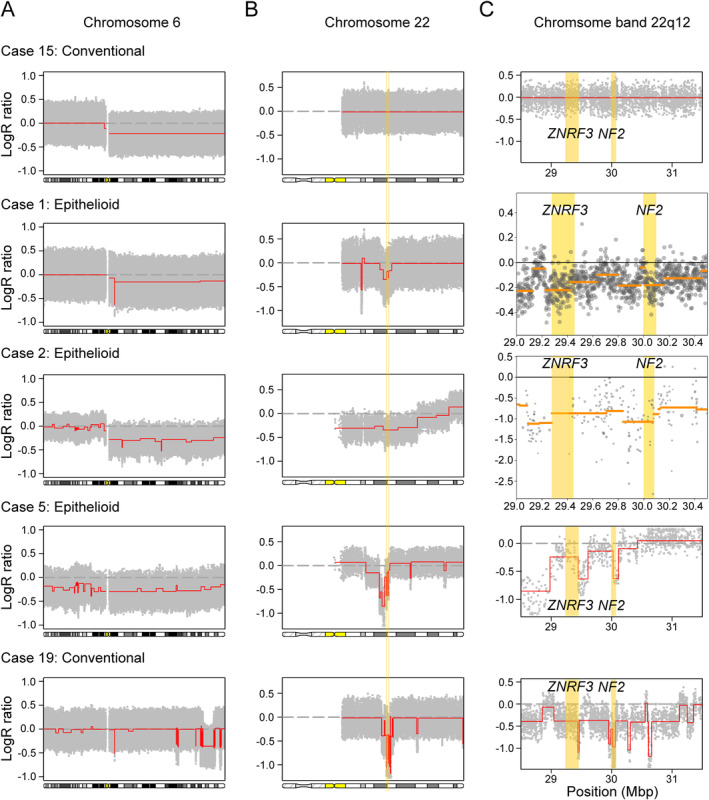
High‐resolution genomic copy number analyses reveal a subgroup of osteoblastoma harbouring recurrent deletions in 6q and 22q12. (A) SNP array analysis detects recurrent deletions in chromosome arm 6q in five osteoblastomas. (B) Four of them harbour concomitant deletions in chromosome arm 22q. (C) Whole genome paired‐end sequencing (Case 1), whole exome sequencing (Case 2), and SNP array analysis (Cases 5 and 19) show that these deletions cluster to the ZNRF3 and NF2 genes in 22q12. The latter gene is affected by intragenic homozygous deletions in all four cases. Case 15 did not harbour any deletions affecting chromosome 22. Yellow lines mark the positions of the ZNRF3 and NF2 genes.
Figure 2
Figure 2
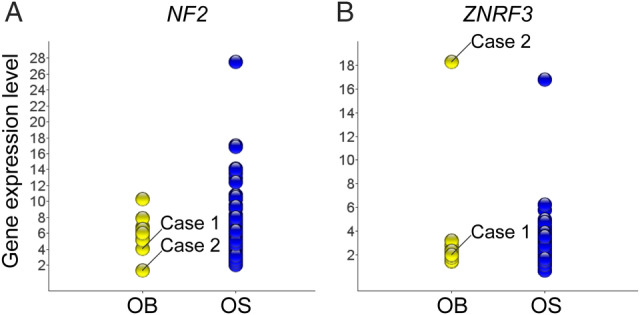
Transcriptome analysis consolidates NF2 as the most likely target for 22q12 deletions in osteoblastoma. (A) Cases 1 and 2 harbour intragenic homozygous NF2 deletions and concomitant low NF2 expression levels, compared with osteoblastomas without detected NF2 deletion (n = 11) and osteosarcomas (n = 69). (B) Case 1 harbours an intragenic homozygous deletion and concomitant low expression level of the ZNRF3 gene. Case 2 harbours a hemizygous loss and relative high expression level of ZNRF3. OB, osteoblastoma; OS, osteosarcoma.
Figure 3
Figure 3
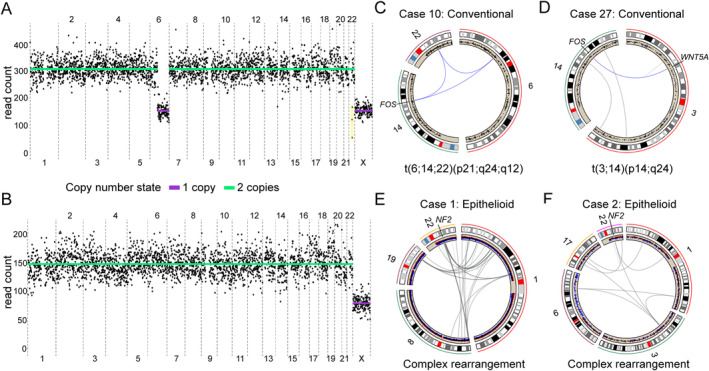
NF2 deletions and FOS structural variations are mutually exclusive in osteoblastoma. (A) Whole genome sequencing of an individual cell from Case 1 shows hemizygous loss of chromosome arm 6q. The patient is male, and a single copy of the X chromosome is detected (the Y chromosome is not shown). The low number of reads mapping to the three copy number bins highlighted in yellow suggest a combination of hemi‐ and homozygous losses across this region (27.7–31.1 Mb, according to genome assembly GRCh37/hg19). (B) A representative cell with no acquired copy number alterations, presumably a non‐neoplastic cell.(C) A balanced three‐way translocation results in structural rearrangement of the 3′ part of the FOS gene in Case 10. (D) A balanced two‐way translocation juxtaposes the complete coding region of FOS and the enhancer region of WNT5A in Case 27. (E,F) Complex structural variations affecting 22q12 and many other chromosomal regions result in genomic copy number imbalances, including intragenic homozygous losses of NF2 in Cases 1 and 2.

References

    1. Fittall MW, Mifsud W, Pillay N, et al Recurrent rearrangements of FOS and FOSB define osteoblastoma. Nat Commun 2018; 9: 2150. - PMC - PubMed
    1. Lam SW, Cleven AHG, Kroon HM, et al Utility of FOS as diagnostic marker for osteoid osteoma and osteoblastoma. Virchows Arch 2020; 476: 455–463. - PMC - PubMed
    1. van Ijzendoorn DGP, Forghany Z, Liebelt F, et al Functional analyses of a human vascular tumor FOS variant identify a novel degradation mechanism and a link to tumorigenesis. J Biol Chem 2017; 292: 21282–21290. - PMC - PubMed
    1. Amary F, Markert E, Berisha F, et al FOS expression in osteoid osteoma and osteoblastoma: a valuable ancillary diagnostic tool. Am J Surg Pathol 2019; 43: 1661–1667. - PubMed
    1. Nord KH, Nilsson J, Arbajian E, et al Recurrent chromosome 22 deletions in osteoblastoma affect inhibitors of the Wnt/beta‐catenin signaling pathway. PLoS One 2013; 8: e80725. - PMC - PubMed

Publication types

MeSH terms