


Community Susceptibility and Resiliency to COVID-19 Across the Rural-Urban Continuum in the United States
- PMID: 32543751
- PMCID: PMC7323251
- DOI: 10.1111/jrh.12477
Community Susceptibility and Resiliency to COVID-19 Across the Rural-Urban Continuum in the United States
Abstract
Purpose: This study creates a COVID-19 susceptibility scale at the county level, describes its components, and then assesses the health and socioeconomic resiliency of susceptible places across the rural-urban continuum.
Methods: Factor analysis grouped 11 indicators into 7 distinct susceptibility factors for 3,079 counties in the conterminous United States. Unconditional mean differences are assessed using a multivariate general linear model. Data from 2018 are primarily taken from the US Census Bureau and CDC.
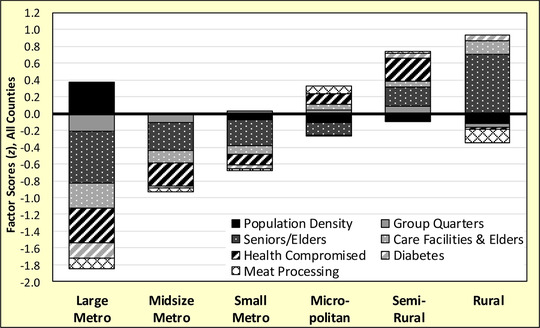
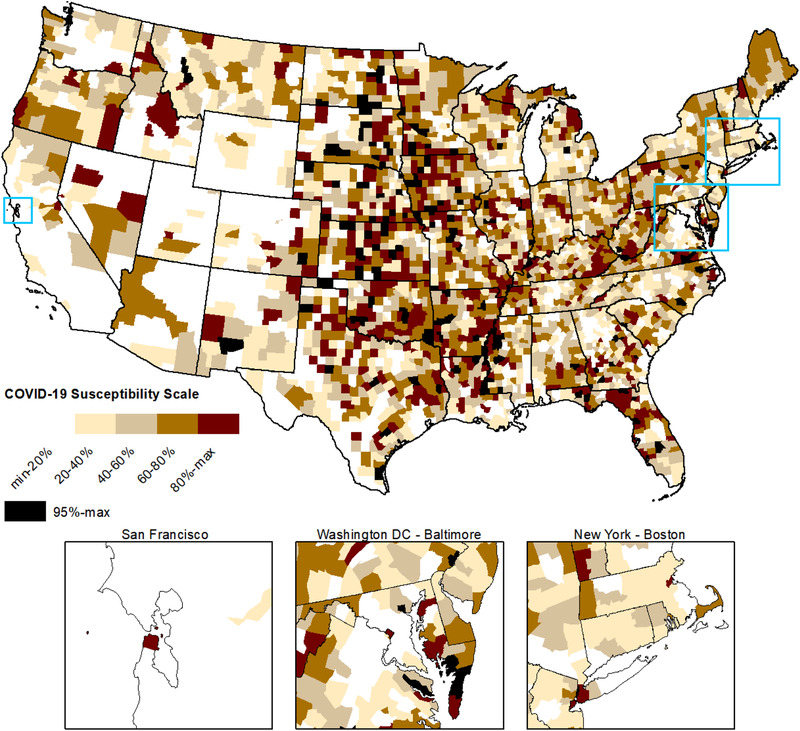
Results: About 33% of rural counties are highly susceptible to COVID-19, driven by older and health-compromised populations, and care facilities for the elderly. Major vulnerabilities in rural counties include fewer physicians, lack of mental health services, higher disability, and more uninsured. Poor Internet access limits telemedicine. Lack of social capital and social services may hinder local pandemic recovery. Meat processing facilities drive risk in micropolitan counties. Although metropolitan counties are less susceptible due to healthier and younger populations, about 6% are at risk due to community spread from dense populations. Metropolitan vulnerabilities include minorities at higher health and diabetes risk, language barriers, being a transportation hub that helps spread infection, and acute housing distress.
Conclusions: There is an immediate need to know specific types of susceptibilities and vulnerabilities ahead of time to allow local and state health officials to plan and allocate resources accordingly. In rural areas it is essential to shelter-in-place vulnerable populations, whereas in large metropolitan areas general closure orders are needed to stop community spread. Pandemic response plans should address vulnerabilities.
Keywords: COVID-19; community resiliency; county; rural-urban; susceptibility.
© 2020 The Authors. The Journal of Rural Health published by Wiley Periodicals LLC on behalf of National Rural Health Association.
Figures


References
-
- Most Americans say coronavirus outbreak has impacted their lives. Pew Research Center; 2020. Updated March 30, 2020. Available at: https://www.pewsocialtrends.org/2020/03/30/most-americans-say-coronaviru.... Accessed April 14, 2020.
-
- Coronavirus in the U.S. Latest map and case count. The New York Times; 2020. Updated April 6, 2020. https://www.nytimes.com/interactive/2020/us/coronavirus-us-cases.html. Accessed April 6, 2020.
-
- Miller IF, Becker AD, Grenfell BT, Metcalf CJ. Mapping the burden of COVID‐19 in the United States. medRxiv. 2020;OnLine(0), 1–21. 10.1101/2020.04.05.20054700. Accessed May 14, 2020. - DOI
Publication types
MeSH terms
Grants and funding
LinkOut - more resources
Full Text Sources
Medical
